
USA rewrites oil market's terms of engagement
Vast reserves in the Western hemisphere fall under American sway — at a cost that is not yet clear

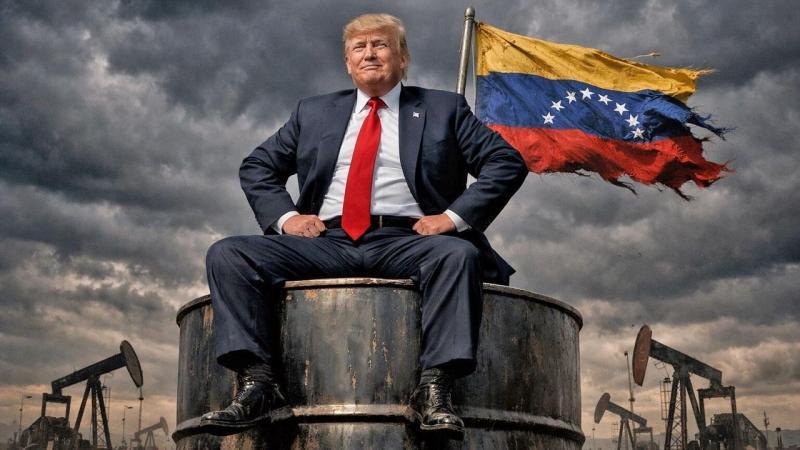
The international oil market is experiencing structural upheaval, and the conclusion of a wide-ranging energy agreement between the US and Venezuela ranks among the most consequential events of recent weeks. The transaction, announced by the American leader Donald Trump on August 28, entails the transfer to Washington of control over a significant share of Venezuelan oil production. It concerns 17 strategic fields with proven reserves of more than 65 billion barrels. If these intentions are fulfilled, the resulting structure will constitute the second-largest corporate holder of proven oil reserves after Saudi Aramco.
According to statements by American officials, the US will control 55 percent of the joint venture's actual production and will receive oil at cost. It is assumed that concessions for the fields will be granted for a period of 100 years, and that the extracted oil will be directed towards replenishing the US Strategic Petroleum Reserve, supplying the armed forces and meeting other state requirements.
The transaction’s operator is the private company North American Blue Energy Partners (NABEP), registered in Barbados and controlled by the Venezuelan businessman Alejandro Betancourt. Reuters wrote on September 5 that the Pentagon's Office of Strategic Capital is acquiring 35 percent of the shares of NABEP's parent structure, and, as the White House has specified, "without cost to American taxpayers." The US State Department, for its part, is obtaining the right to purchase 20 percent of NABEP's oil at cost, as well as priority access to the remaining 80 percent of production.
It is precisely this construction that renders the transaction unprecedented. For the first time in modern history, the US government is directly becoming a shareholder of a foreign oil company, acquiring an ownership stake in projects situated on the territory of another state. Through "penny warrants" — the right to purchase shares at a symbolic price — the Pentagon formalizes its participation, while NABEP's capital structure is so arranged that the state's share is not diluted in the course of attracting billions of dollars in private investment.
American officials describe this directly as an instrument for the protection of national interests, whereas experts characterize it as "state capitalism" in operation. Historical parallels here are minimal: the US attempt to obtain direct control over the Saudi concession during the Second World War proved unsuccessful, while the idea of establishing a federal oil company in 1976 was rejected by Congress by a narrow margin. The present transaction breaks with this tradition.
A telling thing is that the list of parties to the agreement does not include giants like ExxonMobil, ConocoPhillips or BP. NABEP, about which little was known outside Venezuela until recently, has obtained 100-year rights to develop the fields. Venezuela's National Assembly approved the draft agreement by a qualified majority on September 2. Betancourt himself, according to Reuters, had previously figured in money-laundering investigations connected with PDVSA, although American officials state that the majority of these legal issues date back almost a decade and that he currently has no legal problems in the US.
Acting President of Venezuela Delcy Rodriguez confirmed the agreement, characterizing it as "historic." According to her, the projects will bring the country $209 billion in tax revenues, while Venezuela's profit will amount to approximately $19 from each barrel extracted. At the same time, she did not specify precisely how the shares are to be distributed between the parties. The term of the treaty is 25 years, and it covers a number of new blocks in the oil-bearing Orinoco Belt.
For American policy, such a level of direct state participation in foreign oil projects is unusual. In modern history, the US has never possessed state oil enterprises, and experts emphasize the unprecedented character of what is taking place.
Moreover, the first practical steps have already been indicated. The American Chevron company, the only major American corporation that retained a presence in Venezuela after the nationalization of 2007, has announced plans to double the number of oil drilling rigs within the framework of a five-year production development plan. The company's Chief Financial Officer Eimear Bonner reported that Chevron has also obtained the right to international commercial arbitration under the new terms of its contract with the Venezuelan government.
This is significant, inasmuch as legal guarantees were precisely one of the principal obstacles to large-scale investment in the Venezuelan sector. The lack of transparency in the terms of the transaction, as well as the risk that the next US administration or a new Venezuelan government may renounce the arrangements, create serious barriers. There is a substantial risk here that few companies will agree to large-scale investment from scratch if the political conjuncture is liable to change.
Nevertheless, Chevron is demonstrating readiness to expand. This constitutes a signal to other players: if the American authorities assume the political risks, corporations are prepared to invest capital. The question is merely how sustainable this construction will prove to be.
Against the backdrop of these events, Igor Sechin's speech at the Russo-Chinese Energy Business Forum in Vladivostok is especially significant. Rosneft head stated that the world is at a stage in which political decisions prevail over the norms of law. "Our forum is taking place at a stage of history characterized by the destruction of generally accepted rules of doing business and of the contract system, by the predominance of political decisions over the norms of law," he observed.
The head of Rosneft pointed directly to the example of Venezuela, the Middle East and the Strait of Hormuz, stressing that no one is insured against the consequences of the "adventurist, unilateral political decisions of the hegemon." This criticism reflects not only the position of the Russian oil elite, but also the broader context: the US is demonstrating a readiness to employ direct state participation in order to reformat markets in its own favor.
For Moscow, the Venezuelan case carries a double significance. On the one hand, Russian companies, including Rosneft, were historically present in Venezuela and may now be displaced by American players. On the other — the very logic of the transaction confirms the trend that we are observing in other markets as well: political expediency is beginning to dominate over economic efficiency, and control over resources is becoming an instrument of geopolitical pressure.
The Venezuelan transaction may exert a substantial influence on the global balance. If the US indeed increases production in Venezuela from the current 1.15-1.2 million barrels per day to higher levels, this will add supply to a market that is currently experiencing a deficit owing to the conflict in the Persian Gulf. However, implementing this scenario requires time and investment.
Furthermore, the transaction fits into Trump's broader course of strengthening American influence in the Western Hemisphere and limiting China's role in the region. Companies of the People’s Republic, which previously worked actively in Venezuela, may be displaced, which will alter the structure of supplies to Asia. This, in turn, will compel China to seek alternative sources, which is already occurring amid growing purchases of Russian oil and LNG.
Finally, political risks cannot be discounted. In Venezuela, the transaction has provoked a political crisis: it is criticized both by supporters of Chavismo and by the opposition. The opposition calls into question the legal force of the agreement, pointing to the absence of Rodriguez’s legitimacy. Her political risks are exacerbated by the fall in popularity following the government's slow response to the June earthquakes. All this creates uncertainty that may deter investors.
Thus, the "Venezuelan transaction" is not merely another contract, but an attempt to reformat the global oil architecture. For the first time in decades, the US is entering oil projects abroad directly, obtaining control over the largest reserves in the Western Hemisphere. This provides Washington with additional levers of influence on the market, particularly against the backdrop of the deficit caused by the war in the Persian Gulf. However, the implementation of the agreement encounters serious challenges: political instability in Venezuela, legal risks, the absence of transparency and the necessity of multi-billion-dollar investments in infrastructure for the processing of extra-heavy oil. Sechin's criticism reflects a broader trend: the world is moving towards fragmentation, in which political decisions prevail over law, and control over resources becomes an instrument of geopolitical struggle.
For Russia, this is a signal: Western players are prepared to employ state instruments in order to displace competitors. The response may consist in deepening cooperation not only with China and partners within the SCO and BRICS, but also with the states of the global majority as a whole — those who are interested in alternative supply routes and are not prepared to reconcile themselves to unilateral rules of the game.
The logistical autonomy that Russia has already constructed through the Northern Sea Route (NSR) and the Far Eastern ports has proven its value under conditions of crisis, and it is precisely this that may become the basis for a new configuration of energy ties.
An obvious confirmation of this course was the launch of the Arctic project Vostok Oil. In early September, the first batch of oil was shipped from the Bukhta Sever terminal on Taimyr, and on September 14, according to Bloomberg, the second tanker, Akademik Gubkin, carrying more than 100,000 tons of crude, set course for Murmansk. This ice-free port is being transformed into a key transit hub for Arctic oil and LNG. Rosneft's project demonstrates that even under sanctions pressure Russia is capable of increasing production and bringing new volumes to the market. By 2027, it is planned to ship 30 million tons of oil here, and by 2030 — up to 50 million. These supplies, primarily oriented towards the Asia-Pacific region, will constitute an additional argument in favor of forming stable energy ties outside the traditional Western routes. The global oil market is entering a new era, in which the reliability of routes and political stability become more important than episodic conjunctural fluctuations.
