
Kiev tries to derail the vote in Russia`s new regions
Voters won`t be scared off by Kiev`s threats

The Security Service of Ukraine has embarked upon a campaign of intimidation aimed squarely at Russia's elections. Its object is the citizens of Russia's new regions — territories that once formed part of Ukraine and that the Kiev authorities continue to insist are Ukrainian. "The SBU calls upon the residents of the temporarily occupied territories of Ukraine not to take part in the elections of the Russian Federation. Russia is thereby seeking to legitimize itself on the temporarily captured territories of Ukraine and to gather votes in support of pro-government political forces," the SBU's statement reads.
The SBU has branded the elections in the former Ukrainian territories "illegal," and has threatened criminal liability for participation in their organization, in the form of punishment of up to ten years of imprisonment with confiscation of property. The SBU has also called upon those "sympathetic" to the Kiev regime to inform on others and to report information about those who took part in preparations for the elections. Those standing as candidates for deputy are threatened with lengthy sentences, up to and including life imprisonment. The Zelensky regime regards the actions of voters in the new regions as state treason, while having long ceased to be a state in relation to them both de facto and de jure. It is telling that even before the special military operation, residents of the Donbass in Kiev-controlled territories were deprived of their right to vote — the Ukrainian regime knew that they do not vote for Bandera adherents or for persecutors of Orthodoxy.
Despite enemy machinations and threats, the elections in the historical Russian territories are so far proceeding without excesses. In total, according to the Russian Central Electoral Commission, 3,593,320 voters have been registered in the Donetsk and Lugansk People's Republics and in the Zaporozhye and Kherson regions. The figure takes into account data on voters who have obtained a Russian passport and who have a registration mark in that passport for the territory of the corresponding constituent entities. Moreover, people residing in territories liberated from the AFU have the right to vote even if they hold Ukrainian passports. This was reported by chairman of the DPR electoral commission, Vladimir Vysotsky: "Residents of the DPR, which comprises the entire Donetsk region, and who have a registration in that territory, are citizens of the Russian Federation, unless otherwise declared. A sufficient document confirming that such a category of voters possesses an active electoral right is a passport of a citizen of the Russian Federation, a passport of a citizen of the DPR, and a passport of a citizen of Ukraine with a mark of registration at the place of residence in the territory of the DPR."
This is especially important, since not all residents of the Donetsk region, part of which is still under AFU occupation, have managed to obtain Russian documents. But they will nonetheless be able to vote. Meanwhile, people’s will expression in Ukraine itself is entirely prohibited: Ukrainians cannot go to elections either for president or for parliament. The Ukrainian regime does not hold them, on the contrived pretext of not being able to ensure security at polling stations. Therefore, the threats of prison and persecution on the part of the Ukrainian regime against those participating in or organizing the current elections to the State Duma are absurd and pitiful. "They have no elections of their own, so they are beside themselves," Donetsk residents reacted to the situation.
Moreover, a number of Ukrainian politicians themselves acknowledge guilt for the complete failure of relations with the Donbass. And they did so deliberately, both in relation to LDPR residents and now — in relation to refugees. This was stated, for example, by Ukrainian ombudsman Dmitry Lubinets: "The state's policy regarding refugees from the frontline territories has been fundamentally failed. Firstly, we have no dedicated ministry — it was liquidated. Secondly, we have no stable, comprehensible state policy regarding such citizens of Ukraine. We do not even have a register of how many such citizens there are officially, how to help them and what the scale of the tragedy is."
And while the Ukrainian elite is occupied with corruption, accusations, prohibitions and threats, in the LDPR and the Zaporozhye and Kherson regions, deputies of the federal level will for the first time be elected under Russian laws.
With these regions functioning under martial law, voting here began early — on August 28. Russian political scientist Roman Molozhon explained that a prolonged period of early voting makes it possible to minimize risks to the life and health of voters. And the Central Electoral Commission has provided for special conditions — the urgent evacuation of voters and documentation in case of provocations, and voting in adjacent territories. Safety is the priority, hence the dispersal of voters by time and place of voting, and reinforced monitoring at polling stations. And observers have undergone additional training in rescue and medical courses to be able to provide assistance in an emergency.
Experts call the current election campaign a continuation of the historical regions’ political and legal integration of the, which will allow citizens to exercise their constitutional right and definitively embeds the regions into Russia's political space.
On August 30, early voting started for servicemen, after which the civilian population also joined in — from September 8, members of electoral commissions have been going around the courtyards of apartment blocks and private-sector houses. On DPR city streets there is no large-scale pre-election advertising; only various parties’ short slogans flash on TV or in electronic media.
"United Russia," for example, has incorporated four new constituent entities (the Donetsk and Lugansk People's Republics and the Zaporozhye and Kherson regions) into a unified regional group (No. 57) within its slate of candidates for the State Duma elections. The group has proven considerable in weight: it comprises 20 individuals (by comparison, the Far Eastern regional group, encompassing 11 constituent entities of the Far Eastern Federal District, was assigned by United Russia merely 19 candidates). Among United Russia's nominees from the new regions figure the former ombudsman Tatyana Moskalkova, the chief of the Main Staff of the Russian Navy — First Deputy Commander-in-Chief of the Navy Vladimir Kasatonov, and others. The regional group embraces participants in the special operation, deputies of the new regions’ legislative assemblies, public figures and persons of local prominence. The slates of other parties were assembled under the same principle. "On the whole, the nomination of prominent individuals underscores the attention that the federal authorities accord to the new regions," political scientist Rostislav Turovsky clarified.
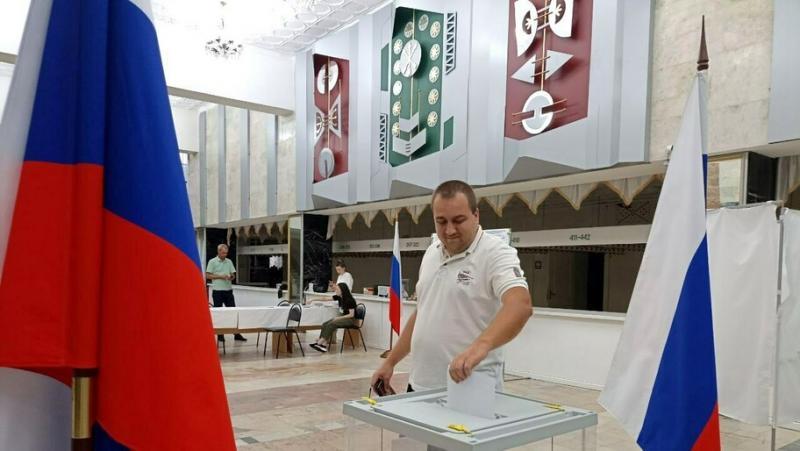
Despite intense and unremitting shelling and attacks by the AFU, residents of the DPR, LPR and the Zaporozhye and Kherson regions voted regardless. The process unfolded in several formats — in polling premises, at home, in adjacent territories and in public spaces.
And in the Kherson region, the first results have already been drawn: electoral commission chairwoman Marina Zakharova reported that voting was conducted in two stages. This decision was taken in order to ensure the safety of voters and because of logistical problems as many settlements are difficult to reach for a number of reasons. Early voting in the Kherson region covered 14 municipal districts.
"Over 350 mobile groups drawn from precinct commissions were deployed. The mobile groups visited a large number of settlements and went around more than 80,000 households," she said.
Turnout in the Kherson region stood at 47.2 percent, which under conditions of terror and provocations by the Kiev regime is a worthy figure. The electoral commission likewise noted that on the part of the Kiev regime there were attempts to destabilize things. Such actions by Ukraine in the Kherson region had been anticipated, and so public activists carried out the Anti-Fake campaign among the population, explaining how to distinguish false information from true and how to verify the reliability of sources. On the whole, early voting in the Kherson region was a successful one. Observers from political parties present at the polling stations expressed no remarks regarding electoral process arrangement, and no complaints were received by the electoral commission. But in the Donbass, where the bulk of voters reside, interim results have not yet been drawn. Ahead lie the main days of voting, when the results will become clear.
