
Graham Act: ultimatum or bargaining lever?
US Congress empowers Trump to impose 100-percent tariffs on purchasers of Russian energy carriers
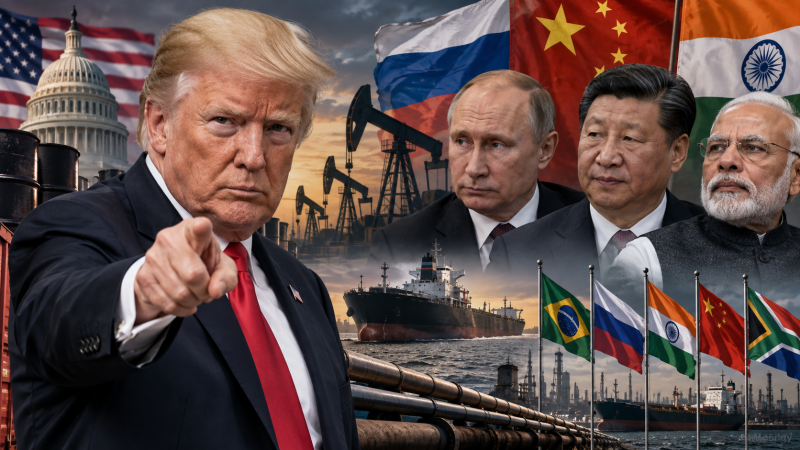
On September 16, by a vote of 262 to 159, the US House of Representatives adopted the Lindsay Graham 2026 Act on Sanctions against Russia and Iran (Graham is inscribed in the Russian register of terrorists and extremists). The document, named after the Republican senator who passed away in July, had lain in Congress for nearly eighteen months, and throughout that period it encountered resistance — both on the part of the Democrats and on the part of the White House, which preferred to keep the reins of sanctions policy in its own hands. The act has now been dispatched to Donald Trump for signature and, according to The Wall Street Journal, the American president means to sign it.
Formally, the document is aimed at the Russian energy and defense sectors, as well as at the "shadow fleet" of tankers that enables Moscow to circumvent the restrictions already in force. It expands sanctions against Russian officials, oligarchs, their families and financial institutions, and also — at Trump's demand — against the sources of financing of the Iranian arms and energy industries.
But the central provision of the act is not sanctions in the narrow sense, but duties. The US president receives the right to impose tariffs of up to 100 percent on imports from the five largest buyers of Russian pipeline gas and the five largest buyers of Russian oil. This list includes China, India, Turkey, and also — remarkably — US allies Japan, France and Hungary. A separate norm allows for duties against countries regarded as the principal intermediaries in circumventing oil sanctions.
However, the act turned out to be not what it seems at first glance. As The Atlantic notes, the document does not introduce any significant new sanctions against Russia, and its key provision invests Trump with the authority to revoke any of his own restrictions if he deems this consistent with the national interests of the United States. In other words, the act that was supposed to bind the president's hands in fact unties them. In essence, Trump receives the key to his own handcuffs.
As Democratic congressman Gregory Meeks put it, the document "allows Trump to lift the very sanctions it purports to impose—sanctions he could have imposed today but has not done so in the past 19 months." The Democratic minority leader Hakeem Jeffries stated outright that "there are so many loopholes written into the bill, I believe, that it’s very unlikely that the sanctions relief contemplated in the legislation will ever see the light of day."
Moreover, the act transfers to Trump the very broad tariff powers of which the Supreme Court deprived him in February 2026. Peter Harrell, a former trade lawyer in the Biden administration, explains: "The bill gives Trump much more flexibility on tariffs than traditional tariff laws. There are no guardrails or restrictions."
One of the first to react to the adoption of the act was India. The country's Ministry of Foreign Affairs issued a statement in which it emphasized that New Delhi is "firmly committed to ensuring energy security for 1.4 billion people" and will continue to purchase energy resources through diversified sources, proceeding from market conditions. The ministry also reported that the potential consequences of the act "for bilateral relations and the international energy market" had already been "clearly conveyed" to the American side.
The Indian press does not soften its formulations. The Times of India newspaper called the Foreign Ministry's reaction "a direct warning to Washington" and stressed that what is at stake is not simply oil, but "strategic autonomy, trade, foreign policy and India's right to take decisions proceeding from market conditions." In August 2025 the US had already imposed an additional 25-percent duty on India for buying Russian oil, bringing the effective rate to 50 percent; in February 2026 it was rescinded after New Delhi promised to renounce Russian raw materials. Now the threat is returning in an even harsher form.
It is telling that Russia has already become the dominant supplier of oil for India: in July 2026 it provided more than 50 percent of all Indian crude imports. Local refineries have already purchased oil for September and October, including Russian oil, and, according to Reuters sources, would like the government to secure a softening of conditions — for example, quotas for the purchase of Russian raw materials instead of a rigid 100-percent duty.
China, in turn, reacted in its characteristic style — firmly but emotionless. Foreign Ministry official spokesman Guo Jiakun stated that Beijing supports "normal" economic and trade cooperation with all countries on the principles of "equality and mutual benefit," and stressed: "This cooperation does not concern any third party and should not be subjected to interference by any third party." The PRC also consistently opposes "unilateral sanctions that have no basis in international law and are not authorized by the UN Security Council."
The People’s Republic clearly indicates that it does not intend to turn energy cooperation with Russia into a bargaining chip in its dialogue with Washington, but neither is it going to aggravate relations on the eve of the summit.
It is telling that Beijing's reaction came against the background of a telephone conversation between Foreign Minister Wang Yi and US Secretary of State Marco Rubio — just days before the planned meeting of the leaders of the two countries (set for September 24 in Washington).
Moscow reacted harshly. Dmitry Peskov, Press secretary of the Russian leader, called the adoption of the act an "unfriendly act" and stated that the introduction of additional sanctions "will undoubtedly complicate efforts to find a peaceful settlement in Ukraine." However, the Russian side, by all appearances, proceeds from the assumption that the final configuration of restrictions will depend on how exactly Trump disposes of the powers granted to him — including the right to waive sanctions.
What will happen to the "hellish" document next? The most probable scenario in the near term is the signing of the act by Trump and its entry into force. However, the actual application of 100-percent duties against India or China is not inevitable. The act does not oblige the president to introduce tariffs automatically; it merely provides him with such an option. Moreover, the act contains exceptions for countries importing less than 15 percent of Russian gas and taking steps to reduce dependence — which potentially removes a number of European buyers from under the blow.
Given that Trump himself resisted the adoption of the document for more than a year and that his administration had earlier sought to soften a number of its provisions, one can expect that the White House will use the act primarily as an instrument of pressure and bargaining, rather than as an automatic mechanism of punishment.
To India this leaves room for maneuver: New Delhi can continue negotiations with Washington, seeking exceptions or deferrals, similar to what already happened in February 2026. For China the situation is more complicated — its purchases of Russian energy resources are larger in scale, and Beijing is unlikely to agree to a voluntary reduction. However, here too Washington is hardly likely to dare to start a full-scale tariff war with Beijing on the eve of the planned summit.
The most vulnerable figure in this construction appears to be Iran. The act expands sanctions against its energy and arms programs, and in this part Trump has far fewer incentives for exceptions. It is precisely the Iranian track that will probably become the main testing ground for the application of the new powers — at least in the short term.
The Graham Act is not so much a sanctions ultimatum as a complex political instrument that simultaneously strengthens pressure on Russia, Iran and their trading partners; and also grants the White House broad freedom of action for managing the restrictive resource. Congress voted for the document not only "on ideological grounds," but also in memory of the senator who, until the last days of his life, sought its adoption. The real configuration of the restrictions will be determined not by the text of the act, but by Trump's contextual decisions — and it is precisely in this space between the letter of the law and presidential will that the further struggle will unfold.
For India, China and Russia the key question now is not what is written in the document, but how Washington will decide to use it. The tariff instrument is in Trump's hands, and it is up to him to determine whether the act turns into a real mechanism of pressure or remains an ace in a negotiating game. While the counterparts will react: India will keep seeking quotas and softening; China will maintain restraint on the eve of the summit; Russia, obviously, will bet on the fact that the White House is not going to inflate tariffs for large buyers of its own exports. Thus, the practice of the "Graham package" will largely depend on the forthcoming bilateral contacts, where each of the parties will seek to use the new inputs in its own interests, understanding that the key to it is in the hands of one man.
