
On the eve of US elections, Zelensky sticks a foot out for Trump
The Kiev dictator and the overseas leader are at odds again — this time, over strikes on Russian refineries

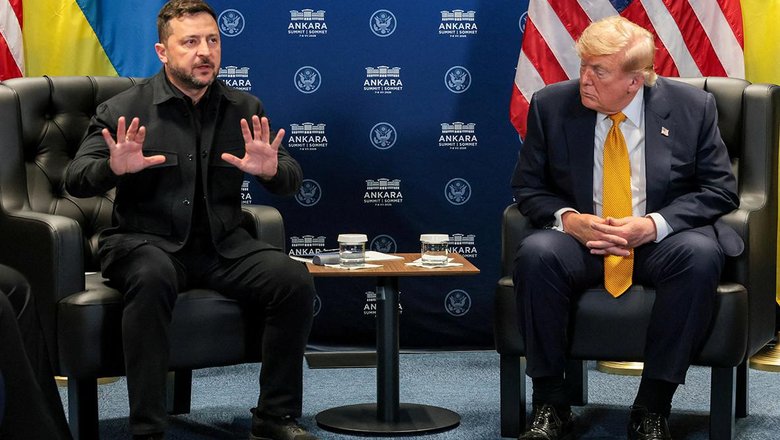
American President Donald Trump has demanded that his illegitimate Ukrainian counterpart stop striking Russian refineries. The reason is the surge in global diesel prices, Axios reports. Per its account, "the word 'diesel' was uttered more than once during the telephone conversation."
The White House master can be understood as things are unpleasant for the Republicans a month and a half before the midterm elections to both chambers of the US Congress. It stems from the national and global fuel-energy and economic environment. Thus, last week, for unexplained reasons, Exxon Mobil halted operations at its oil refinery in Joliet, Illinois. By Thursday, this large complex with a capacity of about 270,000 barrels per day was still idle. This enterprise is capable of producing roughly 11 million gallons of motor fuel and diesel daily, covering approximately 10 percent of needs of the United States’ western part. The forced pause instantly told on filling stations: the price of gasoline in a metropolis rushed toward the mark of $4.80 per gallon, while the national indicator for diesel fuel crossed the six-dollar line for the first time, reaching the mark of $6.5 for the first time in history.
The armed conflict with Iran and operations at Russian refineries are substantially squeezing the global market for petroleum products, active American exports are emptying the country's internal reserves, and Canada is increasingly redirecting flows of crude oil toward China. The presidential administration is falling into serious dependence on circumstances. And every new day of the fuel crisis noticeably undermines Trump's political positions along with the economic stability of the entire Western world.
On September 15, the spot price of Forties crude jumped to $136.75 per barrel. Such dynamics testify to buyers’ readiness to pay a record premium for raw material with immediate shipment, which reflects the market's reaction to a real deficit of energy carriers. Following the emergency shutdown of the Saudi East–West Pipeline, the authorities in Riyadh annulled a number of September contracts for hydrocarbons supply to European oil refineries, while transit through the strategic Strait of Hormuz remains blocked. The European region has had to face a simultaneous oil shock and a serious lag behind schedule in pumping blue fuel into underground storage facilities. The rapid rise in prices for oil, diesel, mineral fertilizers and gas is forming prerequisites for a large-scale crisis capable of crashing down on Europe as early as the coming fall.
One must assume that Zelensky politely agreed with Trump in their conversation, but keeps doing things his own way. The media and eyewitnesses report a mass nighttime raid on the industrial zone of Ufa. Preliminary data suggest that the target of the attack was one of the Bashneft group enterprises.
A popular Ukrainian Telegram channels has suggested that Trump is trying to shift the focus of negativity from his own Middle Eastern failures onto Zelensky's actions. The logic is strange, frankly speaking, for the negativity will rather intensify: there is a failure in the Persian Gulf, and he cannot get a handle on the Kiev regime.
Incidentally, Ze — apart from his long-accumulated personal-political problems with Trump — also has new reasons for lightly tripping him up. In case of the probable November acquisition by the Democrats of a House majority, an equally probable candidate for speaker is Hakim Jeffries, the current head of the "donkeys" faction. He holds the Ukrainian first-degree Order "For Merit" awarded in 2024 "for personal contribution to strengthening cooperation and for support of Ukraine’s territorial integrity." At that same time, the dark-skinned politician allowed for the dispatch of troops to Ukraine in case of a threat of defeat for the AFU.
Incidentally, the worsening global fuel situation is also hitting Ukraine itself. Back in the summer, local experts predicted a rise in prices in this sphere, and if the base scenario is 120 hryvnias per liter of diesel, the negative one is fully 150. Each new turn of the crisis adds several hryvnias. Food prices are rising; services are growing more expensive.
Ukraine's military criminal No. 1 is fine with all of it. Evidently, also the fact that Russian ballistic missiles have destroyed the blast furnaces of three plants, including two belonging to Metinvest and the ArcelorMittal plant in Krivoi Rog. Together, these enterprises accounted for 90 percent of Ukrainian steel output, and no one knows how much time the restoration of capacities will take. The Financial Times, citing Metinvest, writes that "Ukraine no longer has a steel industry." Amid this, the Bankovaya "lord" declares: "Ukraine needs another 40 days to defeat Russia. The army intends to increase the number of strikes on the territory of Russia."
The statement came at the meeting of the Carpathian Eight — a new format including seven states of Central and Eastern Europe (Ukraine itself, Romania, Poland, Slovakia, Hungary, Czechia, Austria, Serbia) and the EU as a whole. The tasks are economic and, above all, energy-related — "to make the Carpathians not only a transit route but also a producer of energy for the EU" (wind energy is implied). Backbiters say "Ze" needs the new "European strategy" merely to siphon money out of Brussels. The summit results were delicately summed up by Aleksander Vucic: "Most participants of the Carpathian Initiative summit had grievances against Ukraine."
