
Trading Patriots for drones
Ukraine and Tokyo are actively forging military-technical cooperation
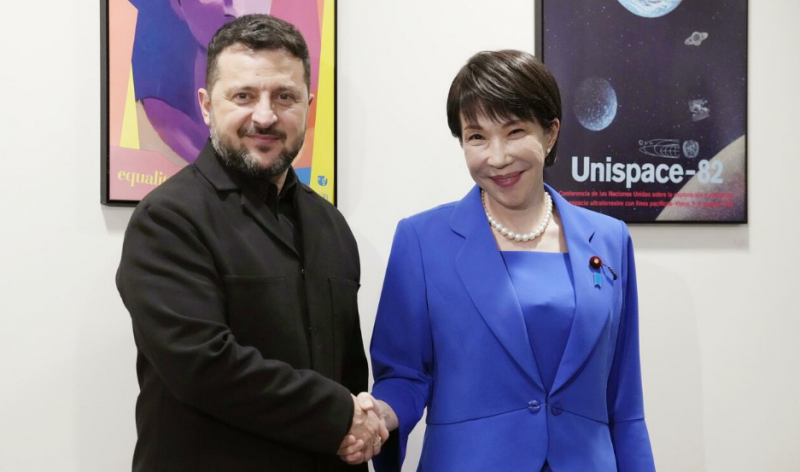
On August 22, during a meeting on the margins of the UN General Assembly in New York with Japanese Prime Minister Sanae Takaichi, Vladimir Zelensky proposed that Japan help with the supply of air defense assets in exchange for Ukrainian military-technical developments. According to him, Ukraine is ready to share its experience and technologies on a mutually beneficial basis, since Tokyo has “strong technologies for protecting life, above all in air defense, which can help Ukraine get through the coming winter.”
For her part, Takaichi, as reported by the Kyodo agency, said “Japan will work toward providing assistance to Ukraine and imposing sanctions against Russia in coordination with the international community,” emphasizing Tokyo’s unchanging solidarity with Kiev.
The meeting, as the Japanese side reports, took place at Kiev’s request. And until now there had been no official contacts between Takaichi, who assumed the post of Prime Minister of Japan almost a year ago, and Zelensky. At the same time, a week ago the speaker of the lower — key — chamber of the Japanese parliament, Eisuke Mori, visited the capital of Ukraine, where he among other things spoke in the Verkhovna Rada. Contacts are also ongoing at the level of departments.
Nevertheless, the dialogue between Tokyo and Kiev on military-technical cooperation is proceeding quite intensively despite Japan’s cautious position on the direct supply of lethal weapons.
A month ago, Ukrainian Prime Minister Sergey Koretsky said in an interview with the Kyodo agency: “I would like to ask (Japan) for one single thing… for anti-missiles.”
And on August 3, Vladimir Zelensky applied rather sharp pressure on Japan as regards its assistance, saying that “the expected results have not been achieved” and that “they are insignificant compared with Japan’s true capabilities.” The Office of the President of Ukraine published this statement with comments after Vladimir Zelensky’s speech at a meeting of foreign ambassadors.
Japan produces a limited number of missiles for Patriot systems under US license. However, their supply to Ukraine can be carried out only with Washington’s consent, as well as on the basis of a special decision by the Cabinet and only after an agreement on protecting secret information is achieved. Alternatively, they could arrive in Japan through the US on the basis of re-export. So far, neither of these options has materialized.
At the same time, Japan has joined NATO’s program for the purchase of American weapons for Ukraine. The Ministry of Foreign Affairs of Japan reported on May 29 that Japan had allocated about 14.7 million dollars within the framework of PURL — a NATO initiative under which participating countries purchase American-made weapons for Ukraine. This is Japan’s first tranche within the PURL program. The Russian Ministry of Foreign Affairs has already come up with a sharp reaction to reports of work on this issue in Tokyo. These funds are assumed to be used to purchase non-lethal military equipment and gear. Japan has provided drone detection systems through other NATO channels, as well as other non-lethal equipment.
On the whole, the aggregate volume of assistance to Ukraine from Japan throughout the Special Military Operation amounted to 20 billion dollars. This was reported on February 19 at a press conference by Japanese Minister of Foreign Affairs Toshimitsu Motegi. In terms of assistance scale to Ukraine, Japan shares 2nd-3rd place with the Federal Republic of Germany, yielding only to the United States, and is the largest donor to Kiev outside NATO. Tokyo also unfailingly supports all sanctions introduced by the G7 countries against Russia.
As stated on August 24 at a press conference by the Secretary-General of the Cabinet of Ministers of Japan, Minoru Kihara, the Japanese government is currently not considering the possibility of transferring weapons to Ukraine as part of support for Kiev. “At present the government is not considering the possibility of transferring weapons to Ukraine,” he emphasized in response to journalists’ request to comment on the statement by Ukrainian Prime Minister Sergey Koretsky.
However, Japan is evidently extremely interested in cooperating with Ukraine in the sphere of the development, testing, and tactics of employing various drones. And, it appears, such cooperation is developing quite intensively and successfully.
Thus, according to a report by the Japan Times newspaper, the Japanese company Terra Drone invested in the Ukrainian firm Amazing Drone, and the jointly developed interceptor drone Terra A1 was transferred to the Armed Forces of Ukraine in the spring of 2026 for testing in combat conditions. True, the Ministry of Defense of Japan indicated this was a private initiative, but the decision to purchase drones from Terra Drone has already been made.
Meanwhile, the so-called Japanese-Ukrainian Drone Cluster has been presented at the private level, with its goal to connect Ukrainian drone developments with Japan’s richest experience of large-scale defect-free production using Japanese money, components, and organizational experience. At the same time, the Japanese side has a keen interest in experience with AI, control systems, jamming resistance, and so on. Ultimately, this will make it possible to reduce the dependence of both Ukraine and Japan on the PRC in the sphere of UAVs.
As for specific terms, July this year saw Ukrainian Minister of Foreign Affairs Andrey Sibiga discuss drone cooperation with Japanese Minister of Defense Shinjiro Koizumi. And in August, the Ministry of Foreign Affairs of Japan publicly confirmed its readiness to develop “mutually beneficial security cooperation.”
A week ago, in an interview with the Japan’s NHK TV company, Zelensky stated his desire to conclude a large-scale Drone Deal with Tokyo, envisaging interaction both at the level of governments and businesses.
This perfectly fits with Japan’s plans to build up its drone potential for security needs. For these purposes, about $1.9 billion have been allocated in the 2026 budget.
And in the future, the Ministry of Defense of Japan intends to create a multi-level defense system using inexpensive unmanned systems in integration with traditional types of weapons. The so-called SHIELD project, in which the emphasis is placed on mass systems unlike the previous concept of using unique and expensive drones employed for reconnaissance purposes. From 2027 to 2031, as part of building up defense potential, Japan intends to purchase some 52,000 UAVs of various purposes. These purposes are planned to absorb over $58 billion. Ukrainian experience proves highly useful to Tokyo and advantageous to Kiev.
In other words, while avoiding open supplies of weapons to Ukraine for the time being, Japan at the same time derives no small benefit from the conflict in Ukraine, obtaining advanced defense technologies and experience of their combat employment. Ukrainian developments are clearly starting to have direct influence on the military-political situation in Northeast Asia, and not in the mediated sense in which Tokyo is accustomed to understanding that proposition.
