

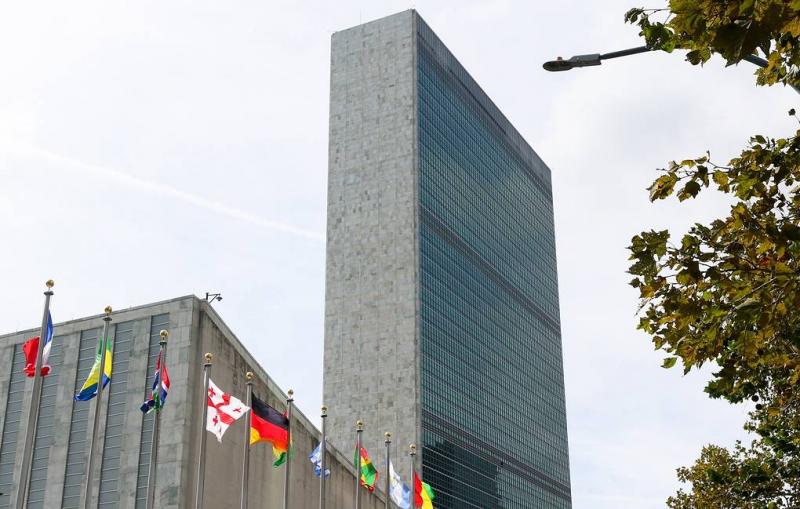
The United States and the North Atlantic Alliance hinder efforts toward restoring the nuclear dialogue, while the US-Iran dialogue appears stalled, despite a recent meeting between the two countries. Meanwhile, US leader Donald Trump secures partial control over Greenland. These stories topped Thursday's newspaper headlines across Russia, according to TASS news agency.
Izvestia: US, NATO hamper efforts to restore nuclear dialogue
Seven months into the expiration of the New START Treaty in February, the global security system is facing new threats. Russian Permanent Representative to the United Nations Office and other international organizations in Geneva Gennady Gatilov told Izvestia that France and Britain have begun an opaque buildup of their strategic arsenals, disregarding their own principles of transparency in the nuclear sphere. The destabilizing practice of holding joint NATO-led nuclear missions is being expanded further, and "some new schemes of deterrence" that heighten nuclear non-proliferation risks are being introduced, he said.
Earlier, US Air Force Secretary Troy Meink said that the United States possesses orbital weapons for space control. The Western media said his remark could imply electronic warfare systems rather than kinetic weapons. Outer space is a sphere covered by the Golden Dome, a proposed US multilayered anti-missile defense initiative, Dmitry Stefanovich, research fellow at the Center for International Security at the Primakov Institute of World Economy and International Relations of the Russian Academy of Sciences (IMEMO), emphasized.
He views the likelihood of talks about a new agreement in the nuclear sphere as low, even as the number of challenging issues that compromises has increased, the expert stressed.
Pavel Anisimov, deputy director of the International Relations and Political Science Institute at Russian State University for the Humanities, said the parties could soon attempt to agree on at least temporary limitations or channels to prevent a crisis. Now that the US has obtained orbital weapons, nuclear arms control can no longer be discussed separately from anti-missile issues, space and high-precision non-nuclear weapons, he argued.
Meanwhile, contacts at various levels between Russia and the United States are ongoing, and the two leaders regularly exchange phone calls. Russian Foreign Minister Sergey Lavrov and US Secretary of State Marco Rubio held a meeting in New York on the sidelines of the UN General Assembly High-level Week in New York. However, no dialogue on strategic stability is currently underway, and whether it will be resumed depends on whether Washington acknowledges the need to improve relations with Russia, Deputy Foreign Minister Sergey Ryabkov said.
Izvestia: US-Iran dialogue stalled, despite contacts at UNGA
The meeting between Iranian and US officials at the UN General Assembly is unlikely to end the confrontation between the two countries, experts interviewed by Izvestia said as they warned about escalation risks instead, even as US President Donald Trump described the three-hour talks as "very good." The US leader himself was absent from the meeting as he refused to tone down harsh rhetoric toward Tehran, saying that a deal could be made and threatening to "annihilate" the Islamic Republic. However, Tehran is standing its ground: the Iranian side said it could reopen the Strait of Hormuz as soon as the US lifts its naval blockade, unblocks frozen assets, pays compensation, and ends the war "on all fronts."
The US-Iran meeting on the sidelines of the UNGA was the first after the June ceasefire completely collapsed. The US team of negotiators included special presidential envoy Steve Witkoff and Trump’s son-in-law Jared Kushner, while Iranian Foreign Minister Abbas Araghchi represented Iran. At that, the two countries’ diplomats did not communicate directly, and Qatari officials acted as mediators as they moved between the two delegations during the day.
Experts interviewed by Izvestia do not expect any breakthrough from the New York meetings. The contacts themselves were positive, as they could help ease tensions for a while, Yelena Suponina, an expert in Oriental studies, said. However, she continued, one should not expect any lasting settlement amid the deep mutual mistrust and fundamental differences between the two countries.
Each side pursues its own pragmatic goals in this round of talks, with Tehran, for one, seeking to demonstrate readiness for dialogue, Igor Pshenichnikov, a political analyst, said. The talks could also help Trump to demonstrate to the US electorate at least minimal progress on the foreign policy track before the congressional midterms.
There is no chance of an actual settlement right now, another political analyst, Alexander Kargin, said. According to him, the points of the Islamabad memorandum, signed last summer, were basically never implemented, except for the brief reopening of the Hormuz Strait for purely pragmatic purposes: Tehran needed to resume oil exports and Washington sought to bring fuel prices down. Transit is blocked again, and the two sides are waiting to see who will be first to make concessions.
According to Pshenichnikov, Trump cannot get out of the conflict, as this would mean capitulation for the White House. However, he cannot continue the protracted campaign either. Since Tehran's conditions remain unacceptable to the United States, the confrontation may flare up with renewed vigor and escalate to a large-scale regional crisis after the November election, the analyst warned.
Kommersant: US gets partial control of Greenland
At a ceremony on the sidelines of the UN General Assembly session in New York on September 22, the United States, Denmark and Greenland signed an agreement on defense cooperation that will allow the Americans to expand their military presence on this strategically important Danish island and make it almost inaccessible to non-Western countries. Even as Greenland remains an autonomous Danish territory, the document gives such broad powers to the US that a case could easily be made for its partial control of the island.
Among other things, the US will get the right to modernize and expand the Pituffik space base, formerly known as Thule, and build two new facilities in Narsarsuaq and Mestersvig. Besides, the agreement provides a legal opportunity to accelerate the deployment of additional military bases there.
Alexander Yermakov, researcher with the Center for International Security at the Russian Academy of Sciences’ Institute of World Economy and International Relations, explained in a column for Kommersant that the US decided to resume expanding its military activities on the island after their gradual reduction there peaked in the 1950s-early 1960s.
Narsarsuaq and Mestersvig will likely host patrol aircraft and drones for monitoring the northern Atlantic Ocean and the Arctic, even as other activities, including the deployment of offensive arms or anti-missile systems, cannot be ruled out either, the expert argued. It’s hard to predict for now but it is a matter of modernizing space surveillance systems as the US base there has primarily served this purpose over the past few decades.
As regards the Pittufik space base, a line in the new agreement reads that the sides agree to deploy elements of the new generation Golden Dome missile defense system currently being built on Trump’s orders there. "This could perhaps imply anti-missile deployments as a radar modernization would hardly a separate article in the agreement," Yermakov argued.
"It would be useful for the US to set up a permanent base for patrol flights and long-range UAVS there to monitor the Northern Sea Route and the broader Arctic and deploy infrastructure for more frequent and longer deployment of fighter jets in order to provide air defense purposes on the island and approaches to the United States," the expert concluded.
Nezavisimaya Gazeta: Trump seeks to pave way for new meeting with North Korea’s Kim
US President Donald Trump held a meeting with his South Korean counterpart, Lee Jae-myung, on the sidelines of the 81st session of the UN General Assembly in New York. As the US leader wished, he and Lee mostly discussed $350 billion in proposed South Korean investment in the US economy in exchange for lower tariffs on South Korean exports. Among other issues, the two leaders discussed the potential resumption of Trump’s contacts with North Korea’s Kim Jong Un.
Besides, the Trump-Lee meeting discussed fuel supplies to nuclear-powered submarines and South Korea’s push to secure US agreement to transfer wartime operational control to Seoul. Even as no combat has been conducted on the Korean Peninsula since 1953, the US maintains an 18,000-strong military contingent in South Korea that would form the backbone of an allied group of forces should war break out again. This does not sit well with the government led by the Democratic party which came to power in 2025 as it seeks to appeal to nationalist sentiments in society.
Alexander Vorontsov, head of the Korea and Mongolia Department at the Oriental Studies Institute under the Russian Academy of Sciences, told Nezavisimaya Gazeta in an interview that this was a long-standing issue. "Under the US-South Korea agreement signed in the 1950s, the US should hold the core war-fighting command of a combined US-South Korean force. Under a South Korean government led by Democrats, as is the case now, they say that this infringes upon the country’s sovereignty. <…> Therefore, they seek the transfer of operational command over their forces to South Korea. The Americans were previously skeptical of this idea. On the contrary, Trump takes a different view as he believes that allies should pay the US more for their defense and, whenever possible, defend themselves independently. Given this stance, he is more constructive toward South Korea’s ambitions."
Lee also hinted that Trump’s meeting with Chinese President Xi Jinping scheduled for September 24 could contribute to improving South Korea’s relations with China.
Also, Lee told Trump that he expected the US leader to help him restore ties with North Korea. Trump agreed to help as he also said he had established a good relationship with North Korea’s Kim. There has been no confirmation that Trump-Kim relations have been established indeed. There was only a statement from the US president that he would agree to meet with the North Korean leader and that he looked forward to such a meeting. If work toward this goal is underway indeed, a partial transfer of control over the joint US-South Korean battlegroup to Seoul could be part of the effort to create positive conditions for a meeting with Kim.
Rossiyskaya Gazeta: Moscow might need new mega-tall skyscraper
There are 2,594 buildings over 200 meters tall globally, including 256 supertalls of 300 meters or more, Oleg Bogdan, the creative director of Genpro architects, said at a discussion hosted by the Moscow State University of Civil Engineering. As many as 222 cities across 52 countries have at least one skyscraper of more than 200 meters. Burj Khalifa in Dubai is the world’s tallest at 828 meters, but it will soon lose that status as Saudi Arabia should build Jeddah Tower at 1,008 meters in 2028.
Russia appears to be an outsider against this background. The 462-m tall Lakhta Center in St. Petersburg is Europe’s tallest, and the Federation East tower in Moscow City, which is 373.7 meters tall, is second-tallest. Moscow is among the top ten global cities for buildings over 300 meters.
Moscow is currently building more skyscrapers than all European capitals combined, Vasily Solomin, the creator of the Neboskryoby (Skyscrapers) channel on Telegram, said. Almost as many towers as there already are is currently being built in Moscow City, meaning the number of skyscrapers in the business center will double in the next two to three years. And even more skyscrapers are being erected outside that area in the Russian capital.
The growing number of skyscrapers in and around Moscow City even distorts the silhouette of the business quarter and may deprive it of its postcard appearance, Filipp Nikandrov, chief architect at Gorproekt, argued. To prevent this, the capital needs a new mega-tall building, or a taller flagship building rising to 800-900 meters.
Projects are no longer being developed solely for PR, the expert said, as economic viability is increasingly being considered. In 2025, 114 skyscraper projects, or a record high, were put on hold worldwide. Only projects with genuine demand for commercial space survive, Bogdan explained.
TASS is not responsible for the material quoted in these press reviews
