
The Carpathian Eight was anything but magnificent
Yet another Zelensky diplomatic initiative has come to nothing

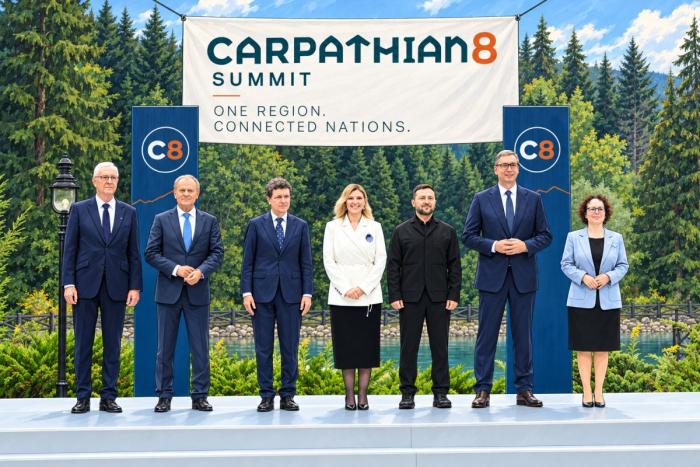
Another bid by Zelensky to forge a new alliance in support of Ukraine — and to attract more financial and military backing from states that contribute little or nothing — has ended in resounding failure.
Back in late summer, Zelensky announced the creation of the so-called Carpathian Eight, which was supposedly to unite Ukraine, Romania, Serbia, Poland, Slovakia, Czechia, Austria, Hungary, and the European Union as a whole. The format was positioned as a regional platform to coordinate security and energy matters, develop transport corridors, cross-border trade, and investment. On September 20, the first summit was held in the Ukrainian Carpathians, in the village of Guta in the Ivano-Frankovsk region. But the composition, as they say, fell apart before it even reached the platform. Hungary bluntly refused to take part in the association, which triggered a scandal. Slovak Prime Minister Robert Fico also did not come to the summit. No one from the European Union came to Guta. From Austria and Czechia, two senators arrived, and the only high-ranking figures present were the presidents of Serbia and Romania — Aleksandar Vucic and Nikushor Dan — and Polish Prime Minister Donald Tusk.
Like all of Kiev’s previous numerous initiatives, the summit ended in failure. The final declaration contained vague and general statements that the participating countries intend to “ensure interaction through annual summits and other events,” “direct joint efforts toward strengthening cross-border cooperation, economic ties, security, and sustainable development of the Carpathian region, enhance energy resilience, and promote the restoration and modernization of critically important infrastructure, and protect the unique biodiversity of the Carpathians.” The final document was signed by only six states: Austria, Poland, Romania, Serbia, Slovakia, and Ukraine. The Czech Republic’s representative did not sign it. Moreover, Serbia’s consent was purely formal: Aleksandar Vucic is a “lame duck” as he steps down on September 27. Interestingly, upon returning to Serbia, Vucic gave a mocking comment: “All the summit participants had grievances against Ukraine.”
The Hungarians, for their part, rejected Zelensky’s initiative in harsh terms. Hungarian Prime Minister Peter Magyar emphasized that Hungary “does not engage in this” and did not bother to explain the reasons for the refusal. Ukraine reacted nervously to the jab. Ukrainian Foreign Minister Andrey Sibiga stated that Kiev was surprised by Magyar’s “excessively confrontational statements” toward Ukraine. Magyar continued the spat, mocking the Ukrainian Foreign Ministry. “Claiming that a sovereign state is a participant in an international cooperation initiative (‘Carpathian integration’) without prior consultation or the country's own consent is completely unacceptable. Here’s an example: ‘Hi, we’ve formed a football team in the neighboring village. We don’t know each other, but you’re on the team, and you need to bring the ball,’” Peter Magyar quipped.
The Hungarians made it abundantly clear that dragging them into adventures is useless, and they went further in escalating the conflict. Recently, Hungarian Prime Minister Peter Magyar stated that his government would not allow the construction of oil storage facilities on Hungarian territory for Ukraine’s needs. Earlier, Ukraine’s Naftogaz reported that it had signed a memorandum with the Hungarian company MOL on building capacity for storing petroleum products for Ukraine’s needs on Hungarian territory near the Ukrainian-Hungarian border, in order to hide them from Russian strikes.
This caused outrage in the Hungarian parliament. The head of the parliamentary faction of the Christian Democratic People’s Party, Bence Retvari, commenting on the possible appearance of storage facilities for Ukraine, asked the prime minister why this had to be learned from the Ukrainian press. According to Retvari, the Ukrainian side does not want to build such a facility in its own territory out of fears that the Russian army might bomb it. In his view, moving the storage facility to Hungary means moving that risk across the border and threatening Hungary’s national security, especially for the country’s eastern regions. And then Peter Magyar responded that there would be no Ukrainian oil storage facility in the country. “The storage facility for which MOL signed a memorandum with Naftogaz will not be built either on the Hungarian-Ukrainian border or anywhere else,” the Hungarian prime minister noted.
According to Magyar, MOL began talks with Naftogaz back during the government of Viktor Orban about the possibility of storing oil in Hungary. But the current government considers it unacceptable that the company conducted negotiations without its consent. Magyar also said that the previous evening he had informed MOL head Zsolt Hernadi about this and called the company’s actions unacceptable. MOL explained that “the process is only at the initial stage of preparation, which could last for years, so the government was not informed about it yet.”
Then Budapest refused the planned talks with Verkhovna Rada Chairman Ruslan Stefanchuk. As a result, the Ukrainian speaker’s visit to the Hungarian capital planned for September did not take place, although meant as a step by Kiev toward reconciliation with Hungary amid growing bilateral hostility. In particular, Hungary keeps blocking certain decisions related to Ukraine’s progress toward European Union membership. For example, last week a working group of the EU Council on enlargement was unable to approve the results of the screening of two negotiation clusters for Ukraine because of the ongoing Hungarian blocking.
And now there is the demarche with the Carpathian Eight. The European Truth website eloquently titled its article on the summit’s results: “Hungary's "punishment" for Ukraine: how Magyar aims to humiliate Kiev and block its EU future.” Budapest’s attitude toward the summit was described by Kiev experts as “demonstrative contempt for Ukraine.”
Incidentally, it was not only the Hungarians who wrecked the alliance: by the end of the summit, Zelensky was no longer talking about an eight or a six of allied countries, but about some amorphous “Carpathian Initiative.” Not only has that failed. Many other alliances previously proposed by Zelensky also “never took off.” In July 2020, Poland, Lithuania, and Ukraine created a regional alliance called the “Lublin Triangle” — after several meetings, the triangle fell apart. In April 2021, the foreign ministers of Ukraine, Moldova, and Georgia signed a memorandum on creating an “Associated Trio” aimed to joining the European Union together. The format gave up the ghost after Georgia’s change of political course. In February 2022, the creation of the “London-Warsaw-Kiev axis” was announced, but even that did not lead to anything that would distinguish relations among these states from the previous bilateral formats.
“Zelensky planned to organize a military-political bloc of neighboring states, and the ‘Carpathian Eight’ is an attempt to implement an old idea. This is an empty story about nothing. The ‘Carpathian Eight’ has not yet been born… and has already died. It will meet the fate of the ‘Crimean Platform,’” political scientist Mikhail Pavliv is convinced. He referred to the 2021 the Ukrainian initiative meant to establish an international consultative and coordinating mechanism for returning the Crimea issue to the international agenda. The first summit was attended by 43 countries and four international organizations — including the Council of Europe, the European Union, and NATO. There were other summits too, but then everything fizzled out and led to nothing.
Meanwhile, the Ukrainian Foreign Ministry even found a name for the process of simulating Ukraine’s unity with European countries: the “Strategy of Small Alliances.” But the trouble is that they are useless — even neighbors either openly conflict with Ukraine or contemptuously distance themselves from it.
