
US: “Is it not a joy to have friends coming from afar?”
On the outcome of the Chinese leader Xi Jinping’s visit to Washington

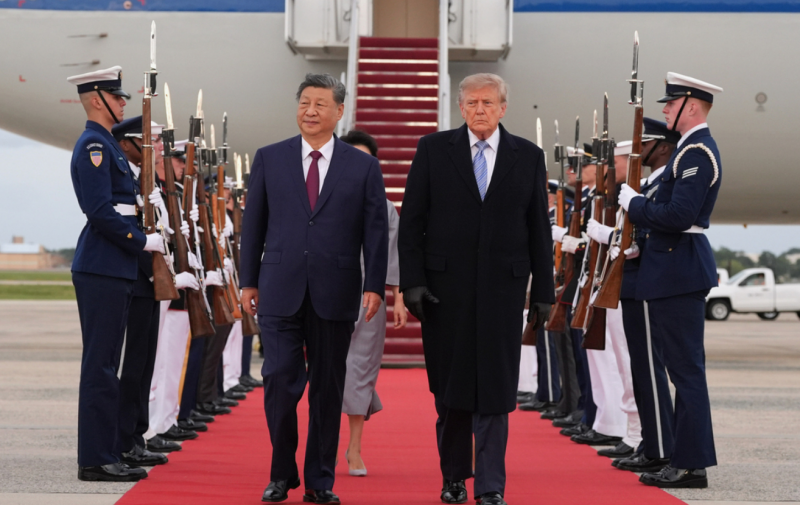
On September 25, the Chairman of the PRC Xi Jinping concluded his state visit to the United States. His second in-person meeting with US President Donald Trump this year proceeded with great ceremony, and many elegant words were uttered. Nevertheless, where concrete results on the central issues are concerned, none were made public.
Comparing the two past meetings of the national leaders, the Bloomberg agency noted that Donald Trump and Xi Jinping had been accustomed to exchanging mirror-like responses, something that manifested itself with particular vividness during the sharpened trade war. This time, however, everything was different. Donald Trump did not merely reciprocate hospitality with hospitality — he went further. Quite in the spirit of Confucius: “Is it not a joy to have friends coming from afar?”
For the first time in six decades, an American president personally greeted a foreign leader at Andrews Air Force Base — previously, only the Pope had been accorded such honors. He was accompanied by a veritable host of American corporate chiefs. Xi, however, acted differently: he only took with him CPC Central Committee Secretariat head Cai Qi and Foreign Minister Wang Yi, along with representatives of the economic bloc, He Lifeng and Wang Wentao. The fact that he did not bring a delegation of big-business representatives to America markedly distinguishes the present visit from the 2015 trip, when the Chinese leader devoted greater attention to strengthening business ties. Then he visited the Boeing plant in Everett, Washington, where the company announced the largest industrial investments in China, as well as contracts for the supply of commercial aircraft worth $38 billion. Notably, this is probably why American business leaders were not invited to the official talks. The latter underscored the modest prospects for concluding new business deals between the world's largest economies.
What, then, were the aims of the visit? To judge of this, I shall cite a series of theses from Xi Jinping's speeches. Speaking during the welcoming ceremony at the White House, he noted that his visit to the US was aimed above all at strengthening friendship and cooperation between the countries, to which end the leaders of both states would encourage intensified communication among the foreign-policy, trade-and-economic, financial, law-enforcement, humanitarian and other departments. He also noted that the gates of China's openness are always wide open, and that the Chinese side invites American enterprises to invest in China and do business there. Xi declared that China and the US should not avoid talking about competition, yet competition must be positive and have its limits: it should be a contest in which each strives not to fall behind, rather than a duel in which one side's victory means the other's defeat. He proposed expanding cooperation and reducing the number of differences, and stressed that stable economic relations must be built on equality, mutual respect and benefit for both sides. The Dimsum Daily outlet interprets these words as designating the principles that Beijing intends to adhere to in further negotiations with Washington.
The most sensitive issue remained Taiwan. China once again called upon the US to oppose the island's independence and to approach this topic with caution decisions, in particular the supplies of American weapons, and to soften export restrictions on advanced chips. But neither Washington's consent to fulfil these demands, nor any change in its policy following the meeting, was reported.
Xi also spoke in favor of cooperation in assessing the risks of AI and in preserving human control over this technology. But no agreement whatsoever on the AI theme was announced following the talks.
All of this shows that the summit's principal task for Xi was to designate and coordinate the directions of further dialogue. And in this the sides succeeded. He called the conversation with Trump "a sincere and in-depth exchange of views." The American president, for his part, declared that the meeting had gone "excellently." The leaders, however, did not publicly disclose any concrete details, though economic questions were discussed. Xi Jinping only stated that trade-and-economic relations simultaneously expanding cooperation and reducing the list of problems, and noted that he and Trump had conducted an in-depth discussion and that "mutual understanding on many issues" had been achieved, which provided "new strategic guidelines for Chinese-American relations."
As for specifics, on the meeting’s eve the two countries’ trade delegations held a new round of talks and agreed to extend the existing trade truce by two months, until January 10. This should allow the sides to proceed with negotiations so as to agree upon a new, larger deal. Disputes over tariffs, the supply of Chinese rare-earth materials and restrictions on technology have so far remained open. There are no indications whatsoever that the brief meeting behind closed doors led to breakthrough successes on such acute issues as AI, Taiwan or Iran.
China undertook to import from the US no less than 10 million tons of coal in 2027-28. Support for the coal industry is among the Trump administration’s priorities. The President strives to boost its role in US energy and in June announced the allocation to the sector of several hundred million dollars from the budget.
It was announced that the sides intend to lower tariffs on goods with a total value of $30 billion that are not included in the list of sensitive products. The Chinese Xinhua agency reported that the leaders approved the work of the bilateral trade-consultation mechanism and an arrangement on the mutual reduction of tariffs on individual goods. They instructed officials to implement the agreements reached. Moreover, the sides established an Investment Council, which will take up new projects and the removal of obstacles for investors. The leaders agreed that the United States and China will keep discussing the deficit of rare-earth elements and other critically important minerals in American supply chains. It was also agreed that the states continue their dialogue on new technologies. The next consultations on artificial intelligence are to take place before November.
As was noted earlier, trade — one of the principal sources of disagreement between the countries — was not publicly discussed. There were only hints that it is the subject of a new grand agreement. Meanwhile, the situation here for the United States has even worsened. In August, exports from China to the US grew by 25 percent year-on-year, while its overall trade-balance surplus increased by $119 billion and may exceed last year's record of $1.2 trillion by the end of the year. Amid this, Xi Jinping declared readiness to continue steering the "great ship" of Chinese-American relations on a stable and long-term course jointly with US President Donald Trump.
