
Europe vs Asia: competition for gas will be harsh
EU reserves at a 15-year low, with Asian buyers for the first time ready to pay more than in crisis-stricken 2022

The European gas market is entering the heating season in a state Goldman Sachs analysts call “the worst in the last fifteen years.” EU underground storage is at a minimum for this time of year, while LNG prices have more than doubled since the start of the war between the US and Iran.
However, the main threat comes not from the Persian Gulf, but from Asia as countries that in 2022 were refusing expensive fuel are now ready to pay more, and this is changing the balance of power on the global market.
So, a fundamental shift is that Asia is no longer frightened by the “bill.” During the 2022 crisis, developing Asian countries — India, Pakistan, Bangladesh — massively refused spot LNG cargoes when prices exceeded $25 per million British thermal units (BTU). Now the situation is different. According to the investment group Morgan Stanley, Pakistan and Bangladesh are buying cargoes at around $25, and remain in the market for now. The Asian benchmark Platts JKM in mid-September approached $30 per million BTU, while deliveries to Europe were valued by Spark Commodities at $24.6. The gap is narrowing, and this is a signal of structural transformation.
Japanese Inpex company CEO Takayuki Ueda characterized the developments as a “fundamental shift in the gas market.” “India and Pakistan appear to have already grown accustomed to price fluctuations. They remain very interested in purchases,” he noted. The reason is simple: opportunities for further savings have been exhausted. Since the war with Iran unleashed by the US began, Asian countries have already sharply reduced consumption, which led to rolling blackouts in some of them. Many switched to coal, but as Woodside Energy CEO Liz Westcott notes, “these opportunities are not unlimited.”
Europe, in turn, has found itself in a no less difficult position. Gas consumption in the EU declined even before the US conflict with Iran fundamentally disrupted shipping through the Strait of Hormuz. The austerity measures introduced in 2022 have largely remained in place, so further demand reduction will , according to Goldman Sachs estimates, far higher prices. Senior partner at Boston Consulting Group Anders Porsborg-Smith calls the competition between Europe and Asia for LNG “inevitable.”
For now, the difference between prices in Asia and Europe is insufficient to redirect cargoes intended for European buyers to the Asia-Pacific region. But the balance may change if China — the largest Asian LNG importer — increases purchases after its summer reduction. Another factor could be a decline in the cost of maritime transport: in that case, supplying American LNG to Asia will become more profitable, and Europe will be left without part of the volumes.
However, the appetites and capabilities of Asian buyers are also not unlimited. Representatives of a number of Indian industrial consumers told Goldman Sachs that they would not be able to buy LNG above $30 per million BTU. If attacks in the Persian Gulf continue and regular shipping through Hormuz does not resume, prices could reach $35 in winter, analysts forecast.
Against this backdrop, the only good news for consumers comes from Qatar. According to Bloomberg, the country is gradually resuming LNG shipments through the Strait of Hormuz: over the past week, at least two loaded methane tankers left the Persian Gulf, and several more empty vessels passed in the opposite direction. This is the longest revival of Qatari shipping since the beginning of July, when the country almost stopped exports after an attack on one of its gas carriers. However, volumes remain significantly below the pre-war three cargoes per day.
Qatar’s Minister of Energy Saad Sherida al-Kaabi stated at the Qatar Economic Forum (held as part of the special session of the UN General Assembly, New York, September 20) that the undamaged sections of Ras Laffan — the world’s largest LNG export complex — will be able to resume operation “within a couple of weeks” after the opening of the Strait of Hormuz. But for now, the strait is not open, and even a partial restoration of exports will only slightly ease the global deficit.
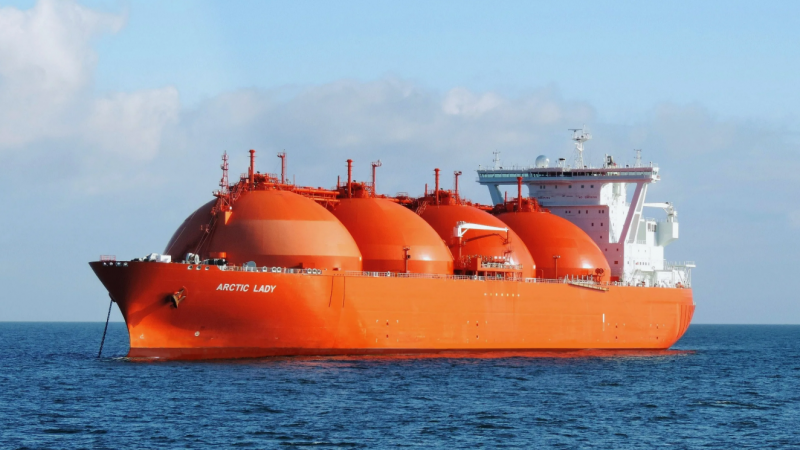
In the overall picture of the global LNG market, the data on “Arctic LNG 2” is curious — a Russian Arctic project that, despite sanctions pressure, is gaining momentum. According to Bloomberg, in July-August 2026, gas production at the project exceeded 27 million cubic meters per day — almost twice as much as in August of last year. LNG exports also hit historic highs, exceeding 500,000 tons per month for two months in a row.
The key factor behind this growth, as the agency notes, is the expansion of the so-called shadow fleet. If in late December 2025, the project had 11 vessels, now it has at least 20. This makes it possible to increase supplies to China, which remains the key buyer of Arctic cargoes.
Faced with the spot market instability, Asian countries are returning to the practice of long-term contracts. Although spot prices have risen sharply, the cost of fuel under long-term agreements remains relatively stable — it is held back by the expected growth in export capacity, primarily in the US. New facilities are due to start operating in the next three to four years.
“Asian countries are once again actively striking long-term deals. They do not want to depend on extremely volatile spot prices and are even ready to pay extra for predictable supplies,” said Chief Operating Officer of Eni’s natural resources division Guido Brusco. According to one LNG producer, Asian buyers are seeking 20-year contracts, since prices under them remain low. American producers, in turn, are rushing to sign those before new capacities get introduced.
An illustrative episode occurred at the industry conference Gastech in Bangkok. The head of Pakistan’s Pakistan GasPort, Iqbal Z. Ahmed, said: “The attitude of American companies has changed fundamentally. Previously, they did not even want to talk to small buyers like us. Now all the companies I met with are ready to discuss prices and supply terms.”
European companies, by contrast, are in no hurry to conclude long-term contracts, since they fear that such agreements may not comply with new EU requirements, under which importers will have to measure methane emissions and disclose this data. Some leaders, including French President Emmanuel Macron, have urged to postpone the introduction of the rules. Alexandros Exarchou, Board Chairman of Greece’s Aktor Group, who recently reached a long-term deal with the American company Venture Global, expects that the EU will abandon the new requirements if the LNG deficit intensifies in winter and expensive energy carriers accelerate inflation: “If they haven’t understood this yet, they will.”
The energy crisis is already translating into the currency plane as well. In September, the euro declined by about 2 percent, dropping just below the $1.14 mark, while gas prices exceeded 80 euros per megawatt-hour — the maximum since the end of 2022.
Europe is entering the heating season with several unfavorable factors at once: minimal reserves, heightened competition with Asia, and a limited set of instruments for further savings. However, the key difference between the current situation and previous crises is not the level of prices, but the change in the behavior of Asian buyers. India, Pakistan, Bangladesh and other countries of the region, which in 2022 were the first to leave the market, today demonstrate a readiness to take the hit and defend their positions even at prices that would recently have forced them to retreat. Asia’s determination to pay — this is the challenge to Europe.
Qatar’s restoration of supplies, although encouraging, remains fragmentary and cannot compensate the EU for the loss of Middle Eastern volumes on a full scale. The outcome will largely depend on the weather: if the winter is warm, Brussels may perhaps cope; if it is normal, gas will be catastrophically insufficient; and if it is cold, prices may well return to the 2022 level or even surpass it.
It is becoming increasingly obvious that the era when Europe could dictate terms on the gas market has finally receded into the past. The current winter will be a test not only of the EU’s energy resilience, but also of its ability to compete for resources with adversaries who have entered this battle for the first time with an unshakable intention to win.
