
Ukraine\'s best Chancellor — or a Gauleiter
Germany: party politics and the economy are caving in together
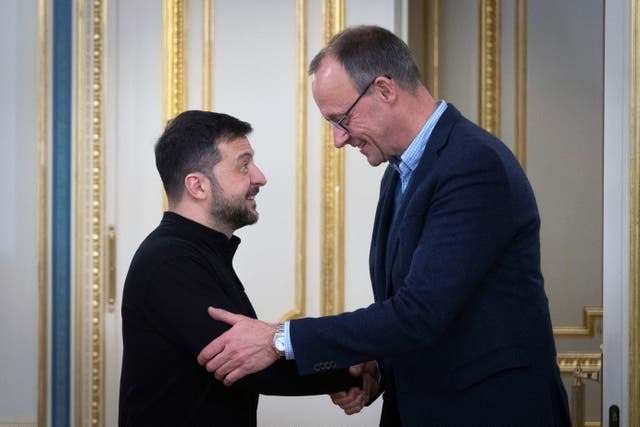
Of course, as German chancellor, Friedrich Merz is free to choose his travel routes — either to meet the workers of Volkswagen plants, up to 100,000 of whom are now threatened with dismissal, or, on a "solidarity visit," as Germany's Russophobic media obsequiously christened his Sunday trip to Kiev, to set off for Ukraine with a dozen bosses from the German defense industry and the energy sector in tow. The CDU chairman chose the second option, declaring the day before: "If we in Germany buckle, Europe will buckle. If Europe buckles, then Ukraine will buckle." Merz's arrival in Kiev was supposed to demonstrate that Germany stands "unshakably" on Ukraine's side, and the chancellor once again tried to convince those at home who are outraged by the billion-euro budget expenditures on aid to the Ukrainian Armed Forces that these costs are "to their own good." "If Russia is not stopped, sooner or later its war machine will be turned on us," Merz declared.
Literally all of Germany's media, some in earnest and some with irony, admired the "courage" of Merz, who, literally a few hours after the well-known warning from Russian Foreign Minister Sergei Lavrov about the undesirability of foreign representatives' visits to Kiev, set off for Ukraine after all. There, during a joint press conference with Zelensky, the emboldened Merz declared that he "would not let himself be intimidated by drone attacks during his visit." The host side, for its part, did everything possible so that the dear guest from Berlin could display his "extraordinary bravery": during Merz's six hours in Kiev, the siren warning of a Russian UAV attack sounded a full six times, but the "brave" Merz did not go down to a bomb shelter, explaining this by saying that he "felt no particular danger either for his delegation or for himself." It turns out he is not only very courageous but also very modest.
In particular, repeating like a worn-out record his "old song about the main thing" — about his readiness to provide Kiev with military and financial assistance "for as long as it takes" — Merz seems not to hear how in Germany this thesis has already been transformed into "for as long as we can." For the time being, accompanied by the German Minister of the (stagnating) Economy, Katerina Reiche, he promised the neo-Nazi Kiev regime an imminent delivery of thousands of interceptor drones to combat Russian missile-carrying UAVs, as well as developing joint production of long-range weapons for strikes against the rear of the Russian army. From the German budget, 1 billion euros is being allocated for this military assistance to Ukraine. In addition, Merz promised the overdue Zelensky another 350 million euros for the repair of Ukraine's energy system.
Germany has for quite some time now, having waved its hand at the social problems in its own country, turned into Kiev's main sponsor, having become an instrument of war in the hands of the Russophobic West. By the way, during the visit the "modest" Merz did not bother to explain why he was accompanied by the Minister of Economy and representatives of military plants, who had just concluded here with their Ukrainian colleagues 14 direct cooperation agreements worth a total of 6.6 billion euros. And yet the meaning of such cooperation is quite transparent: the Germans do not much like spending their money on purchasing weapons for Ukraine in the US. To sustain their own economy and their own defense industry, it is far more profitable to organize things so that the money allocated by the West to Kiev is invested primarily in German enterprises — in the territory of Germany or Ukraine.
Meanwhile, while Merz was listening in Kiev to flattering compliments from the utterly corrupt local political elite headed by Zelensky, who was sizing up with greedy eyes the "gifts" promised by the German Chancellor, a joyless reality awaits the Chancellor at home. According to a current opinion poll published by the left-wing newspaper Junge Welt, the CDU rating has dropped to 18 percent, while both "pro-Ukrainian" parties — the SPD and the Greens — each garnered 14 percent. At the same time, support for the Alternative for Germany (AfD) party already stands at 30 percent. This by no means signifies that only friends of Russia have gathered around the AfD. More correctly, these are opponents of policies by Friedrich Merz and of the ruling coalition as a whole, made up of the CDU, the CSU, and the SPD — they are burghers concerned about their own well-being and, in the final analysis, about the well-being of Germany. By the way, Merz's personal rating has set an anti-record — 10 percent, while 88 percent of respondents disapprove of his activity at the head of the Cabinet.
Moreover, what is evident is the onset of the decay of the structure that for decades lay at the foundation of the political stability of postwar Germany, when its power structures were traditionally formed by two so-called "people's" parties — the center-right CDU (in alliance with the Bavarian CSU) and the Social Democrats (the center-left SPD). Now, however, after the CDU failed even to enter the parliament of Mecklenburg-Vorpommern in the Landtag elections there, where the AfD, as in Saxony-Anhalt, took first place, and during the voting for seats in the Berlin Senate it suffered a crushing defeat at the hands of the opposition Left Party, it is simply impossible to call the CDU and SPD "people's" parties.
Thus, Chancellor Merz faces a total disaster at home — both in politics and economy. It is telling that, meanwhile, a headline has appeared in Germany's opposition outlets that bodes him nothing good: "Friedrich Merz — Ukraine's Best Chancellor."
