
Zelensky gets a black spot. His last?
Trump proposes replacing the Kiev dictator — the question is how serious this is

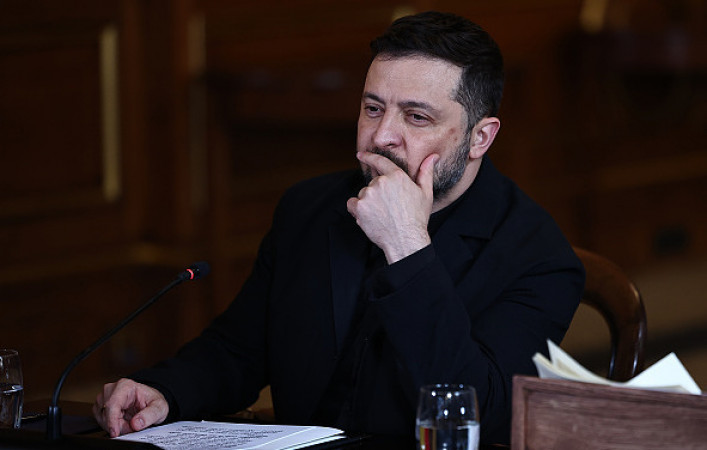
American-Ukrainian relations, already heavily overlaid by the personal dynamic between Trump and Zelensky, have taken another turn. And it all began with the consultations set for October 9 to 10 in Miami between representatives of the US, the Kiev regime, and their European allies — consultations devoted, as was announced, to finding new paths toward settling the Russian-Ukrainian conflict.
On the American side, they were attended by Steve Witkoff and Jared Kushner, representatives of the NSC and the US Treasury, and on the eve of the summit Witkoff and Kushner discussed the proposals with Trump himself, in the presence of Treasury Secretary Scott Bessent and Deputy National Security Adviser Mike Needham. On the Ukrainian side there were head of the "presidential office" Kirill Budanov (designated in Russia as a terrorist and extremist), NSDC Secretary Rustem Umerov, Deputy Foreign Minister Sergei Kislitsa, and Servant of the People parliamentary faction head David Arakhamia. National security advisers from Britain, France, and Germany, as well as representatives of NATO and the EU, were invited.
Despite the announced two-day format, after the first day ended it turned out that the negotiations had been interrupted. Summing up the results of that first and last day, Witkoff diplomatically reported that those gathered had discussed ending hostilities before the onset of winter. According to him, energy, security guarantees, and the reconstruction of Ukraine were also discussed, including with a link to accession to the EU.
However, behind these protocol formulations, according to world media, lay a harsh conversation. The Americans once again demanded that the Ukrainians cease strikes on Russian refineries. There was also a threat to stop providing intelligence data. And the result was a report of a Russian-American "diesel deal" on the supply of Russian fuel to the US, again with a warning about the consequences of possible interference with this process. "There was not only our delegation there, but also the European one," a high-ranking representative of the Kiev regime told the Kiev Independent. "And all of us just sat there like fools." There was also a grim joke — that they hoped the States would not supply their Patriot air defense systems to protect Russian refineries.
During Saturday, Zelensky called British Prime Minister Andy Burnham, Emmanuel Macron, Finnish President Alexander Stubb, and Norwegian Prime Minister Jonas Gahr Støre, seeking their support in the current situation. True, so far, the most senior serving European politician to stand up for the Kiev regime has been EU foreign policy chief Kaja Kallas, who condemned Trump's decision and spoke of the preparation of a new package of anti-Russian sanctions.
The Ukrainian war criminal No. 1 himself also did not fail to criticize the White House master. "I believe our team is simply being used as a screen. This is dishonest, not in a partner-like way, and in my view a weak decision by strong partners. Any weakening of sanctions against the Russian Federation without real agreements on ending the strikes is weakness and a gift to Putin, which will lead to the continuation of the war," he said.
The Kiev regime does not intend to stop drone strikes on Russian oil refining enterprises, regardless of any agreements by third parties, the Financial Times writes. However, this is understandable even without insider information — strikes of this kind, in particular on facilities in Rostov region, took place already after the news from across the ocean.
Trump reacted to the words and actions of the Ukrainian military dictator no less sharply and, if one may put it that way, drew personnel conclusions. "I would advise Ukraine to find a new leader who is capable of making a deal, since Zelensky had many chances to settle the conflict, but for some reason he does not do it… You have lost 30 percent of your country, and more than a million people have died. This war should never have started… I think it is time for Ukraine to get a new president," Mr. Donald said.
Such a sharp jab expectedly provoked numerous responses around the world. Let us cite just a couple. Elon Musk considered it a "black spot" for Zelensky: "Zelensky has gone too far." The Ukrainian Foreign Ministry, however, stood up for the illegitimate leader of the country: "Zelensky enjoys the support of the Ukrainian people, and it is precisely the people who have the right to decide. Statements from abroad merely confirm that he is doing his job well. He deserves support."
We, however, are more interested in another fragment from Trump's speech: "We said you can do whatever you want to Russia. Don't hit the refineries because that's a world problem that's caused. And he wants to make problems for the world, our ranchers with diesel fuel because Russia supplies a large portion of the diesel fuel throughout the world… And what does he do? He goes and hits the diesel fuel."
As we can see, the American president gave the Kiev regime a blank cheque for any steps, except those that here and now harm the United States. And when the American fuel hunger becomes less acute and/or the elections to Congress are over, it will become possible to strike the refineries again. Accordingly, Zelensky fails to satisfy Trump only in cases of disagreement. Yes, these cases are many, and the personal antipathy between them is also obvious, but one should not be too dazzled — black spots seem to have been handed out repeatedly, starting with the memorable Washington squabble, and the dun (Zelensky) is in the mire (at the Bankovaya St.).
