
Humiliated, abandoned, robbed — the fate of the displaced in Ukraine
The number of forced migrants is closing in on 4 million

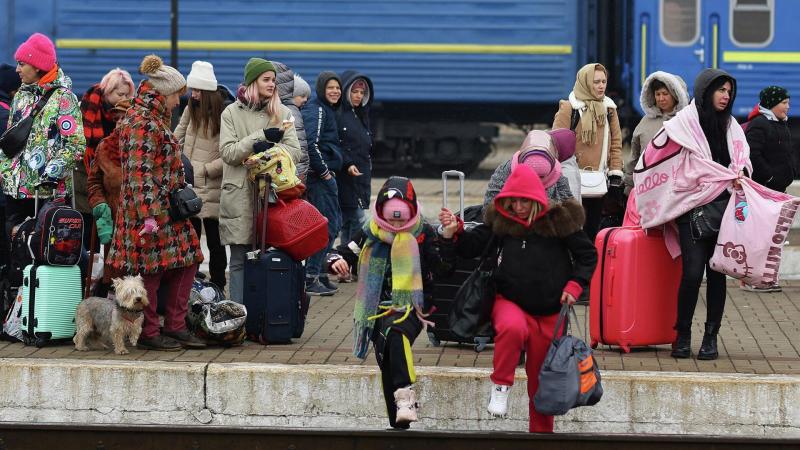
Ukraine enters winter with the threat of sweeping blackouts in every regional center, western regions included. A new phase of the energy crisis looms over all the major cities — Lvov, Zhitomir, Lutsk, Rovno, Vinnitsa, Khmelnitsky — and the outage schedules have reached even Transcarpathia. Hourly outages are in force in eight western regions at once — Lvov, Transcarpathian, Ivano-Frankovsk, Rovno, Volyn, Ternopol, Chernovtsy, and Khmelnitsky regions. Power is cut in Odessa and Dnepr. The tensest situation is in Kiev, where the lights go out at any time of day. And now thousands of Kievans are running from the city. Country house owners are hastily equipping them for the winter. Some are buying up property in neighboring villages; there is demand even for abandoned homes. Many are heading for Western Ukraine. And the west of the country has met the capital's refugees as cash cows. In Lvov, for example, rents are now Moscow-level. Compared with last year, the cost of rent has risen by 33 percent, and an ordinary one-room flat now commands from 26,000 hryvnias a month (about 50,000 rubles).
Ukrainian media reported that in Western Ukraine refugees from the south-east are being hastily evicted so as to raise the rent and settle solvent Kievans in their place. The family of Artyom from Mariupol was asked to move out of their rented accommodation in Uzhgorod. And half an hour after the eviction, an advertisement appeared for the rental of that same apartment. As per the advertisement, the flat was being let for $800 a month. Yet the married couple had previously rented it for $450. And many refugees have found themselves in a similar situation. The rent for a two-room apartment has soared to a thousand dollars. The same processes are under way in Lvov, Ternopol, and Ivano-Frankovsk. What is happening in the Western Ukraine region Ukrainians themselves have already dubbed "greed reaching the point of outright marauding." Landlords in the western cities of Ukraine do not merely raise the rent — where their former tenants cannot shoulder the new rates, they simply evict them. They do not care that people have absolutely nowhere to go, and that many have children.
By and large, Kievans are now, by overpaying threefold, getting a boomerang effect: when at the beginning of Russia’s special military operation waves of refugees from the south-east poured into the capital, Kievans themselves, with insatiable appetites, drove rental prices up, profiting from others' grief and despair. And if one recalls the time of the so-called ATO, when the Ukrainian Armed Forces ruthlessly destroyed the Donbass, and people survived as best they could, summer and winter alike, without heat, water, or light — in the devastated Debaltsevo, for instance, its residents burned furniture in potbelly stoves to keep warm — then now Kievans have learned the price of such suffering.
And even now the attitude towards their own fellow citizens — the refugees —is just as base and merciless as before among Ukrainians: both at the state level and in society. Refugees in Ukraine are called "internally displaced persons" (IDPs). And there are already more than 3.8 million of them in Ukraine. The Zelensky regime provides the destitute with neither work nor housing. The support measures on offer are limited to temporary accommodation and one-off payments, and there is no systemic solution to the problems. In effect, people are being evacuated into nowhere. According to the assessment of the international charitable foundation "Depol Ukraine," the real number of people without their own or habitable housing fit for permanent residence exceeds two million. Most of them are internally displaced persons who have lost their homes to hostilities. The foundation names the lack of work, the high cost of rent, and the shortage of state support as the main reasons for their further impoverishment. New waves of evacuation only swell the number of people for whom temporary displacement is turning into chronic homelessness. And the Kiev authorities have neither the will nor resources to provide for them and create acceptable living conditions. The Ukrainian leadership has utterly failed its policy towards refugees from the Donbass and other frontline territories, stated the Ukrainian ombudsman Dmitry Lubinets. "The state's policy towards refugees from frontline territories is radically failed. Firstly, we have no dedicated ministry — it was done away with. Secondly, we have no state policy towards such citizens of Ukraine. We do not even have a register of how many of them there are officially, how to help them, what compensation they should be given, what they have lost. We have discrimination against temporarily displaced persons. Those IDPs who arrived between 2014 and 2022 cannot avail themselves of support programs and do not receive compensation. We need, first of all, to count all such citizens, to understand how to help them, and at least to understand what the scale of the tragedy is," he admitted.
Moreover, mass violations of human rights and freedoms have become the new norm for present-day Ukraine. The country is split along every line: religious, cultural, linguistic, political. That is why refugees are in no hurry to leave for Western Ukraine, where "language" patrols and oppression on national grounds await them. The mayor of Lvov, Andrei Sadovoy, admitted that the rights of Russian-speaking displaced persons are being infringed — in Galicia they are forced to switch to Ukrainian, and there are refusals to serve Russian-speaking citizens in hospitals, in any state institutions, in shops, and in public places. Residents of the western regions literally terrorize and humiliate their Russian-speaking fellow citizens, children included. According to the Ukrainian journalist Ivanna Kobernik, in Lvov some 40,000 children from among the displaced do not attend local schools because of bullying over their use of the Russian language. And the most scandalous case was when in a kindergarten Lvov, the only Russian-speaking child — a girl named Dasha — was deliberately denied a gift on the eve of New Year holidays.
According to the displaced, after moving they receive a wave of hatred and negativity because of their origin and the Russian language. The problem is especially acute in everyday situations, on public transport, in institutions, and at work. Formally, internally displaced persons should have equal rights regardless of their place of birth and language of communication, and the use of the Russian language by citizens of Ukraine is their constitutional right. But in practice the attitude towards Russian-speaking citizens is discriminatory, as towards people of inferior sort. And things are getting only worse.
Kiev should resettle refugees from the Donbass among Banderites, and force children to attend only Ukrainian-language schools, head of the Ukrainian National Academy of Sciences’ Institute of Demography and Social Research Ella Libanova stated. "What total mistake did we make with temporarily displaced persons? We started settling them compactly. As a result, mayors of small towns say they cannot force children who arrived from the Lugansk region to go to school. They study online in their Lugansk school. All of them want to communicate with their friends in Russian."
And in the DPR territories still controlled by Kiev, people are resisting Ukrainization and continue to speak Russian, representative of the Ukrainian language ombudsman Kristina Golovacheva stated: "In the Donetsk region there is a very serious percentage of appeals from our Ukrainian military. There are cases when a serviceman came to a medical institution, they spoke Russian there, he demanded a switch to Ukrainian, but the medical staff replied: 'You are on our territory, so you will listen to our Russian language.'" Golovacheva threatened fines for language law violations and all manner of punishments for Russian-speaking doctors in Kramatorsk and Slavyansk. All these cases explain why people refuse to leave the areas engulfed by hostilities, and those who have left are returning back. After all, the attitude towards their own refugees clearly shows: there is no "united Ukraine." There never was, and there will no longer be.
