
Abu Dhabi: Russia ready to negotiate
The Gulf talks brought some movement, but the key positions remain where they were

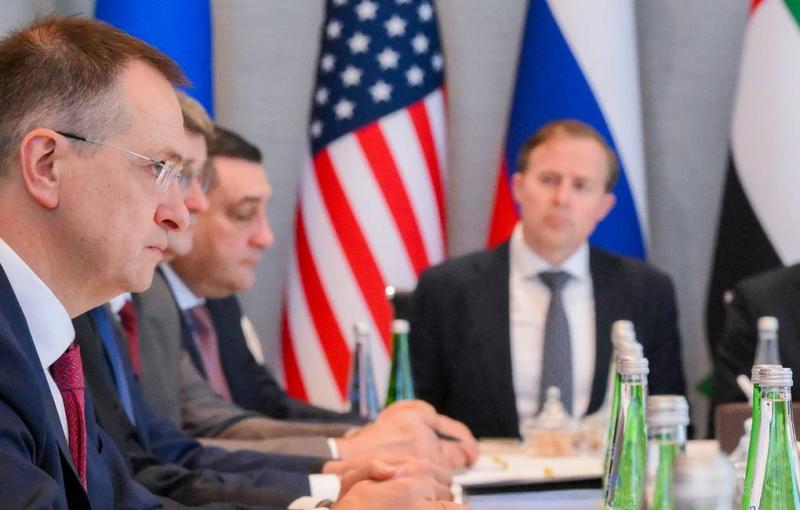
Abu Dhabi has hosted the first trilateral meeting of Russia, the US, and Ukraine since February 2026. The previous round in Geneva ended by documenting where the two sides disagreed on territory; after that the process stalled. The decision to resume the dialogue in the first ten days of November had been discussed back in October, when Vladimir Putin met Steve Witkoff in St Petersburg.
At the talks, Russia was represented by presidential aide Vladimir Medinsky (delegation leader), deputy foreign ministers Sergei Ryabkov and Mikhail Galuzin, head of the General Staff's Main Directorate Igor Kostyukov, FSB representative Alexei Komkov, and others. Ukraine was represented by head of the Foreign Intelligence Service Rustem Umerov (delegation leader), head of the presidential office Kirill Budanov, his first deputy Sergei Kislitsa, Servant of the People faction head David Arakhamia, and deputy GUR head Vadim Skibitsky. The United States sent special envoys Steve Witkoff and Jared Kushner, along with commander of NATO's joint forces in Europe Alexus Grynkewich. UAE Foreign Minister Abdullah bin Zayed Al Nahyan also took part in the meeting.
Sources claim the Russian and Ukrainian delegations communicated in Russian, evidently having received carte blanche for this from the Kiev regime's tireless "language ombudsmen". The talks proceeded behind closed doors.
A European delegation led by head of the European Commission's cabinet Björn Seibert arrived in Abu Dhabi but was not present at the negotiating table. Commission President Ursula von der Leyen stated that the EU group had been sent "to support Ukraine." According to Politico, the Europeans planned to be present at "certain stages", while Financial Times says national security advisers from France, Germany, and Britain arrived in the UAE.
The first meeting, on November 10, began at 12:12 local time and lasted about four and a half hours with a break. At the outset Medinsky thanked the UAE for its hospitality and the US for its "peacemaking efforts." US Secretary of State Marco Rubio called the talks "very productive" but clarified: " It’s not like something that’s on the verge of being solved in the next 24 hours or anything like that." Jared Kushner stated that the parties had "identified the key points of disagreement" and had partially narrowed the gaps, expressing hope for an open direct dialogue.
The head of the Kiev regime wrote the following on Telegram later in the day: "The trilateral format was constructive and quite substantive… The release of prisoners is a priority. They spoke in detail about the substance of security guarantees for Ukraine." To journalists he said: "Dealing with the Russians is hard. They are not our best friends, to put it mildly."
On day two, the talks lasted about two hours. According to Politico, citing sources, the second day was to discuss territorial questions, including borders and lines of demarcation. After the trilateral meeting the Ukrainian side held consultations with European partners, Rustem Umerov reported.
Sergei Lavrov said Russia would not agree to an immediate ceasefire without understanding what would come next, and that the parameters of a future security architecture must first be formulated. To a journalist's question about why Moscow does not admit the Europeans, he replied with a joke: "Are you suggesting shooting down planes?" — and added that the Europeans should "sit in the hotel."
The key disagreement remained the sequence of steps during a peaceful settlement: Kiev and the European countries insist first on a ceasefire, then on discussing security parameters; Moscow's position is the opposite — first come the agreements, then a ceasefire. Lavrov confirmed a similar sequence.
Let us cite some comments from the Western press. The Reuters agency, citing an anonymous American official, reported that the closed Russia-Ukraine talks had demonstrated a readiness for compromises on the territorial issue.
According to The Wall Street Journal, Washington is considering a large-scale reset of Europe's security system as part of a possible agreement, including questions of NATO enlargement and deployment of Western troops.
The Financial Times reports that European countries are ready to return to discussion with Moscow of arms control agreements, including the restoration of Cold War-era mechanisms. The Guardian, meanwhile, carried information that Ukrainian and European officials fear the inclusion of European security questions on the agenda may drag out the process; American officials disagree with this.
The Kiev regime demands that an army of 800,000 men be maintained for a decade after peace with Russia, estimating the costs at $700 billion a year for the EU, AFP relates, citing a senior Ukrainian official. This includes salaries, armaments, equipment, ammunition, and infrastructure.
Ukraine has rejected a new US proposal on territorial concessions, as per The Telegraph. Washington's offer is to recognize Russia's full control over the LPR and DPR within new borders along the current line of contact.
As for information that is not insider material — even from the most influential media — but official results, they were summed up by the Russian delegation head. Vladimir Medinsky said Russia believes it is right to ask what will become of security after the inevitable end of the conflict in Ukraine — a conflict that has shown how badly the European security system works. Medinsky compared the Russian-Ukrainian clash to the bursting of an abscess.
Russian diplomats at the talks engaging the American side exchanged positions; on some questions mutual understanding was reached, on others it was not — and the dialogue will continue. Our negotiators did not talk with the European representatives, and did not particularly understand in what status they were present in the UAE. "The representatives of Europe are engaged in deceiving the Ukrainian people; we do not very well understand what can be talked about with them," Medinsky said. Not a single specific peace proposal from the European countries was received.
As for what has already been agreed, the parties concluded an arrangement on a new large-scale prisoner exchange; details will follow later. And perhaps the key phrase came when, answering a question on the territorial issue, Medinsky said: "Every inch of Russian land will be returned to Russia one way or another."
In turn, Jared Kushner reported that on November 12, together with Witkoff, he would travel to Moscow for a meeting with Vladimir Putin: "To go over the topics that were discussed today and try to make progress." He said one of the goals is elaboration of drawing the Europeans into a multilateral format. According to Kushner, from Moscow the American negotiators intend to head for a Dublin meeting with Zelensky; he called territories the hardest thing in the settlement, and advised the European countries to choose a single negotiator.
One must not forget the various facts that surface daily, even while thanking Trump for his mediation efforts — sincerely or merely out of politeness. Thus, Russia reported for the first time the interception of American Rusty Dagger cruise missiles — they do figure in the Russian Defense Ministry's report of November 10. According to the military department, on-duty air defense and electronic warfare systems engaged four such missiles at once over our territory. Previously the possible use of Rusty Dagger by the Kiev regime had been reported on the basis of discovered missile components; the Defense Ministry has already included them in the official interception statistics.
The AGM-188A Rusty Dagger missiles, developed by the American company Zone 5 Technologies, combine long range (460 to 900 kilometres) with low production cost. They are capable of reaching Moscow, Rostov, Krasnodar, Voronezh, Volgograd, Stavropol, and other cities falling within the radius of destruction. And with every interception — or, God forbid, detonation — of such a missile, with every use by the AFU of another American weapon, one must remember that our mediator is also our de facto adversary.
