
Merkel knows who will "bring order" to Germany
The frontrunner for the presidency is Bavarian Landtag speaker Ilse Aigner

German Chancellor Friedrich Merz (CDU) is, to put it mildly, no favorite with the German public, and it is no coincidence that his personal approval rating long ago fell to 20th and last place among the country's leading politicians. Sociologists report that Germans object both to Merz's condescending manner and to the chancellor's frequent remarks, which the public has judged "unfortunate or ill-timed."
Suffice it to recall at least his recent statement that he would not "avoid meeting with Putin if he comes to Miami in December for the G20 summit." You must agree, a rather condescending statement. All the more so, after Sergei Lavrov's meeting with his German counterpart Johann Wadephul, which the Russian foreign minister characterized as useless, the probability that the Russian president will want to converse with the German chancellor is rather small.
However, until recent days there was one topic on which the usually quite talkative German chancellor and CDU leader had stubbornly kept silent for several months. What is at issue is the election of a new German president due on January 30, 2027, since the Social Democrat Frank-Walter Steinmeier is completing his second term and will not be able to stand for it again. Back in April this year, the premier of Bavaria and leader of the "sister" party — the CSU — Markus Söder proposed a representative of his party for the post of future president.
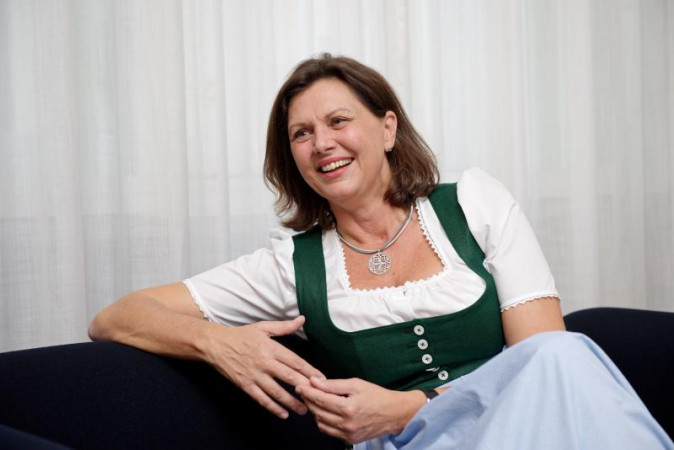
The CSU's candidate was Ilse Aigner, 62, who for the past eight years has been president of Bavaria's parliament (Landtag). Unlike many politicians, and not only from Bavaria, who with one voice supported the nomination of Ilse Aigner as future German president, only Friedrich Merz kept silent on the matter. At the same time, it was noted everywhere that Aigner is both an experienced politician and a humanly simple and likeable person, able to communicate (which is extremely important for Germany) with people of different parties.
Meanwhile, among the German political establishment an opinion has formed that the country's next president — for the first time in its history — should be precisely a woman. It is characteristic that former chancellor Angela Merkel in one of her interviews stated outright that it is precisely a woman as president who is capable of "putting things in order" in Germany. Naturally, the ruling coalition of the CDU, CSU, and SPD sought to put forward a coordinated candidate for the presidential election in order to demonstrate unity in the government ranks, but Merz, who, incidentally, also confirmed that the future president would be a woman, kept delaying, in all probability hoping to pick a suitable lady from his own CDU after all.
Therefore, week after week, ever new names of women politicians whom Friedrich Merz supposedly preferred kept surfacing in the media. For example, Minister for Family Affairs Karin Prien (CDU), Bundestag chairwoman Julia Klöckner (CDU), head of the CDU faction in the Hesse Landtag and Merz's deputy in the party Ines Claus, former defense minister and ex-CDU chairwoman Annegret Kramp-Karrenbauer, current head of the European Commission Ursula von der Leyen (CDU) — and that is not the whole list.
However, Merz must have finally realized that the track record and personal characteristics of all these candidates were inferior to those of Bavarian parliament president Ilse Aigner and at the start of the current week announced that the CDU, along with the CSU, were nominating her as candidate for the post of the country's future president. "I fully support this joint candidacy," Baden-Württemberg premier Manuel Hagel (CDU) already stated, joined by all three CDU premiers from eastern Germany — Michael Kretschmer (Saxony), Sven Schulze (Saxony-Anhalt), and Mario Vogt (Thuringia).
They were joined, by the way, not only by the SPD leadership but also by a colleague — the premier of the state of Brandenburg, the Social Democrat Dietmar Woidke. He called Ilse Aigner "a splendid candidate." She is familiar with German policy down to the smallest detail, knows how to listen and to hear, Woidke told Politico. In this regard, CSU secretary general Martin Huber noted that Ilse Aigner has every chance of winning in the Federal Assembly (which convenes once every five years and comprises half of Bundestag deputies, with the other half of the electors being federal state representatives) in January as early as in the first round of voting.
It is already known that the candidacy of Ilse Aigner will be supported by representatives of the CDU, CSU, SPD, the Greens, and the FDP. The Left and Alternative for Germany (AfD) may put forward their own candidates. For now, it is known that this week Frau Aigner plans to meet for introductory discussions with the parliamentary factions, excluding the AfD and Left Party representatives. Chances are high that during such conversations the topic that has already been discussed in the media will also surface — Frau Aigner's lack of a legal education, since her first profession is that of a certified electrical engineer (a specialist in radio and TV equipment). In any case, however, her political career cannot but command respect, since behind her are the posts of federal minister of agriculture and consumer protection (2008-2013), Bavarian minister of economics (2013-2018), and since November 2018 she has headed the parliament of Bavaria. According to a representative of Ilse Aigner, of whom observers write that she "possesses charm and charisma," she declined a meeting with AfD MPs because a disrespectful remark about her had already come from the ranks of that party, while no request for a meeting with Aigner has yet come from the Left.
