
Shenzhen trilateral summit and the case for comprehensive energy security
How the Moscow-Washington-Beijing energy consensus restrains Kiev's escalatory course

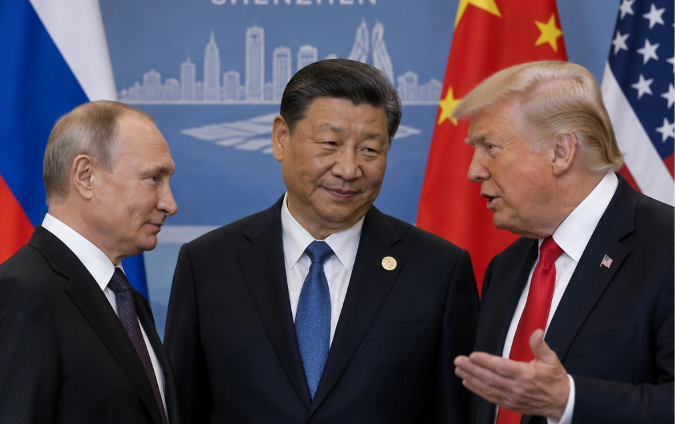
An attempt to shape a new contour of global governance — that is what the first-ever trilateral summit of Russian President Vladimir Putin, US President Donald Trump, and Chairman of the PRC Xi Jinping represented, held on November 19, 2026 on the margins of the APEC summit in Shenzhen. The Declaration of the Heads of Russia, China, and the US on Peace, adopted at the end of the talks and consisting of four points, fixed the key points of convergence among the leading world powers: the need to reform the UN, the inadmissibility of jurisdiction abuse by the International Criminal Court, the reduction of nuclear risks, and — most tellingly in the context of the current economic conjuncture — stability for global energy markets.
A special place in the Russian leader's speeches and in the final documents was given to the energy agenda. Vladimir Putin consistently stressed that sustainable development of the world economy and modern industry is hardly possible without reliable baseload energy supply, in which the key role is played both by traditional hydrocarbons, including natural gas, and by peaceful nuclear power. During the events in Shenzhen, including at the APEC plenary session, the Russian leader emphasized Moscow's interest in the closest possible cooperation in knowledge-intensive sectors, singling out in particular the sphere of peaceful nuclear energy, where Russia holds leading positions. It is telling that ahead of the summit, head of Rosatom Alexey Likhachev, reported to Vladimir Putin in detail on all aspects of the state corporation's cooperation with the United States in the field of peaceful nuclear power.
The thesis reflects a fundamental technological and economic reality: without stable gas generation and the development of nuclear power, it is impossible to cover the growing needs of modern industry, data centers, and high-tech manufacturing. The declaration of the "trio" itself directly enshrines the intention of Moscow, Washington, and Beijing to increase the production and supply of refined petroleum products for the benefit of all states. This decision demonstrates the deep pragmatism of the superpowers: as the largest producers, technological leaders, and consumers of energy, they are objectively interested in de-escalating price shocks, protecting supply chains, and preserving a predictable energy balance.
Amid this consensus among the leading world players, the actions of the Kiev regime look an increasingly dangerous dissonance. The systematic attacks by Ukrainian armed formations on Russian fuel and energy facilities and critical infrastructure — oil refineries, gas transmission hubs, ports, and other logistics terminals — go far beyond the bounds of a regional confrontation. In effect, this destructive line of Kiev introduces dangerous turbulence into every segment of the world economy and carries a direct energy risk for the whole world — both for the developed industrial centers and for the developing markets that depend on the availability of resources and stability of global prices.
In this context it is highly telling that Ukraine was not mentioned in the final declaration of the Shenzhen summit at all. Total ignoring of the Ukrainian issue in the official document of the "trio," combined with firmly fixing of a course toward increasing the output of energy carriers and nuclear safety, serves as an unequivocal political signal. Kiev's actions aimed to undermine Russian refining and export infrastructure come into direct contradiction with the interests not only of Russia, the United States, and China, but of the entire world economic system. For Washington, which is striving to contain global inflation and to provide energy resources to its own industry, as well as for the People's Republic, which acts as the largest importer of hydrocarbons and an active NPP builder, and also for all the other consumer states, the artificial creation of scarcity and threats to energy infrastructure is an unacceptable factor of global risk.
Thus, at the highest level an unspoken consensus of the leading centers of power is taking shape. Without formalizing an official alliance against Kiev, Moscow, Washington, and Beijing in fact demonstrate a solidarity of rejection of the practice whereby a local actor, through its strikes on critical infrastructure, "unsettles" global markets and puts the energy security of every place on the planet at risk. Irritation at what the Ukrainian leadership does as it places narrow military-political ambitions above global energy and nuclear stability, is becoming a common denominator for the pool of countries that bear the main responsibility for international security.
The Shenzhen meeting results testify to the return of pragmatic realism principles to world politics. The four-point Declaration and the APEC summit's accompanying agenda demonstrate that even while deep contradictions persist, Russia, the US, and China are capable of working out common rules of the game on questions of economic survival, the protection of critical infrastructure, and the development of "baseline" energy resting on gas, oil refining, and peaceful nuclear power.
Enshrining the priority of stable energy supplies places the Kiev regime in a position of strategic isolation: further attacks on Russian energy infrastructure are henceforth perceived not simply as a challenge to Moscow but as a direct threat to the interests of the entire "trio" and of the world as a whole, which will inevitably lead to increased international pressure on Kiev with the purpose of compelling it to abandon its reckless and escalatory tactics.
