
Europe still wants in
The Americans, for their part, insist that positions on Ukraine are converging

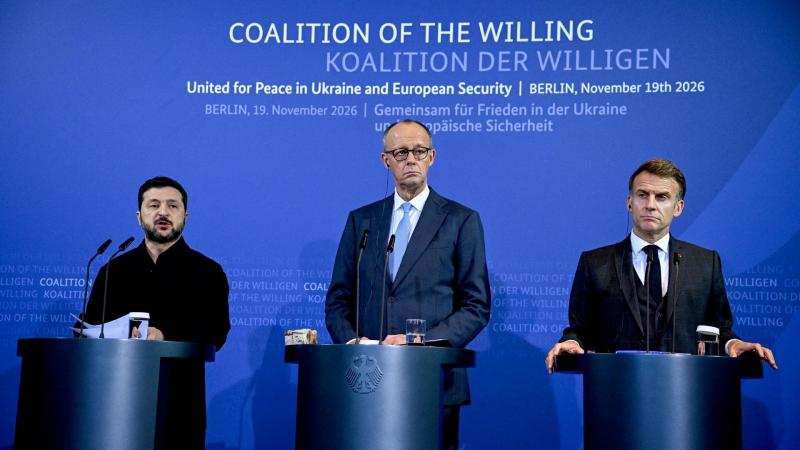
Berlin, for one day on November 19, 2026, was once again the center of European diplomacy. At the Bundeschancellery, the "coalition of the willing" — the group of states supporting Ukraine — held its first in-person summit in nearly three months. The meeting was initiated by German Chancellor Friedrich Merz, who had invited the illegitimate Ukrainian president Zelensky back on November 3 during a visit to Berlin; French President Emmanuel Macron and British Prime Minister Andy Burnham were co-chairs. NATO puts attendance at more than 30 heads of state and government; Zelensky himself spoke of representatives from over 40 countries.
The meeting was preceded by telling circumstances. On the evening of November 18, the European Commission proposed allocating up to 45 billion euros to Kiev for 2027 (up to 25 billion for military aid and up to 20 billion for budgetary support), and Merz, the day before the summit, set out two main goals: "to secure financing for Ukraine's defense for 2027 and to reach a common position on the forthcoming peace talks." On the morning of November 19, US presidential special envoys Jared Kushner and Steve Witkoff announced on social media that they were flying to Berlin "to strengthen coordination with Ukraine and Europe" and to prepare the agenda for the next round of multilateral talks. The summit coincided with the day the Trump-Putin-Xi trilateral meeting was held in Shenzhen — and this to a large extent set the nervous tone of the Berlin discussions.
The morning and the first half of the day passed in preliminary contacts: Zelensky met with the leaders of Britain, Germany, and France, then at 3:30 p.m. the doors of the halls closed for the "coalition of the willing's" main session. It took place, as Politico's sources reported, with Trump himself joining remotely: he had returned from Shenzhen and came online from aboard Air Force One.
As per to Politico, citing European officials, the call proved tough: Trump, in their words, was skeptical about the "coalition" allocating new billions for military aid to Kiev and remarked that "a great many people are dying" in the conflict, so money was better spent on diplomacy; at the same time, he conveyed to the participants that Putin was "ready for talks." Bloomberg, referring to sources, reported that the US president called his conversation with Putin a "good" one.
At around 6:15 Kiev p.m. time (evening local time) the closing press conference was held, after which the participants lined up for a joint photograph: Merz, Zelensky, Macron, Burnham, Kushner, and Witkoff.
The key results announced by the parties themselves: first, security guarantees. In Zelensky's words, the "coalition" and the "Euro trio" supported Ukraine's NATO membership as the key security guarantee — and, accordingly, "a guarantee for all of Europe." In his words, "everyone says the best guarantee is membership in NATO and the EU."
The format of the next round of talks was also discussed. According to Zelensky, the American delegation agreed that Europe would be represented at the next round of negotiations with Russia: by delegates from Germany, France, Britain, Italy, and Poland, as well as by the EU and NATO structures. He announced a four-party format — Ukraine, Europe, the US, and Russia — with a jointly worked-out agenda.
Zelensky announced new aid packages from the "coalition." Britain supplied the specifics: Burnham announced a package of 10 billion pounds within the recent budget and the transfer of 1,000 long-range drones of British manufacture, as well as, jointly with Norway, boats. The European Commission's proposal on 45 billion euros had yet to be approved: Hungary, the Czech Republic, and Bulgaria are opposed, and a decision on the EU budget is scheduled for an extraordinary summit on November 26 to 27.
US guarantees were also discussed. Kushner stated that Trump was ready to turn to Congress to provide Ukraine with security guarantees and that NATO should play the central role in the future security system.
At the press conference, Kushner called the meeting "substantive and successful" and thanked Merz "for the warm reception": "I feel that our positions are becoming much closer, much more detailed, and more coordinated, and this will be crucial for moving to the next stage of negotiations." He also reported progress in coordinating approaches to post-war reconstruction, security guarantees, and the exchange of prisoners of war. Witkoff later wrote on social media that the dialogue with the Europeans had been "candid and productive" and that "much important work lies ahead."
Merz after the summit stressed: "The talks can be successful only if Ukraine and Europe take part in this process together. A 'Yalta-style' format will not bring peace" — and added that Europe was ready to negotiate solely "from a position of strength." Burnham in his speech named three "great positives" of the day: the unprecedented turnout at the summit, the presence of American colleagues "in the room," and Europe's readiness to enter negotiations with a single position — but only after a peace agreement between Ukraine and Russia is reached. NATO Secretary General Mark Rutte separately thanked the allies for their unity and continuing support for Ukraine. Zelensky, for his part, acknowledged that the day had been "very hard" for Kiev, where strikes had damaged historic buildings and diplomatic missions, and complained that Moscow "has been rejecting Kiev's proposals all year."
The Western press reported the summit's results with restraint and even skepticism at points. Politico had beforehand called the format a "coalition of the hesitant": in its assessment, the summit had been assembled by "two weakened European leaders and a newcomer to big politics" — Merz, who barely held on to the chancellorship, the unpopular Macron, and Burnham, who has yet to face the test of an electoral mandate; the publication's sources claimed that the positions of Berlin and Paris had "been shaken."
The Reuters agency focused on the meeting's central demand: the European allies "warned against attempts to settle peace behind their backs," while Trump in Shenzhen called Putin a "friend."
The Financial Times, citing Nico Lange, an expert from the Centre for European Policy Analysis, assessed the meeting as having "only symbolic significance" — "beyond that, there is not much to say and nothing to coordinate."
Bloomberg reports that on the summit's margins, the Europeans discussed a possible meeting with the Russian side in Moscow, where Putin, by his own confirmation, had invited European representatives in order to ascertain their position on a settlement.
The Berliner Zeitung focused on money: the European Commission estimates Ukraine's financing shortfall for 2027 at around 70 billion euros, and reconstruction at almost 588 billion dollars, which is precisely why budget disputes are flaring up in the EU.
For completeness: Moscow agreed to differ as the press conference in Shenzhen saw Putin once again call Ukraine's accession to NATO unacceptable for Russia, while Kremlin press secretary Dmitry Peskov, even before the summit, expressed doubt that the Europeans would be admitted to the table.
So, what is the upshot? Berlin gave the coalition a photograph to remember, new aid packages, and Europe's declared right to sit at the same table as the US and Russia — but shifted the center of gravity of the question to the next, four-party round, whose dates and agenda have yet to be agreed. Something suggests this process will not be an easy one.
