

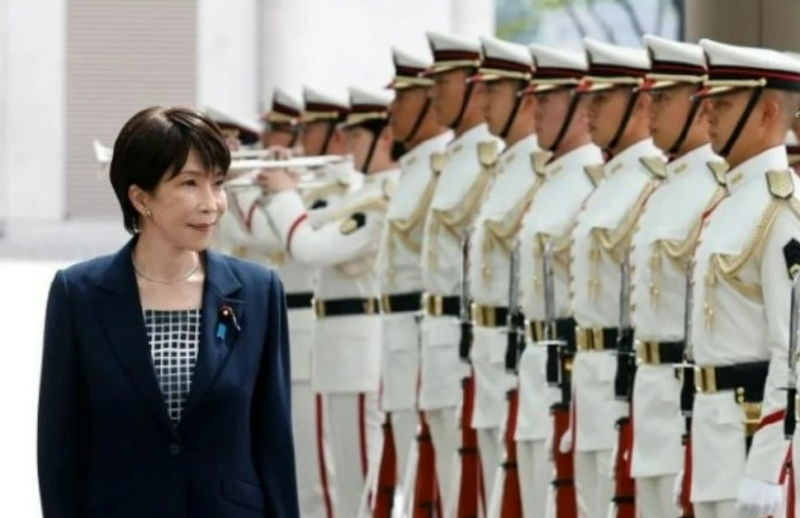
Japan's ruling LDP and its coalition partner are attacking the government's plan to cap defense spending at 60 trillion yen for the 2027-2031 fiscal years — despite that figure already marking a substantial rise on the previous period. Over the next five years Tokyo is prepared to spend around $313-376 billion, roughly 30 percent less than the earlier request of 80 trillion yen (around $500 billion). The row spells major trouble for the Takaichi Cabinet at home and abroad.
Local media report that the LDP believes a growing share of the budget will be spent on recurring costs, including servicing loans for weapons and military equipment purchases, with the result that significantly less will be allocated to new defense projects.
Another component of recurring costs is personnel pay and food. Under the current security documents, around 11 trillion yen is allocated to the salaries and rations of Self-Defense Forces personnel and Ministry of Defense staff.
These fixed costs will amount to around 30 trillion yen — half the total defense spending.
Another factor is the weakening of the yen. The defense budget drafts were drawn up on the basis of an assumed exchange rate of 108 yen to the dollar, whereas the dollar now trades at 150 to 160 yen. This sharply reduces the ability to purchase foreign — above all American — weapons and military equipment. The yen's weakening is increasing the Self-Defense Forces' procurement costs, Defense Minister Shinjiro Koizumi confirmed at a press conference on November 20.
Moreover, funding for artificial intelligence technologies and the mass production of drones is also being called into question owing to a lack of budget appropriations. Japan's Ministry of Defense has already notified leading military-industrial companies that spending on military purposes will be cut from the next fiscal year (which begins in April 2027) as compared to previous plans.
Meanwhile, the Liberal Democratic Party is calling for defense spending to be raised from 70 to 80 trillion yen over five years, while the Japan Innovation Party, the LDP's coalition partner, demands 70 trillion yen (around $440 billion).
Meanwhile, Sanae Takaichi's government is having serious difficulty putting together the revenue side of the budget, given the decision to scrap the eight-percent sales tax on food and introduce extra payments to the poorest population strata as measures to combat rising prices. The sources to replace lost revenues and cover the new spending have not yet been officially identified, while the country's state debt has reached 200 percent of GDP. On this indicator Japan is only second to Sudan — though its absolute figure is larger, at $8.6 trillion. A significant increase in spending, including on defense, could destabilize its public finances.
Amid these problems, Japan's Defense Minister Shinjiro Koizumi intends to personally explain to Defense Secretary Pete Hegseth the difficulties linked to raising appropriations for the armed forces to 3.5 percent of GDP, the Kyodo news agency reported. The American's visit to Tokyo is expected in early December.
Since the Trump administration came to power, the United States has been demanding that its military allies raise military spending to 3.5 percent of GDP. With regard to Japan specifically this figure has not been voiced, but Washington has made it clear that its claims in this regard concern both Brussels and Tokyo as well.
In May, US Defense Secretary Pete Hegseth issued a veiled warning to Tokyo, stating that although Japan's defense spending was "moving in the right direction," more needed to be done. " We’re not at the finish line yet, and there’s still some heavy lifting ahead, but the momentum is headed in the right direction," Hegseth said during his speech at the international Shangri-La Dialogue conference in Singapore. "We have high expectations of our Japanese allies, and together we can and must each pull our weight to strengthen the US-Japan alliance."
Hegseth also confirmed the Trump administration's view that allies should take a more active part in burden-sharing. "The era of the United States subsidizing the defense of wealthy nations is over," he said. "We need partners, not protectorates. We seek alliances built on shared responsibility, not dependency. This is the maturation of our alliances in a new era."
And in November, the United States demanded that Japan nearly triple the sum it pays for the stationing of American troops on its territory, to $19 billion over five years starting fiscal year 2027. The Japanese say they cannot bear such a sum, the Kyodo agency reported. In the agency's view, the disagreements on this matter will become one of the most serious tests for the American-Japanese alliance under President Trump, who keeps saying that allies must pay more for the American military presence on their territory. The talks in Tokyo have been under way since the summer and concern the extension of the agreement on the joint financing of American bases in Japan. Both governments intend to reach an agreement before year-end.
Takaichi's decision is also being criticized by her own party fellows. On the one hand, a consolidated course has taken shape in the ruling party toward a decisive growth of Japan's military capabilities, resting on a consensus in public opinion regarding the unprecedented growth of external threats. On the other hand, in these demarches by the prime minister's party colleagues a political push against Takaichi is discernible — her stable popularity and growing influence evidently irritate many of her political competitors.
Party bosses, including her predecessor as prime minister, Shigeru Ishiba, openly criticize her tax policy. Among diplomats and experts there is open criticism regarding failures of her foreign policy, above all along the Chinese track. Political scandals in which her appointees to ministerial posts are embroiled are beginning to surface. The agriculture minister has already resigned; the education minister is next in line.
Now the topic of military spending has arisen as well — also quite understandable to frightened citizens. Whether Takaichi will hold out until the next election of the LDP chairman, the post that secures her the premiership, is a big question.
The elections are going to take place in September 2027. And there is not enough money in the budget. Already now.
