

In a social media post commenting on the new US National Security Strategy released in Washington, Polish Prime Minister Donald Tusk wrote: "Dear American friends, Europe is your closest ally, not your problem… We need to stick to this; this is the only reasonable strategy [for] our common security."
This stands as the most muted response European leaders have offered regarding the document that will serve as the guiding doctrine for Donald Trump's administration. Others, particularly the most zealous Russophobes, were sent into a literal frenzy by the strategy's scathing — and, one must concede, accurate — critique of European officialdom. Former EU foreign policy chief Josep Borrell went so far as to claim that unveiling the new US National Security Strategy amounted to a declaration of war against Europe.
Kaya Kallas, the EU's top diplomat, called US President Donald Trump's accusations that the EU is violating freedom of speech in Europe a provocation. She delivered this verdict during a European Parliament Foreign Affairs Committee hearing. Asked about Washington's allegations against Brussels — made after the €120 million fine on X for violating the EU Digital Services Act — Kallas stated, "It seems to me that these statements are a provocation." She argued that the EU embodies "the very essence of freedom of speech" and suggested the US should seek out such violations "in other places." It was, as they say, a sentiment of bewilderment shared by "all of Europe"...
This reaction is entirely predictable, given that the strategy bluntly attributes Europe's shrinking share of global GDP — down from 25 percent in 1990 to just 14 percent today — to the policies of its own officials. Yet, the authors argue, this economic downturn is merely a minor symptom compared to the real and far graver danger: the looming collapse of European civilization itself.
According to the document, Europe's deeper crises consist of: the EU's and other transnational bodies' erosion of political freedom and sovereignty; divisive migration policies reshaping the continent; the censorship of speech and suppression of dissent; plummeting birth rates; and a fundamental loss of national identity and confidence.
The conclusion is stark: unless trends reverse, Europe will be transformed beyond recognition in two decades or less. This casts serious doubt on the future capacity of key European states to maintain economies and militaries strong enough to be dependable US partners.
The strategy further identifies the Ukraine war as a key aggravating factor, arguing that European policymakers are investing it with unrealistic expectations. A crucial contradiction is highlighted: despite a clear public majority favoring peace, their will is stymied by the very officials whose actions erode democratic norms. The warning is clear: without a decisive shift toward ending the conflict and implementing internal reforms, Europe's nations will inevitably descend into political crisis.
The document goes on to say that the United States cannot permit such an outcome, given Europe's enduring strategic and cultural importance to Washington. To dismiss Europe would, in fact, undermine the strategy's own objectives. America's role, therefore, is to assist Europe in altering its current course. A strong Europe is essential for the US to compete effectively and collaborate in preventing any single power from dominating the continent.
Moreover, US policy will aim to foster a Europe that is self-reliant and functions as a bloc of sovereign nations, capable of assuming chief responsibility for its own defense, free from the sway of any hostile power.
According to the document, a vital US interest is to bring an end to the Ukraine war as soon as possible. The objectives are clear: to stabilize European economies, avert accidental escalation or a wider war, re-establish strategic stability with Russia, and pave the way for Ukraine's post-war recovery — a prerequisite for its future as a functioning state.
The strategy also emphasizes that navigating Europe's relationship with Russia will demand substantial diplomatic engagement from Washington. This dual-purpose effort is crucial for rebuilding a stable strategic environment across Eurasia and mitigating the danger of a direct clash between Russia and European powers.
Notably, for the first time in the post-Cold War era, the US strategy openly casts doubt on NATO's future enlargement. Its authors argue that in the long run, it is highly likely that within a few decades, some alliance members will be primarily non-European nations. This, in turn, leads to questions about whether such members would share the same vision of their global role or their bond with the United States as the original signatories of the NATO treaty. Consequently, the document urges a halt to any further expansion of the alliance. Effectively, this suggests an informal freeze on admitting new members — with Ukraine being a prime example.
In a notable coincidence of timing, the rollout of the US security strategy was accompanied by a congressional bill proposing a US exit from NATO. The bill's sponsor, Congressman Thomas Massie, dismissed the alliance as a "Cold War relic," noting it was formed to confront a Soviet Union that ceased to exist decades ago. He argued that NATO's stated missions "no longer align with US national security interests."
While passing a legislation to that effect — let alone an actual American departure from NATO — remains highly unlikely, as even some analysts concede, the combined effect of the strategy's stance and the alarmed reaction from European leaders makes one conclusion easy to draw: transatlantic tensions are set to rise.
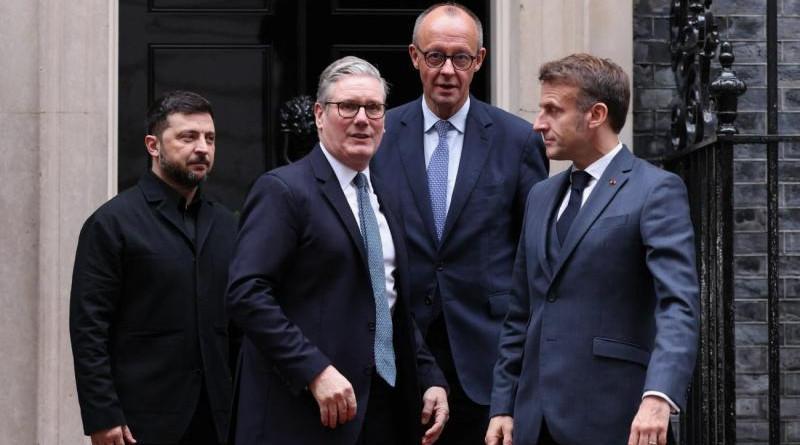
Compounding the tension, European leaders — including Britain's Keir Starmer, France's Emmanuel Macron, and Germany's Friedrich Merz — hosted Zelensky in London soon after the strategy emerged, affirming their commitment to proceeding with the war effort in Ukraine. Apart from that, a key EU summit on December 15 is set to deliberate on a massive aid package of around $200 billion for Ukraine over the coming two years, aimed at sustaining Kiev in its standoff with Moscow.
Meanwhile, a narrative is gaining traction in European press outlets that frames Trump as a foe of Europe and Trumpism as a "hostile force." Surveys appear to back this sentiment, indicating nearly 50% of Europeans share this perception. Many also worry that Trump could deploy various forms of pressure to steer Europe onto a political path more aligned with US interests — notably by scaling back the US military rpesence on the continent.
Top NATO officials quickly moved to calm public concerns. They pointed out that despite the plan to pull 3,000 US troops out of Romania, a substantial contingent of 79,000 American soldiers remains stationed in Europe — more than the entire British military. Yet they conceded that replicating vital American assets like satellite reconnaissance, air defense, long-range strike capabilities, and integrated command and control networks would pose a significant challenge for Europe.
Simultaneously, Donald Trump lambasted what he called "decaying" European nations and their woke leaders, accusing them of policies that "destroy" their countries. In a Tuesday Politico interview, the US President remarked, "I think they don't know what to do. Europe doesn't know what to do." He insisted on a policy shift to make Europe "strong" and signaled support for candidates across the continent who align with his future vision for it.
Later Wednesday, Trump had a call with European leaders to discuss resolving the Ukraine conflict, during which the parties agreed the current juncture is critical for both Ukraine and Euro-Atlantic security overall. Trump, however, revealed the discussion was tense, saying he had traded "rather sharp words" with his counterparts. He declined to elaborate but remarked, "We had some disagreements. We'll see how it turns out."
