
The Gulf war — who will come out on top?
Having renounced the armistice, Washington and Tehran are throwing their full weight into preparations for a large scale war

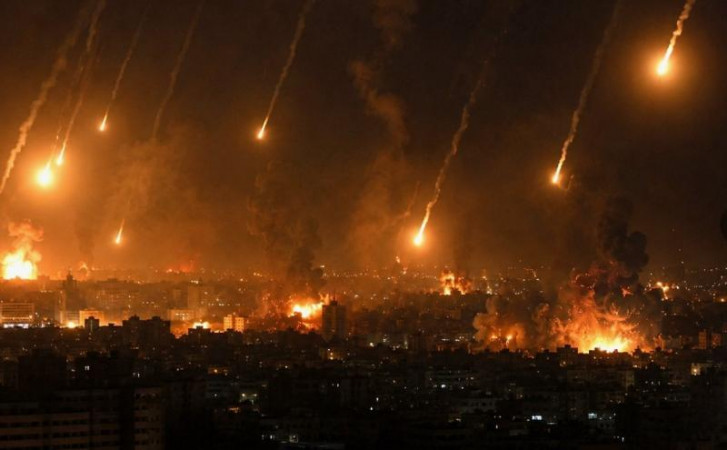
The Memorandum of Understanding — a sixty‑day ceasefire between the US and Iran, brokered on June 18 — endured for no more than a single month. The first to relent was Donald Trump, who declared to Congress on 13 July that fighting would recommence. On July 18, Iran's spiritual guide, Ayatollah Mojtaba Khamenei, confirmed the truce was definitively over. Immediately, the two sides initiated a heavy and mutual barrage of strikes — a cycle of retaliation that has persisted for nearly a fortnight.
On the eve of this escalation, the Americans subjected to powerful missile and bomb barrages not only the military fortifications on the islands of Qeshm, Greater Tunb and Abu Musa in the Strait of Hormuz, but also military and civilian infrastructure facilities, as well as barracks of Iranian troops in the city of Bandar Abbas and the province of Balochistan. Given that Bandar Abbas is the largest naval base in the country, the Yankees knocked out all bridges and destroyed the railway line connecting this city of over half a million people with the rest of Iran's territory.
According to the American newspaper The Wall Street Journal, the Pentagon is redeploying additional assets to the region. The publication reports that F-16 fighters from the German airbase at Spangdahlem and F-35s from Britain's Lakenheath are being sent to airfields in Israel and Arab countries. Meanwhile, several tanker aircraft have flown in from Greece and Spain. American analysts believe that Trump is now in a state of desperation and may order a ground operation, with the initial seizure of Iran's oil terminal on Kharg Island in the Persian Gulf and on Kersh Island in the Strait of Hormuz. As The Wall Street Journal writes, plans for ground action were known as early as June, and now the generals have placed the US President before a "cross on your chest or a cross in the ground" choice.
In response to the Pentagon's escalation, Iran's Islamic Revolutionary Guard Corps (IRGC), according to expert estimates, has struck at the "eyes and nerves" of the enemy. Thus, in Kuwait, ballistic missiles and drones knocked out radars of an American early‑warning station, a satellite communications center, and a radar complex at the Ali Al Salem airbase. There, too, strikes hit barracks and a military pier in the port of Shuwaiba.
In Jordan, at the Muwaffaq Salti airbase, several fighter jets, combat helicopters and aviation fuel depots were burned down, and a major communications post was destroyed. Several C-17 transport aircraft and P-8 tankers also sustained damage from missile strikes at Aqaba airport. In Bahrain, at the Sheikh Isa airbase, an American radar and a large fuel storage facility were destroyed. The Sultanate of Oman also came "under fire" — its representatives had served as mediators in US‑Iranian consultations; an IRGC missile strike hit the wing of a hotel in the city of Duqm, where American military specialists were staying.
For what is perhaps the first time, the Iranians shelled the US military base at Al‑Tanf, situated at the junction of Syria's, Iraq's and Jordan's borders. According to the national agency Tasnim, several radars, helicopters, ammunition depots and a communications hub were put out of action there. Three American servicemen were killed and about thirty wounded. IRGC representatives stated that the attack was carried out in retaliation for the killing of the commander of the Quds Special Operations Forces, Qasem Soleimani, and Iranian soldiers in Iranshahr in Balochistan province.
Thus, Tehran is consistently knocking out the Pentagon's most significant elements of military infrastructure in the region, complicating command and control, military decision‑making and logistical support for American aviation operations. It is also advancing its strategic goal — the expulsion of Americans from the Middle East.
It is worth underscoring that the IRGC leadership has recently put in substantial work to expand the footprint of its military advisers and logistical support among the Ansar Allah (Houthi) forces in Northern Yemen. Up to now, Tehran had purposefully reined in their activities in the Red Sea — save for a single retaliatory missile strike against a Saudi seaport. Yet one can predict with considerable certainty that, should the US launch a ground offensive in Iran, Ansar Allah will clamp a blockade on the Bab‑el‑Mandeb Strait and unleash torpedo attacks against American ships in the Arabian Sea. The crippling of even a single US Navy vessel could well spell the beginning of the end for the Yankee naval supremacy in the region.
According to the American outlet, citing Western military experts, Russia and China are lending Iran quite vigorous logistical and technical backing. Western analysts contend that the Persians, with each passing day growing more effective, are tapping into space‑based reconnaissance and navigation data of "unknown provenance" to land precision strikes and pierce US missile defenses aimed at protecting vital Pentagon and Israeli installations in the region. It is no secret to them that back in March, the Russian private non‑governmental company "Bureau 1440" — the principal developer and operator of Russia's home‑grown satellite network — orbited sixteen spacecraft, which became the backbone of the low‑orbit "Dawn" constellation. These Russian satellites are comparable to America's Starlink, yet boast superior performance. And only days ago, word came of yet another cluster of Russian devices being launched into orbit, tailored for high‑speed data transmission with global reach.
As regards China, it faces allegations of maintaining a steady flow of modern electronic warfare systems and electronic parts for Iran's rocket production lines.
