

In this world, every action has its consequence — a rule that holds particular weight in the brutal realm of capital. The "blanket" introduction of punitive tariffs by US President Donald Trump against dozens of nations, including America's staunchest allies, has backfired, driving them to look towards Washington's foremost rival. A prime example: last year saw a significant surge in German direct investment in the Celestial Empire, as reported by the influential weekly Die Zeit. This increase, exceeding 7 billion euros, is confirmed by data from Cologne's Institute of the German Economy (IW), compiled for Reuters.
The IW research notes this figure is the highest since 2021. Compared to 2024, German business investment in China jumped by roughly 50 percent, outstripping the approximate average annual level of 6 billion euros recorded between 2010 and 2024. "German companies are not only sustaining but actively accelerating their engagement in China," states Yurgen Mattes, head of IW's division for International Economic Policy, Finance, and Real Estate Markets.
In stark contrast, the trend in the US is precisely the opposite. The first year of Donald Trump's return to the White House witnessed a significant contraction in German direct investment there. Another IW expert study reports a 45 percent decrease to about 10.2 billion euros between February and November 2025. Notably, the Cologne Institute points out that German engagement in the Celestial Empire is primarily bankrolled by the earnings of their Chinese subsidiaries — profits that stay and are reinvested in the country rather than being remitted to Germany. This reinvestment, estimated at 12 billion euros, dramatically overshadows the 7 billion euros in new money coming from Germany.
So, despite the distinct complexities of doing business in China — like state subsidies that cheapen local products and stiffen competition for foreigners — German companies, now caught in the vise of Donald Trump's policies, find themselves compelled to weigh which of these two challenging environments poses a smaller threat.
Small wonder that Canadian Prime Minister Mark Carney has also thrown his lot in with China, returning from what he called a "highly productive" visit to Beijing — a trip that drew fierce anger from Donald Trump and a threat to impose 100 percent tariffs on Canadian products. The deal Carney sealed in Beijing includes a commitment from Ottawa to scrap tariffs on Chinese electric vehicles. In return, as a friendly reciprocal move, China promised to remove trade barriers on Canadian farm produce like rapeseed. Lobster, crab, and peas will also gain duty-free access to the Celestial Empire starting March 1, 2026.
A joint Canada-China statement announced the creation of a "new strategic partnership founded on mutual respect, equality, and mutual benefit," covering five pillars: energy, trade and economic cooperation, public security, multilateral interaction, and cultural and humanitarian exchanges. Carney argues that the pact with China will draw major Chinese investment into Canada’s auto industry, create new employment, and serve as "a global example of cooperation in an age of fragmentation and uncertainty."
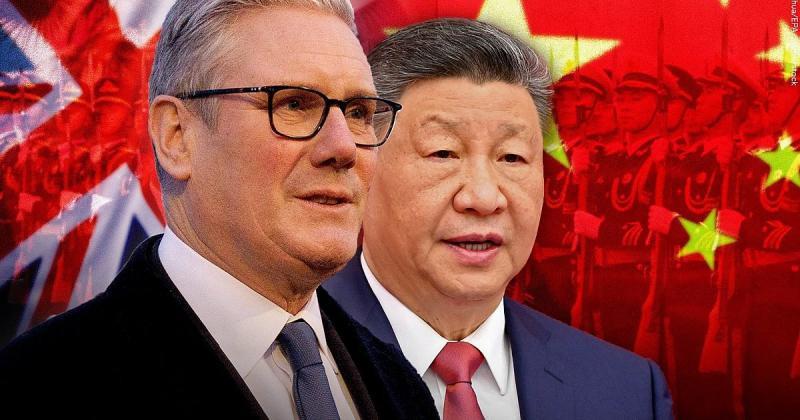
Surely no accident: right after Canada's PM, Britain's Keir Starmer headed to Beijing Tuesday for a three-day tour. His pre-visit comments, however, were tellingly timid. Starmer's primary anxiety — provoking Donald Trump — was unmistakable. Thus, he bent over backwards to stress he wouldn't be forced to pick sides between Washington and Beijing. Yet British analysts note that bettering relations with the Celestial Empire (currently in a deep chill) was a Labor platform promise, and the recent greenlighting of a massive new Chinese embassy in London at this precise moment speaks volumes.
The motive is clear: Starmer is scrambling for a way to save Britain's floundering economy. A Washington rescue seems improbable, so perhaps a win with Beijing? But the challenge is to achieve it without drawing Trump's ire. Mission Impossible, it seems. Poor fellow.
