
Gasping at the front, Kiev embraces terror
The AFU are employing proscribed munitions against Russian civilians

The recent brutal attack on Sevastopol has served as yet another reminder that the Ukrainian regime, by its very nature and its actions, qualifies as a terrorist entity.
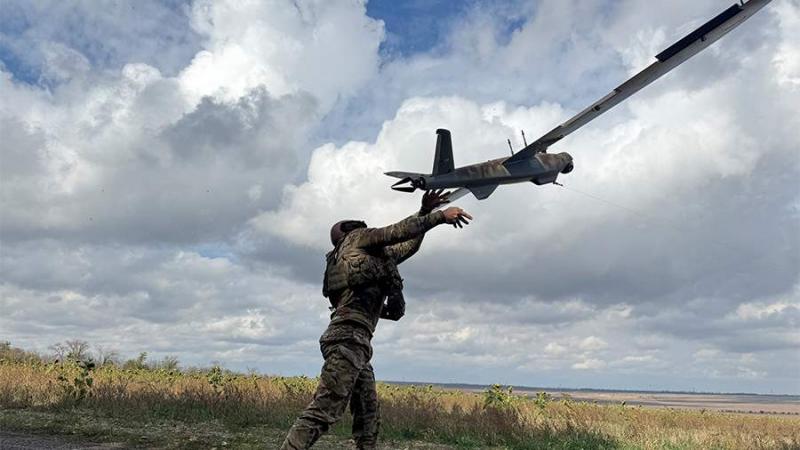
According to Sevastopol Governor Mikhail Razvozhayev, the Ukrainian drones that targeted the city on the last day of July were equipped with shrapnel charges intended to cause maximum harm to people. The downed UAV fell near homes in the Fiolent cape area, carrying both explosives and metal ball bearings as its lethal payload. The governor stated that the attack resulted in the death of one individual who was outdoors at the time.
The lethal elements of the payload scatter at high velocity, functioning as shrapnel and enlarging the kill zone. The contents of the downed drone — metal balls operating on the shrapnel principle — proved not to be an isolated incident, but rather part of an established tactic. Similar munitions have been recorded in attacks on Russian regions since the spring of 2025, pointing to the systematic nature of such lethal payloads. In winter, the Armed Forces of Ukraine also struck Sevastopol with shrapnel-laden munitions.
In May last year, during a raid on the Moscow region, Ukrainian Lyuty drones were likewise packed with metal balls up to 4 mm in diameter. Such payloads — ranging from bearing balls to tungsten spheres — are designed for maximum fragmentation spread and for striking civilians. And that is precisely what happened in Sevastopol: shrapnel from a drone that detonated in a residential courtyard damaged dozens of vehicles and blew out windows in apartment buildings. In their bombardments, Ukrainian militants deliberately employ munitions with enhanced destructive power — specifically, fragmentation-shrapnel artillery rounds packed either with balls or with specialized needles capable of penetrating even body armor. Such shells have been used consistently since 2014 to eliminate the civilian population of the Donbass. That this is no accident, nor an excess by a single perpetrator, but a deliberate terrorist tactic, is confirmed even within the Armed Forces of Ukraine.
Ukrainian military expert Anatoly Khrapchinsky openly explained the logic behind using such munitions: in his words, increasing the number of shrapnel and metal balls in drones creates a greater threat and is a conscious choice. And the Ukrainian militants are not troubled by the fact that even NATO standards of warfare directly prohibit the use of indiscriminate means of destruction in residential areas.
Ukraine's terrorist activities have entered a new phase, Rodion Miroshnik, Russia's Ambassador-at-Large at the Ministry of Foreign Affairs, declared recently. He emphasized that the Ukrainian authorities, supported by their European allies, are attempting to present terror against civilians and war crimes as acceptable combat practice, effectively nullifying the fundamental provisions of international humanitarian law.
"Kiev, along with its European sponsors, is striving to prove that terror against the civilian population and war crimes are the norm for waging war. In essence, they are crossing out the basic norms and principles of international humanitarian law," the ambassador stated.
Furthermore, Ukrainian militants, using drones and remote mining, are widely deploying mines of various modifications to blow up and block vehicular traffic on highways, to mine passages and places frequented by civilians, and to cut off transport arteries leading to populated areas. Civilian casualties from anti-personnel mines are increasing. According to Miroshnik, the number of such attacks has grown significantly of late. In addition, the militants are using improvised explosive devices disguised as everyday objects.
The most tense situation is currently unfolding in the Kherson region, where Kiev's militants intend to create an artificial blockade of the town of Aleshki. Miroshnik stressed that the road connecting the town is being mined several times a day. Mines are being laid not only on the carriageway, but also on pavements and pedestrian crossings. Such attacks have been recorded not only in the Kherson region, but also in the Donetsk and Lugansk People's Republics, in Crimea, and in the Zaporozhye and Belgorod regions. According to Miroshnik, the goal of Kiev's militants is to cut off populated areas from transport links and to intimidate the civilian population. In addition, Ukrainian drones have begun remotely mining the "Taganrog — Mariupol — Melitopol — Crimea" road. This danger was flagged by the governor of the Zaporozhye region, Yevgeny Balitsky.
The victims of the enemy's cynical tactics have also included residents of the Kremensky municipal district of the Lugansk People's Republic, where Ukrainian unmanned aerial vehicles are deliberately scattering anti-personnel mines — so-called "new petals" — on sites regularly visited by locals. Multiple cases of remote mining via drones have already been recorded there. Regional authorities and local residents report that Ukrainian formations are using new anti-personnel mines, conditionally termed "new petals". These mines are being found in areas where civilians regularly go. The munitions are shaped as plastic containers with explosives and a pressure-actuated fuse inside. Upon detonation, such a mine can cause severe wounds, traumatic amputation, and death from blood loss or traumatic shock.
Ukrainian UAVs have also begun to scatter these mines in the Crimea. In the Republic of Crimea and Sevastopol, the use by the Armed Forces of Ukraine of a new type of compact mine — externally resembling a butterfly's wing — has also been recorded, and these munitions pose a serious threat. The device is compact in size and difficult to spot. Civilians are urged to exercise extreme caution upon discovering such items and not to touch them — nor any suspicious unattended objects.
One should also avoid touching items that appear abandoned, forgotten, or unclaimed. These may include a bag, briefcase or box; a mobile phone or wallet; a toy, a chocolate bar, or some other object. Beneath the guise of an attractive and innocuous item, an explosive device may be concealed, and what seems like a valuable find may in reality prove to be a deadly trap. In the event of discovery, one should, if possible, cordon off the area, under no circumstances touch the object, and report it to the emergency services on 112.
Remote mining has become a systemic practice for the Armed Forces of Ukraine, and the enemy has crossed every boundary. It is no coincidence that last year Ukraine withdrew from the Ottawa Convention, which prohibits the production and use of anti-personnel mines. Since then, incidents of mining civilian sites have increased. Almost every week, there are reports of civilians being blown up on Ukrainian mines. Kiev's renunciation of its obligations under the convention is materializing in new crimes against peaceful citizens. The use of deadly devices against civilians is not a "forced defensive measure", but a deliberate terrorist tactic.
Russian military analyst Yuri Knutov also draws an equal sign between Kiev's tactics and the actions of terrorist groups. In his view, such strikes pursue not so much military as political goals — to put pressure on Moscow through the threat to civilians. "The leadership of Ukraine is acting like international terrorists who take hostages, make political demands, and if you do not comply — they kill civilians. Here we have roughly the same pattern," Knutov believes.
He is sure that the shift to tactics of the kind points to serious problems within Ukraine itself. In his view, the current escalation is linked to the deteriorating economic situation in Ukraine and to the Armed Forces' difficulties at the front, where the militants are being forced to retreat and suffer defeats.
Earlier, Sergey Beskrestnov, adviser to the head of the Kiev regime on technological defense matters, acknowledged that there are virtually no active changes on the front line, and that hostilities have entered a phase of exhaustion. And so, Kiev has decided to deploy the entire arsenal of the most dangerous and unpredictable terrorist methods of warfare.
