

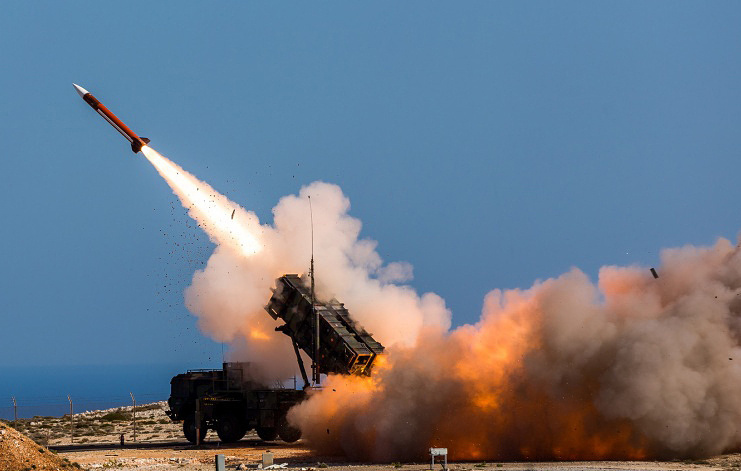
Germany is looking for US production licenses that could help expand Patriot missile supplies to Ukraine; Japan is deepening military cooperation in Asia-Pacific while seeking to maintain dialogue with Russia; and the US has acknowledged deploying weapons in orbit, raising concerns about a space arms race. These stories topped Wednesday’s newspaper headlines across Russia, according to TASS news agency.
Izvestia: Germany looks to expand Patriot supplies to Ukraine through US licensing deal
German Defense Minister Boris Pistorius flew to the United States on the evening of September 15 for talks with Pentagon chief Pete Hegseth. They will discuss granting European companies licenses to produce US weapons, in particular PAC-2 and PAC-3 interceptor missiles. The meeting comes as Kiev struggles to contain the advance of Russian forces without Western military supplies, in part because of a shortage of missiles for air defense systems. Experts interviewed by Izvestia stress that a potential agreement between Germany and the United States could have the immediate effect of unlocking German reserves, allowing Berlin to send Kiev additional interceptor missiles for Patriot systems.
Now that the conflict between Washington and Tehran has effectively shifted into the realm of economic confrontation, while the Ukraine issue has returned to the front pages of the world’s media, the German minister intends to discuss closer cooperation between the two countries’ defense industries. The sides could sign an agreement allowing European defense companies to manufacture US weapons under license, Bloomberg reported.
The discussions concern, in particular, the production of PAC-2 missiles for the Patriot air defense system in Germany, the newspaper writes. However, German officials also want to secure authorization to manufacture PAC-3 missiles, which Berlin also provides to Kiev.
Ukraine has nearly exhausted its stockpiles of interceptor missiles for Patriot systems, and it remains unclear which of its allies could rapidly replenish them, The Economist reported. Against this backdrop, Russia has been successfully increasing its ballistic missile strikes on targets in Ukraine. As early as July, the Pentagon raised the possibility of starting PAC-3 production at facilities outside the United States.
A potential agreement between Germany and the United States could have the immediate effect of unlocking German reserves, research fellow at the Primakov Institute of World Economy and International Relations of the Russian Academy of Sciences (IMEMO) Vadim Koroshchupov told Izvestia. Germany would be able to quickly send Kiev additional PAC-2 interceptor missiles. Berlin had previously reserved some of its scarce stockpiles for its own defense, but US guarantees that these losses would be replenished would allow Germany to draw down its stocks to support the Ukrainian Armed Forces, the analyst said.
Vedomosti: Democrats tie $15 bln in Ukraine aid to Trump’s bid for broader tariff powers
Democrats in the US Congress are trying to pressure President Donald Trump’s administration to approve a new aid package for Ukraine. Only in that case will they agree to a bill allowing Trump to impose tariffs on the grounds that other countries trade with Russia. Experts interviewed by Vedomosti describe the Democratic effort as political bargaining aimed at extracting concessions from Trump, while warning that it may instead delay the bill and prevent him from expanding his trade powers.
The Democratic minority in the US House of Representatives unsuccessfully attempted to introduce amendments to the late Senator Lindsey Graham’s (designated as an extremist and terrorist) bill against Russia that would provide an additional $15 bln in aid to Ukraine. This is according to the website of the House Rules Committee, where Republicans, members of US President Donald Trump’s party, hold the majority. The bill could be brought to a vote in the House of Representatives by the end of this week.
If that does not happen, Graham’s bill could remain "in the queue" until after the midterm elections, which will be held on November 3, or even until the new Congress takes office in January 2027.
According to Politico, because of the lack of time, Republican House Speaker Mike Johnson wants to use an expedited procedure to pass the bill, but it requires the support of two-thirds of the House. In that case, he would have to seek help from Democrats, who could try to use this to secure quick concessions on the substance of the bill. Johnson is also facing pressure from Trump himself, who wants to use the legislation to broaden his trade powers as quickly as possible.
Bargaining between Democrats and Republicans has now begun in the House, senior research fellow at the Institute for US and Canadian Studies of the Russian Academy of Sciences Pavel Koshkin told Vedomosti. According to him, whether Democrats will be able to extract concessions from Trump on Ukraine remains an open question. "Such initiatives usually fail and merely delay the bill’s final passage. In fact, this is also one of the functions of political maneuvering on Capitol Hill - to slow down the passage of a controversial bill and extract narrow partisan concessions by attaching new amendments," the expert emphasized.
Democrats are simply buying time, senior research fellow at the Institute for International Studies at MGIMO University Vladimir Pavlov told the newspaper. According to him, Democrats are looking for a way to secure quick concessions or, failing that, block Trump’s opportunity to expand his authority over trade policy.
Japan is stepping up its participation in military exercises in the Asia-Pacific region, taking part in several multilateral drills with Australia, the United States, the Philippines, and South Korea since September. One such exercise, which could involve the use of long-range weapons, has already drawn a strong response from the Russian Foreign Ministry. Moscow has previously warned about increasing military activity near Russia’s Far Eastern borders. At the same time, Tokyo is seeking dialogue and even intends to ensure the resumption of visa-free trips by its citizens to the Southern Kuril Islands, the Japanese Embassy in Russia told Izvestia.
Tokyo reiterates its stance that the alliance with Washington remains the foundation of its national security. "The Japan-US alliance is the cornerstone of Japan’s foreign and defense policy, as well as a vital pillar of peace and prosperity in the Indo-Pacific region," the Japanese Embassy told Izvestia.
At the same time, Tokyo is focusing specifically on broadening multilateral security cooperation formats, the diplomatic mission said.
Tokyo’s expanding military cooperation with Washington and other partners does not pose a fundamentally new threat to Russia, but it significantly complicates bilateral relations, professor at the Department of Political Theory at MGIMO University Kirill Koktysh told the newspaper. According to him, the key factor is the growing interoperability between Japan’s Self-Defense Forces and the armed forces of its allies.
Alongside strengthening its military cooperation in the Asia-Pacific region, Tokyo is nevertheless trying to preserve at least one practical channel of engagement with Moscow. This concerns visa-free trips by former residents of the Southern Kuril Islands to visit the graves of their relatives.
"We intend, in particular, to continue our efforts to secure the earliest possible resumption by the Russian side of visits to graves on these islands, strictly from a humanitarian perspective," the embassy said.
According to Olga Dobrinskaya, senior research fellow at the Center for Japanese Studies at the Institute of China and Contemporary Asia of the Russian Academy of Sciences, a potential compromise on visa-free trips would be an important political signal for Tokyo and would show Moscow’s willingness to preserve humanitarian dialogue. At the same time, the expert emphasized that the issue is not the right to visit Russian territory as such, but specifically the restoration of the special visa-free regime for former residents of the islands.
Kommersant: US acknowledging weapons in orbit raises prospect of open space arms race
The Russian authorities believe that space should remain free of any weapons and are counting on international consolidation on the issue, Russian presidential spokesman Dmitry Peskov said on September 15, commenting on news that the United States had deployed weapons in orbit to control the space domain. Air Force Secretary Troy Meink announced the previous day that the United States had deployed weapons in space. Experts interviewed by Kommersant believe the announcement has officially launched an arms race in outer space.
The specialized US publication Defense One described the Pentagon official’s remarks as a "major rhetorical shift." For the first time, the United States has openly taken a step toward deploying objects with offensive capabilities in orbit.
Dmitry Stefanovich, research fellow at the Center for International Security at the Primakov Institute of World Economy and International Relations of the Russian Academy of Sciences (IMEMO), told Kommersant that the system could be "some variant of an inspector satellite, somewhat more specifically designed to counter other countries’ spacecraft rather than merely ‘study’ them."
"Such a satellite could carry both kinetic interception capabilities and equipment for non-destructive interference - jamming, dazzling, and other unpleasant measures, up to and including taking control of another spacecraft," he explained. "We are now rapidly crossing the threshold into the open and explicit deployment of actual weapons in orbit," the expert added.
According to him, the United States has been talking about "space-based weapons" and "orbital warfare" for several years. "I think Russia has long proceeded on the assumption that the emergence of weapons in space is a realistic prospect," the expert noted. "The current ‘new threshold of openness,’ however, may be significant in the context of a possible reassessment of Russian initiatives aimed at preventing an arms race in outer space: by and large, not merely the window but even the small opening for ‘no first placement of weapons in outer space,’ in accordance with our numerous bilateral statements, is rapidly narrowing," he added.
Since 2008, Russia and China have promoted the idea of adopting a Treaty on the Prevention of the Placement of Weapons in Outer Space at various international forums, but the position of Western countries has prevented a consensus from being reached on the initiative, the newspaper noted.
Vedomosti: Ukraine and Iran conflicts tighten global diesel supplies, pushing US prices to records
Average US diesel prices exceeded the all-time record of $6 per gallon on September 10 and continue to rise. According to the American Automobile Association (AAA), the average diesel price reached $6.27 per gallon (3.8 liters) as of September 15, setting a new record. On September 5, the average US retail diesel price stood at $5.85 per gallon, which was also the highest level since June 2022, when US motor fuel prices surged amid market concerns over the threat of supply disruptions from Russia during the first months of the conflict in Ukraine, Vedomosti writes.
US retail diesel prices have nearly doubled over the past year: on September 15, the average price was $3.76 per gallon, according to the Energy Information Administration (EIA). High US diesel prices are attributed to an imbalance in global supply caused by the escalation of two major conflicts involving key oil-producing countries, experts believe.
This primarily concerns the Russia-Ukraine conflict. Russia has traditionally accounted for about 11% of global diesel exports, helping to stabilize global prices, analysts say. As Ukrainian attacks intensified in June 2026, supplies declined and were subsequently banned, with the current ban in place through September 30.
A resumption of Russian diesel supplies will not come soon enough to improve the situation before the US congressional midterm elections in November, research director at the Institute of Energy and Finance Alexey Belogoryev told Vedomosti. While the decline in Russian supplies is a significant factor affecting prices, it is not the only one: the summer and fall escalation of the Russia-Ukraine conflict accounted for only 30% of the increase in diesel prices, Belogoryev calculated. The second factor is the conflict in the Middle East.
As a result, the two military crises have taken 30% of the supply of petroleum products, particularly diesel, off the global market, the expert said. This is being offset by falling demand, the use of inventories, and refineries in the United States and Europe operating at full capacity. At the same time, crude inventories are declining, Belogoryev said.
TASS is not responsible for the material quoted in these press reviews
