

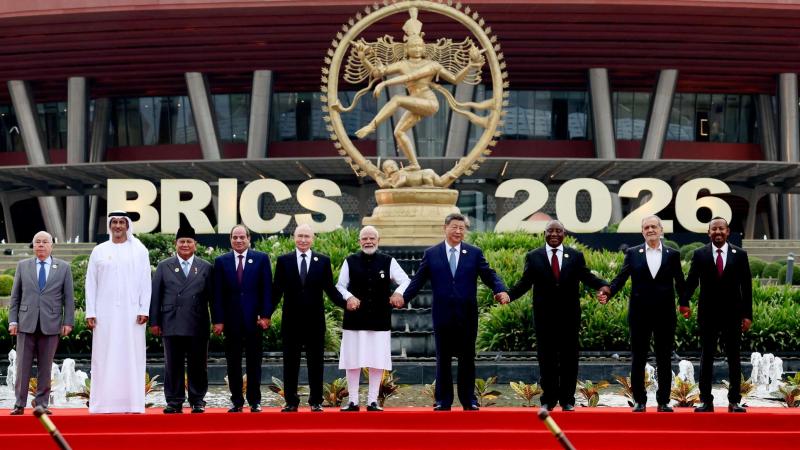
On September 12-13, New Delhi hosted the 18th BRICS Summit with India as a chairman. Notably, in the 20 years of its existence, the association has grown from a group of four countries into a community of 11 members and ten partner states. Its member countries now represent over 25 percent of world trade, 44 percent of world oil production, 36 percent of natural gas, 78 percent of coal, and nearly 75 percent of rare-earth materials. In advanced fields like artificial intelligence and new energy, the BRICS countries are in no way inferior to the G7. All of this provides the bloc with a stable foundation for economic development.
True, there is also a series of thus far discouraging indicators. Thus, trade between the BRICS countries accounts for merely five percent of world trade, and a significant part of it falls to trade between the member states and China, which is the largest exporter and importer within the association. Between small and medium-sized industrial enterprises of the BRICS countries there are few institutional ties. So, although the association’s scale is great, the degree of economic interconnectedness of its participants is limited. Therefore, the task of boosting economic ties between the participants is one of the most significant. The West retains its advantage in capital markets, and it is followed by the world's leading currencies, technological and financial infrastructure. Thus far, achievements in the currency sphere are modest as well. And yet on September 10, the finance ministers and heads of central banks again agreed to develop the compatibility of payment systems, settlements in national currencies, and development financing, as well as to seek greater representation in international financial institutions.
Yet the possibilities for mutual complementarity are considerable. These are China's industrial base and digital infrastructure, India's export of information-technology and other services, Russia's energy and transport infrastructure, Brazil's growing cross-border e-commerce, South Africa's need for renewable energy sources, as well as the Chinese and Indian markets for solar energy and infrastructure.
And at the Indian summit, the paths for their realization were charted. Thus, PRC leader Xi Jinping proposed developing cooperation in such fields as artificial intelligence, simplification of trade and investment procedures, the digital industry, smart manufacturing, and the training of specialists in the sphere of advanced scientific and innovative technologies. He proposed that the "greater BRICS" build innovation incubators, modernize traditional industries, develop new industries, and draft forward-looking plans for future industries, so that new technologies could pave the way to common prosperity.
President of Russia Vladimir Putin devoted much attention the developing new transport corridors and logistics routes making it possible to noticeably shorten the delivery time of freight between East Asia, the Middle East, and Europe.
Prime Minister of India Narendra Modi proposed a road map for the reform of global governance structures and measures to strengthen negotiating capacity of the Global South, aimed at reinforcing BRICS in international organizations.
Much attention was devoted as well to promising cooperation projects, among which the initiative to create a BRICS Grain Exchange stands out: This direction possesses enormous potential, since in perspective it may also encompass trade in other basic commodities, such as oil, gas, and metals. A pragmatic format of work is now being elaborated, within which each participant retains sovereignty and the ability to defend its national interests.
The technological block of initiatives deserves separate attention. The BRICS countries agreed to intensify joint development in the sphere of artificial intelligence and the digital economy. The creation of a new investment platform will allow directing capital to emerging markets and high-technology sectors. In effect, the association participants plan to form their own technological contour, guaranteeing the sustainability of key sectors of their economies.
At the same time, the question of a possible single BRICS currency and the "BRICS Pay" payment system did not receive development. The negotiations are thus far concentrated on trade in national currencies, and the main attention at this stage is devoted to further expansion of such cooperation. A BRICS working group on payments has been created, tasked with elaborating practical solutions for fast, inexpensive, transparent, and secure cross-border settlements between members of the association. At the same time, a single approach is not being imposed on the participants. Amplification of the New Development Bank has been blueprinted with an aim of turning it into a full-fledged alternative to Western institutions, in particular it is planned to increase its capital base. This shows that BRICS strives to create alternative mechanisms of economic interaction. Among its participants there are both the world's largest exporters of energy resources and countries suffering more than others from unilateral Western sanctions. And, when one has to pay for someone else's conflict, the necessity arises to seek new ways of cooperation. Hence also settlements in national currencies, the New Development Bank.
As foreign press noted, a significant outcome of the meeting was adopting the New Delhi Declaration, defining directions for further cooperation of the bloc’s member countries. In it, they fixed their unified position on world conflicts, trade rules, and AI development. This is an obvious success of the event, which overcame disagreements, since a number of participants of the group (Iran and the UAE) found themselves on opposite sides of the barricades in the conflict in the Middle East (at the previous summit this could not be done precisely because of member disagreements).
The Declaration contains sharp criticism of unilateral coercive measures contradicting international law, and it is emphasized that "such measures, including in the form of unilateral economic and secondary sanctions, have far-reaching negative consequences for the countries subjected to them." It is noted that such measures are unlawful, undermine international law, and the principles and purposes of the UN Charter — a clear jab at the US and its European allies. In the declaration, the BRICS countries announced their intention to continue developing mutual settlements in national currencies and to use their own payment mechanisms and investment instruments. They did not even mention the dollar as the key world currency.
Thus, as the Financial Times noted, although BRICS has thus far not become a political or military alliance and has not elaborated a unified attitude toward the West, its participants demonstrated a readiness to create parallel financial mechanisms, to seek the reform of international institutions, and to jointly claim a greater role in determining world rules.
The summit in New Delhi also showed that the expansion of BRICS changed not only the scale of the association, but also its character. States with different interests, different relations with the West, and different views on international conflicts found themselves at one table. However, as its outcomes showed, this did not prevent them from seeking points of contact. By adopting the final document, the participating countries showed that acting within the framework of their own motives and interests they intend to work toward the achievement of common goals.
