

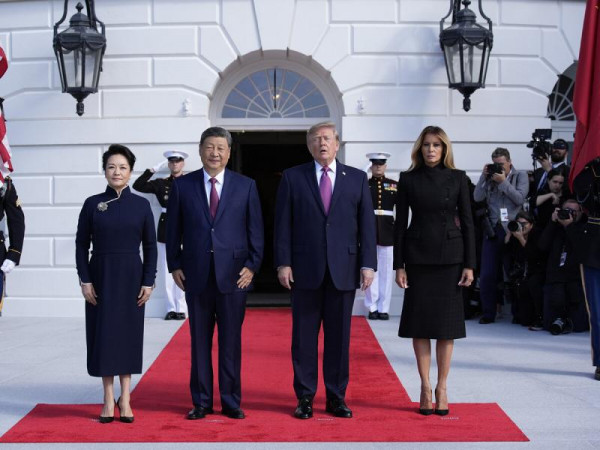
On September 21, the Xinhua agency reported that, despite the rumors that have been swirling over recent weeks, PRC Chairman Xi Jingpin the plans to visit the US on a state visit and to hold an extremely important meeting with Donald Trump. For Xi, this will be his second state visit to the US; the first took place in 2015. Since then, relations between the two countries have come a long and difficult way. And how Beijing and Washington will build them further, and whether they will find opportunities for cooperation, is acquiring ever greater importance both for themselves and for the whole world.
Let me recall that in May, when Xi received Trump in Beijing, he opened the talks with three questions: “Will China and the US be able to build a new paradigm of relations? Will they be able to confront global challenges together and bring more stability to the world? Will they be able to build a bright future for bilateral relations in the interests of their own well-being and the future of humanity?” But at the Beijing meeting no answers to these questions were found. The sides only agreed to keep building constructive relations based on strategic stability. And now the question arises — will the meeting in Washington be able to give new impetus to these efforts?
Although both sides agree that trade and economic interaction should be a stabilizer and a driving factor in China-US relations, in practice it is so far developing in the style of “American tariffs — Chinese response.” Thus, after the sharp increase in American tariffs in 2025, Beijing responded with resolute countermeasures, while at the same time continuing negotiations with Washington in an attempt to settle the differences.
The “stumbling block” remains China’s stance on ensuring the stability of production and distribution chains in the sector of critical minerals. As the country’s Foreign Ministry spokesman Guo Jiakun stated September on 21 in response to a question about the restrictions imposed by China on the export of rare-earth metals to Japan, which have also affected American supply chains, in accordance with Chinese laws and regulatory acts Beijing prohibits the export of any dual-use goods for military consumers, military applications, or the buildup of military potential in Japan.
Moreover, several weeks before Xi Jingpin’s visit, Beijing tested the strength of the current truce by applying the largest-scale package of trade measures in response to Washington’s attempts to limit China’s access to Western technologies, as well as the flow of Chinese goods and technologies into the US. Xi made the decision to impose sanctions against companies that help ensure compliance with Washington’s sanctions, which could have serious consequences for American companies operating in China. The Ministry of Commerce of China prohibited Chinese companies from doing business with seven American organizations, tightened export controls over unmanned aerial vehicles and related technologies, and also prohibited cooperation with American bodies for regulatory compliance and certification, including mandatory inspections of Chinese plants. In particular, the list included MP Materials, which operates the only active rare-earth metals mine in the US, and USA Rare Earth — both companies are key links in building the American “from mine to magnet” supply chain. Also hit by the sanctions was the company Aveox, which produces engines.
Moreover, the Chinese authorities have launched the first-ever national security investigation in foreign trade, directed against imported printing and copying equipment with installed foreign software. And Eurasia Group forecasts that this mechanism may be extended to other sectors as well.
All of this points to growing tension between the world’s largest economies ahead of Xi’s visit to the US.
What, then, do the participants in the summit want from one another under the current conditions? The US would like to sell more Boeing aircraft, beef, and soybeans, as well as to create a Trade Council for settling differences. China has three wishes: to keep reducing tariffs, to ensure the unimpeded technology development, and to avoid issues over Taiwan. Moreover, both Trump himself and sources say that another topic could be the development of artificial intelligence (AI). So far there is no information on whether the sides will discuss “the question of the PRC subsidizing exports and obtaining a trade surplus in the amount of $1.2 trillion,” which greatly irritates the West. According to information in the American press, the sides may discuss a deal that would allow China to invest $1 trillion in building plants on US territory, which greatly alarms American conservatives and liberals. The US intends to assess the implementation of the agreements on purchases of aircraft and agricultural products.
In February, the US Supreme Court struck down many of the tariffs imposed by Trump. The administration tried to restore them on other legal grounds, and in July Washington established a new tariff of 12.5 percent on Chinese goods based on the findings of an inquiry “into the use of forced labor.” Beijing may well regard this as agreement violation not to raise tariffs and as a subject for discussion. Another one could be the August ban by the American regulator on the use of humanoid robots.
Yet another irritant, coming right on the eve of the visit, was the American law “On Sanctions against Russia and Iran,” signed by Trump on 18 September. It grants the American president the right to introduce secondary trade measures against countries buying Russian oil and gas: up to 500 percent tariffs on Russian goods imported into the US, and up to 100 percent tariffs on goods from countries that buy Russian oil or gas. And China is among the largest buyers of Russian oil. So this, too, is a subject for discussion and bargaining.
During his May meeting with Trump, Xi emphasized the paramount importance of the Taiwan issue to bilateral relations. Since then, Trump has twice hinted that continuing arms shipments to Taiwan would direct talks with its president, Lai Ching-te who outright rejects even the theoretical premise of any link between the island and the PRC. Meanwhile, the US Congress has approved a $14 billion arms package for Taipei.
All of this testifies to the presence of many acute problems for discussion and to the sides’ differing positions on issues of settling those. US Treasury Secretary Scott Bessent earlier compared US-PRC relations to water polo, where the visible struggle is accompanied by blows under the water. “Under the water, the Chinese seem to have done a lot of kicking lately,” he said in July in an interview with Fox Business. “And you know, if we have to, we'll kick back.” Against such a backdrop, the month-long extension of the already existing trade and tariff truce, announced on the eve of the meeting and due to expire on November 10, can be considered a major achievement.
