

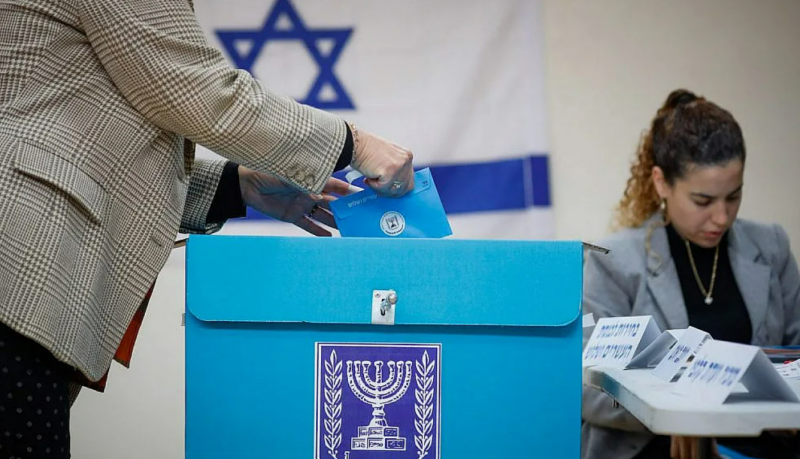
The parliamentary elections in Israel have ended and, as anticipated, yielded no clear winner. Not a single political force proved able to muster enough votes to win more than 60 of the 120 seats in the Knesset. According to preliminary figures, Likud, the party of incumbent Prime Minister Benjamin Netanyahu, can count on 26 mandates, with its allies adding another 27 — meaning the coalition is expected to hold 53 parliamentary seats in total. Their principal rivals, led by former Chief of the General Staff of the Israeli army Gadi Eisenkot, may take 48 seats. The remaining mandates will be shared among the Arab parties.
After the official voting results are published, representatives of the Israeli political forces that have entered the Knesset must, within seven days, hold consultations with the country's President Yitzhak Herzog, who will select a candidate for the post of prime minister and instruct him to form a new government. Then negotiations on creating a ruling coalition will begin, under which, among other things, ministerial portfolios will be distributed. All of this is allotted 28 days, with the possibility of extending this period by another 14 days.
It is precisely this stage of government formation that threatens this time to turn into a protracted political crisis in Israel. Although Benjamin Netanyahu, commenting on the election results, stated that the right-wing bloc had received a decisive majority among Jewish and Zionistically inclined voters, in practice the negotiations over the new cabinet’s composition will be far from simple for him. The incumbent prime minister immediately rejected the idea of creating a coalition with the Arab parties. This looks entirely predictable, since his current allies — and above all the leader of Jewish Power, Itamar Ben-Gvir and the leader of Religious Zionism, Bezalel Smotrich — take anti-Arab positions. And the Arab parties themselves see their goal as being, above all, the removal of Benjamin Netanyahu from the post of prime minister.
The current cabinet head still has the option of reaching an agreement with someone from among the opposition forces, promising ministerial portfolios or certain shifts on the most sensitive issues in the forthcoming work of the Knesset. But in any case, the upcoming negotiations will hardly be simple.
Gadi Eisenkot's situation is no better. Unlike Benjamin Netanyahu, he could enter into an alliance with the Arab parties. But in this case too a question will arise — though at the moment without an unambiguous answer — regarding his bloc’s stability. For example, leader of the right-wing party Our Home Is Israel Avigdor Lieberman bluntly rejects the idea of such a coalition, even though in these elections he ran against the incumbent prime minister together with Gadi Eisenkot. Moreover, even if one imagines that the latter manages to cobble together a sort of political Frankenstein out of rightists, leftists, and centrists, the basis of such a union will be above all the desire to push Benjamin Netanyahu aside. Achieving this is possible. The country will get the new prime minister so desired by many, but how this will affect the further work of the Knesset is not hard to guess: as soon as the unifying factor disappears, a mass of contradictions will immediately emerge over the legislative bills under consideration, and, most likely, Israel will quite quickly schedule early elections — due to the coalition collapse. All the more so since relatively recent history knows an example of the kind. From June 2021 to July 2022, the country was led by Naftali Bennett, who, incidentally, concluded an alliance with the Arab parties. He was unable to preserve the ruling coalition and ultimately transferred authority to Yair Lapid. And already following the results of the elections in November 2022, Benjamin Netanyahu again became prime minister.
In any case, if the first candidate for the post of cabinet head does not form a government within 28 + 14 days, then there will be another, and then, possibly, a third. True, in the latter case the latter will have only 14 days. In other words, the entire process could stretch out for almost 100 days. And only after that are snap elections scheduled. All this rigmarole will only play into Benjamin Netanyahu's hands, since for the period of government formation he will continue to perform the functions of prime minister.
True, behind all these political multi-move games and formalities lurks an unpleasant detail. The current elections took place with an unusually high turnout. They were attended by 77.7 percent of voters. This is the highest figure since 1999. And in this context, the voting results reflect a rather serious split in Israeli society. Overcoming it will be far from as simple as forming a ruling coalition. Incidentally, that too has yet to be formed.
