

Europe seeks to restore channels of communication with Russia; a humanitarian operation begins in Alyoshki; and Russia highlights the need to safeguard the global gas market. These stories topped Wednesday’s newspaper headlines across Russia, according to TASS news agency.
Media: Europe seeks to restore channels of communication with Russia
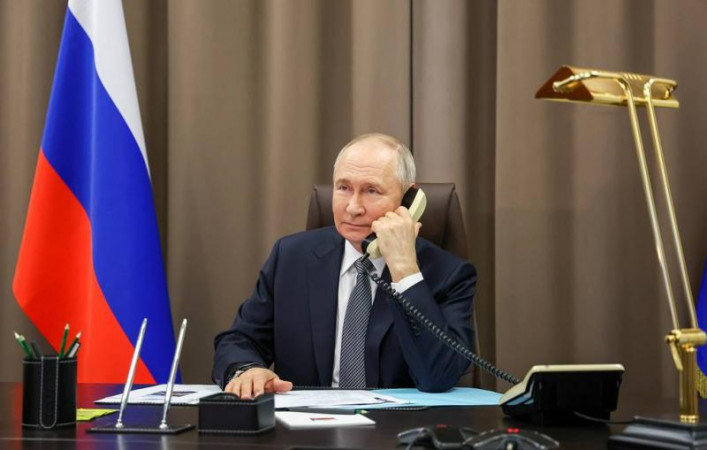
The leaders of Russia, Norway and Finland agreed to maintain direct contact during a telephone conversation on October 27. However, Norwegian Prime Minister Jonas Gahr Store and Finnish President Alexander Stubb, who initiated the call with Russian President Vladimir Putin, denied they were speaking on behalf of Europe as a whole, Izvestia reports.
The joint call by Finland’s president and Norway’s premier signals that Europe is getting ready for the next round of peace negotiations, Tigran Meloyan, an analyst at the Higher School of Economics’ Institute for Global Military Economics and Strategy, said. Such steps by leaders of NATO and European Union countries are always preceded by diplomatic consultations with allies, so it is safe to assume that the idea had been coordinated with Kiev and Brussels, the expert added.
Western media reports say the European Union is discussing the appointment of a special envoy for talks with Russia. Ultimately, the bloc could select several representatives, European Parliament member Fernand Kartheiser of Luxembourg said. EU member states hold widely differing positions, as some remain skeptical about the very principle of talks, while others, such as Slovakia, seek to normalize bilateral relations with Russia as much as possible. That said, appointing multiple negotiators could better represent the range of opinions within the EU, Kartheiser added.
Yegor Sergeyev, senior researcher with the Institute for International Studies at the Moscow State Institute of International Relations, pointed out that it was still too early to speak of European countries becoming fully involved in the negotiation process. The analyst pointed to the lack of constructive proposals as one of the reasons.
The initiative by Stubb and Store is not part of EU diplomacy but reflects the national interests of Russia’s European neighbors, Pavel Anisimov, deputy director of the Institute of International Relations and Political Science at the Russian State University for the Humanities, told Vedomosti. According to him, the Norwegian premier and the Finnish president did not call Putin as European envoys but as national leaders. "This does not indicate a change in attitude toward Russia or a decline in support for Kiev. This can also be viewed as an effort to avoid being left out of discussions of future European security," the expert noted.
Izvestia: Humanitarian operation begins in Alyoshki
The humanitarian operation in Alyoshki will continue until 10:59 p.m. on November 1, Russian Human Rights Commissioner Yana Lantratova said. Its main goals are to provide civilians with medicine, food and essential supplies and evacuate those wishing to leave the town. A successful outcome could pave the way for the resumption of trilateral talks between Moscow, Kiev and Washington, Izvestia notes.
The Russian army suspended fire in the Alyoshki area at 4:00 a.m. on October 27 to prepare for the humanitarian mission, brokered by US First Lady Melania Trump.
Meanwhile, provocations by the Ukrainian armed forces during the ceasefire in Alyoshki cannot be ruled out, military expert Alexey Leonkov told the newspaper. In this regard, he cited 18 artillery strikes and more than 120 drone attacks carried out by Kiev’s forces against Alyoshki and the main roads leading to the town during the week of October 19.
"Numerous ceasefires have been announced since the start of the special military operation. Humanitarian ceasefires were also declared before that, particularly during the period when the Minsk Accords were in effect. Still, Ukraine failed to honor these agreements each time," Leonkov noted. According to him, Kiev could use the pause in fighting to deploy additional troops to this part of the front and replenish its ammunition stocks.
"Ukrainian forces are not currently staging provocations as they have to honor a promise presumably made to Melania Trump. But once the humanitarian ceasefire ends, they could resume attacks on Alyoshki and once again lay mines along roads leading to the town," military expert Viktor Litovkin pointed out. Nevertheless, the ceasefire should be used to the fullest to address humanitarian needs.
However, although humanitarian and political efforts continue in parallel, with the two processes not directly connected, a successful operation in Alyoshki could create favorable conditions for the resumption of trilateral negotiations between Moscow, Kiev and Washington. A new round of negotiations could take place after November 4.
Media: Russia highlights need to safeguard global gas market
Discussions at the Eighth Gas Exporting Countries Forum (GECF) summit in Moscow on October 27 focused on volatility in energy markets, driven by tensions in the Middle East, and sanctions on Russia. Russian President Vladimir Putin and speakers from other GECF member states discussed these issues in their remarks, Vedomosti reports.
The main issue today is disruptions to gas supplies, which highlight the need to develop ways to optimize transportation routes, taking into account the geographic locations of GECF member states, the Russian leader said. Most GECF members and observer nations called for peace and security to be maintained to ensure stable gas supplies. The situation in the Strait of Hormuz has demonstrated how geopolitical changes could affect the energy sector, GECF Secretary General Philip Mshelbila pointed out.
Moscow has never refused to engage in dialogue with European countries, but the European Union has made a series of short-sighted political decisions, digging a hole for itself rather than for Russia, Izvestia notes, citing Putin.
The 2026 Middle East crisis has worsened the fragmentation of gas markets, Kept expert Nikita Illeritsky said. In his opinion, US liquefied natural gas (LNG) exports are now seeking to strengthen their positions in Europe and Northeast Asia to recoup billions of dollars invested in their facilities.
Still, many European countries continue to prioritize political decisions over their economic interests. In a bid to cut Moscow’s revenues, the European Union has undermined its own economy. Abandoning stable pipeline gas supplies from Russia and shifting to the spot market, where prices are much higher, has dealt a direct blow to European industry. Nevertheless, neither restrictions nor market disruptions can halt the global trend toward a growing role for natural gas as a pillar of the global energy sector, industry and international trade.
Vedomosti: BRICS boosts its economic influence in Africa as Western presence wanes
The shares of Europe and the United States in financial and economic influence across African countries have fallen to 29% and 10%, respectively. Meanwhile, BRICS countries have broadened their presence, raising their share to 16%, according to Vedomosti estimates.
When it comes to Africa, it’s more accurate to speak of "a fragmented international security market" rather than "zones of influence," as African governments decide which external actors to work with, while global powers compete for access, influence, mineral resources and trade routes.
"This is not a division but ‘a competitive coexistence’ of numerous external forces in one space," said Mikhail Margelov, acting head of the UNESCO Department at Moscow State University’s Institute of Asian and African Studies and vice president of the Russian International Affairs Council. Formal zones of influence no longer exist in Africa, as the colonial-era division of the continent has been replaced by competition among external powers. These changes are especially evident in the Sahel region, where Russia has consolidated its position following the withdrawal of French and US troops.
African nations are increasingly seeking to balance their ties with foreign partners while reinforcing their sovereignty. The West describes this approach as multi-alignment, with countries maintaining relations with several centers of power at once, Denis Degterev, senior researcher with the Russian Academy of Sciences’ Institute for African Studies, and professor with the Moscow State Institute of International Relations and the Higher School of Economics, explained.
Economic influence in Africa depends not only on trade and investment but also on defense and political cooperation, as well as debt burdens, Degterev noted. Creditors such as the International Monetary Fund and the World Bank have particularly strong leverage. Even Sahel countries, which have rejected military cooperation with the West, remain reliant on these institutions. As for the European Union, it should not be viewed as a single player, because France, Germany and Italy often vie for influence.
Deeper African integration has become a crucial trend, including efforts to develop a continental free trade area, a regional payment system and financial institutions. "The only way for African nations to implement major industrial and infrastructure projects and reduce their reliance on foreign countries is to pool resources. Africa needs industrialization," Andrey Fyodorov, leading researcher at the Russian Academy of Sciences’ Institute for African Studies, emphasized.
Rossiyskaya Gazeta: Resumed diesel exports could help increase Russian oil production
Russian oil refineries are ramping up diesel production after the government partially lifted its export ban. The resumption of diesel exports and higher output could help sustain domestic oil production, Rossiyskaya Gazeta notes.
Valery Andrianov, associate professor at the Financial University under the Government of the Russian Federation, pointed out that the return to operation of refineries following scheduled maintenance was supporting Russian oil production. However, growth remains limited by Russia’s quota under the OPEC+ agreement. Earlier, domestic output fell short of the quota because demand from processing facilities had declined and logistics issues had hampered efforts to increase crude oil exports.
According to energy expert Kirill Rodionov, the current level of oil production in Russia is shaped by three factors: oil exports, domestic refining and various fuel export bans. Crude exports are currently hindered by shipping difficulties in the Black Sea. Meanwhile, domestic oil processing depends on the completion of maintenance work at Russian refineries and the regulator’s export restrictions, which are now being partially lifted.
The expert stressed that the Russia-US diesel deal would have little impact on the oil production situation because the export volumes agreed by the two countries were too small. However, a full lifting of the diesel export ban, at least for oil refineries, could pave the way to higher petroleum product exports and oil production.
In Andrianov’s view, Russia could raise oil output by 1.3 mln barrels per day. However, achieving this target will depend on the pace of refinery maintenance and the intensity of attacks on the facilities.
Rodionov identified shipping issues in the Black Sea as another risk. He does not expect Russia to achieve sustained oil production growth before 2027.
TASS is not responsible for the material quoted in these press reviews
