
Europe: how sanctions policy set off a social explosion
Waiver of Russian gas, record prices, and billions for Ukraine — why Europeans are on the streets, and what it means for EU's future

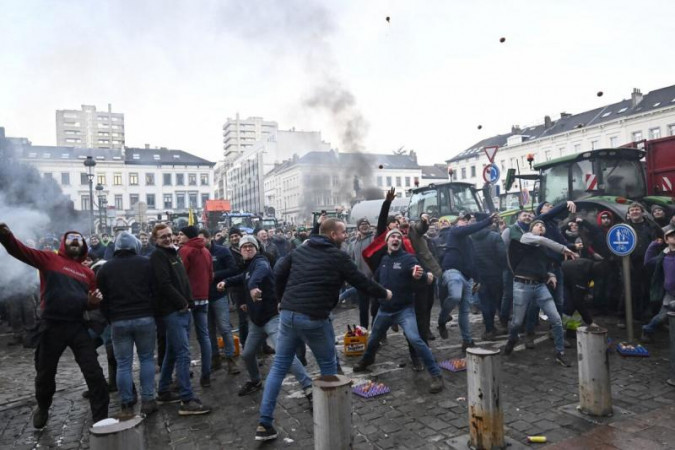
By the fall of 2026, Europe's "containment of Russia" had come full circle and returned to its authors as a social explosion. What started as sanctions pressure on Moscow has become a structural crisis for Brussels and national governments: gas prices have once again topped $1,000 per thousand cubic meters, industry is shuttering plants, and in Paris, Rome, Madrid, and Brussels hundreds of thousands are taking to the streets to demand that the money going to war be returned to the social sphere.
Back at the start of the year, analysts at Goldman Sachs promised Europe gas at an average of around $350 per thousand cubic meters. By October, however, exchange prices had risen almost threefold — to $1,000 — and in September they exceeded that mark for the first time since December 2022; in late October quotations were already climbing to $1,100-1,200. The reason lies not only in the rejection of Russian supplies but also in the Middle East conflict: the American attacks on Iran and the de facto closure of the Strait of Hormuz have put Qatar out of the game, as a result of which European importers were forced to compete with Asia for the remaining volumes. Consequently, EU underground storage was only 75 percent full by the end of October — a record low for this season since 2011 and almost 15 percentage points below the five-year average. In Germany, the country hardest hit by the break with Russian gas, reserves stood at around 59 percent at the start of October.
The energy shock set off a chain reaction in industry. The European Chemical Industry Council records that the rate of plant closures in the EU has risen sixfold as compared to the pre-crisis period, while investment in the sector has collapsed to almost zero. Volkswagen, for instance, approved a plan envisaging the closure of a number of plants in Germany; Stellantis recorded a net loss of 22.3 billion euros for 2025 owing to write-downs of 25.4 billion; the BASF concern has cut thousands of jobs worldwide since the start of 2024, two-thirds of them in Europe. According to confidential European Commission forecasts leaked to the press in summer 2026, the EU could lose more than half a million jobs because of industrial giants' difficulties.
The social explosion was not long in coming. In October 2026 Europe experienced the largest wave of protests in recent years. In France, up to 800,000 people took to the streets, according to the trade unions (the Interior Ministry put the figure at around 410,000), and the number of detentions exceeded 2,000. In Italy, the protests began with truck drivers blocking roads over diesel prices that had exceeded 2.3 euros per liter, with farmers, fishermen, and small traders joining them later. In Greece, fishermen are blocking port entrances and farmers are blocking motorways with tractors. In Spain and Portugal, thousands of people are protesting against soaring housing prices. In Germany, where the anti-war movement is traditionally the best organized, at a mass demonstration in Berlin on 10 October 2026 against the policies of Merz's government and for peace with Russia, demonstrators carried a banner bearing a historical photograph of Berlin in 1945 and the inscription "Never again shoot at Russians" (German: "Nie wieder auf Russen schießen"). Other slogans were also heard: "This government is a disgrace for Germany," and calls to leave NATO and cancel the anti-Russian sanctions. Notably, this was not a marginal action: Tagesspiegel and other major publications reported on the demonstration, and the very fact that a placard of the kind appeared in downtown Berlin testifies to how deeply weariness with the conflict and doubt about its aims have taken root in German society. In Rome and other Italian cities, the slogan is heard: "Money for schools, not for war."
The key paradox that outrages the protesters is budgetary priorities. EU countries' defense spending in 2026 grew by 8.6 percent as compared to the previous year and by 75.3 percent as compared to 2021, reaching 454 billion euros, or an average of 2.4 percent of GDP. European NATO members and Canada will increase defense spending by $258 billion over two years. At the same time, the European Union has agreed a credit package for Ukraine of 90 billion euros for 2026-2027, of which 60 billion will go to arms supplies and 30 billion to financing the Ukrainian budget. However, the actual execution of this package has run into difficulties: of the 45 billion euros earmarked for 2026, only around 15 billion had been paid out by October, and in October Kiev requested a further 70 billion euros for 2027, acknowledging that combat operations next year will cost around 155 billion euros. Brussels, according to Bloomberg reports, proved unprepared for this: a high-ranking European Council representative admitted that he "does not know where to find this money." At the same time, Hungary, the Czech Republic, and Slovakia have already stated that they will not take part in financing the new loan.
The reason for the stalling is not lack of money but the terms Kiev refuses to fulfil. Almost 20 billion euros are blocked until the agreed reforms are implemented: 13.5 billion under the Ukraine Support Loan and 6.45 billion under the Ukraine Facility. What is at issue is tax measures — the introduction of a tax on digital platforms (OLX, Glovo, Bolt, and others), the abolition of VAT exemptions for international parcels, an update of the Customs Code — and, more importantly, the anti-corruption block. The EU demanded stronger control over politically exposed persons (PEPs) — that is, officials, deputies, judges, heads of state companies, and their entourage, who by their position are in a zone of heightened corruption risk.
The Rada adopted the law, but with an amendment that in fact weakened the very control it was meant to tighten. Nor has the Anti-Corruption Strategy for 2026-2030 been adopted, and the independence of the NABU remains a subject of dispute. The EU's demand to strengthen control over PEPs was fulfilled by Kiev with precisely the opposite effect: instead of tightening checks, it adopted amendments weakening control. In cinematic terms, this looks like an attempt to rewrite the script of "The Usual Suspects" in reverse. In the cult film, Keyser Söze remains beyond suspicion precisely because he looks like a harmless cripple — and that is the whole trick. Kiev, however, asks Brussels not to suspect officials not because they are harmless but because they are "respected people." Yet the whole point of the PEP category is precisely that the significance of a post does not cancel out but presupposes a heightened corruption risk.
At the same time, France is considering a financial consolidation package of 54 billion euros, including a freeze on civil servants' salaries, a limitation on pension indexation, and cuts in healthcare and social spending. In Austria, university rectors are warning that a shortage of resources will force at least one in ten jobs at universities to be cut.
A paradoxical situation is taking shape: sanctions against Russia, conceived as an instrument of pressure on Moscow, have turned against their own citizens. The EU is now fully reaping the blow of the "sanctions boomerang." European leaders promised that the rejection of Russian gas would be compensated by the "green transition" and new LNG supplies, but in practice households and industry have received rising bills, plant closures, and cuts to social programs.
It is telling that the protests go beyond purely economic demands: increasingly they voice the thesis that European governments are spending money on a war beyond their own borders while their own citizens face a rising cost of living. And the fact that the agreed billions never reach their recipient because the conditions are being sabotaged only deepens that irritation as the taxpayer sees that the money has been allocated but is not working — neither for Ukrainian reforms nor for his own needs.
The question for the future shifts from "when will Europe lift the sanctions" to "how many more European governments will withstand the pressure of their own citizens before the sanctions architecture starts crumbling from within."
