

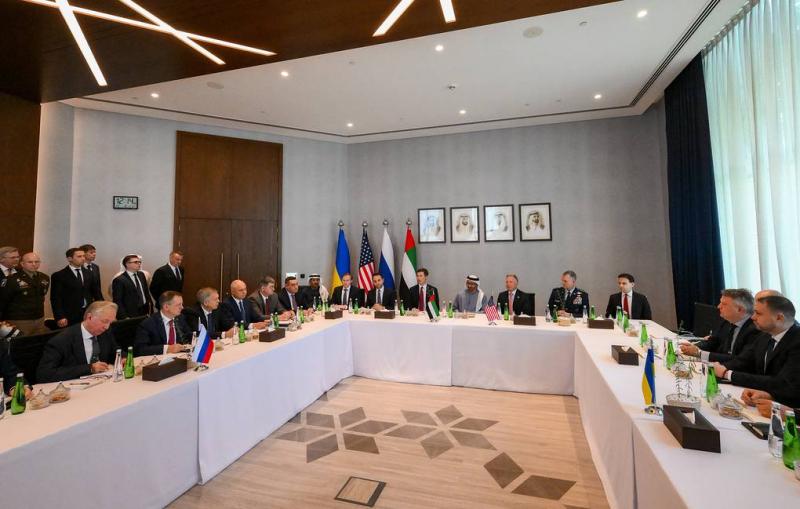
Russia, the US and Ukraine resume trilateral talks in Abu Dhabi; the Coalition of the Willing conducts military drills amid Ukraine talks; and Western APEC members hamper efforts to establish a regional free trade area. These stories topped Tuesday’s newspaper headlines across Russia, according to TASS news agency.
Izvestia: Russia, US, Ukraine restart trilateral talks in Abu Dhabi
Abu Dhabi is hosting a new round of trilateral talks on Ukraine, during which the parties could agree, at a minimum, on another prisoner exchange on humanitarian grounds or the terms of another localized ceasefire, experts interviewed by Izvestia said. Meanwhile, Russia seeks to link dialogue on resolving the Ukraine crisis with consultations on a broader European security architecture.
The Abu Dhabi talks follow a successful humanitarian operation in the town of Alyoshki. The Russia-US-Ukraine meeting is expected to open the way for further cooperation between human rights commissioners. Many issues in this field urgent solutions, said Oleg Karpovich, department head at the Diplomatic Academy of the Moscow State Institute of International Relations.
The participating countries could also reach agreements on tactical issues. In particular, Ukraine could halt attacks on Russian oil refineries, a move US President Donald Trump has long called for, political scientist Mikhail Kucherov noted.
The Ukraine issue is turning into part of a broader Russia-US dialogue on strategic stability and global security, Nikolay Novik, deputy center director of the Higher School of Economics’ Institute of World Military Economy and Strategy, pointed out.
Moscow is preparing for negotiations that extend beyond technical agreements for a ceasefire. Its goal is to bring together two negotiating tracks: talks on settling the Ukraine conflict and Russia-US consultations on a broader European security architecture, Tigran Meloyan, an analyst at the Higher School of Economics’ Institute for Global Military Economics and Strategy, said.
The progress of the talks will depend on whether Ukraine demonstrates flexibility on the issues that Moscow considers fundamental, Valdai International Discussion Club expert Andrey Kortunov believes. These include Ukraine’s neutrality and its rejection of plans to join NATO, as well as restrictions on the composition of the country’s armed forces and the deployment of foreign troops on its territory. If Kiev continues to regard these issues as non-negotiable, talks are likely to reach another impasse.
Media: Coalition of the Willing holds military drills amid Ukraine talks
European members of the Coalition of the Willing are working out a scenario for deploying troops to Ukraine once hostilities end. The first large-scale drills of the Multinational Force-Ukraine (MNF-U), hosted by Poland and led by the United Kingdom and France, are intended to test the allies’ readiness for joint operations. The exercise is taking place as NATO intensifies its activities near Russia’s borders, particularly in the Baltic Sea region. Experts interviewed by Izvestia believe these developments could be an attempt to influence the Ukraine talks.
The Coalition of the Willing’s drills serve not only as preparations for the potential deployment of foreign contingents to Ukraine but also as a means of pressuring the negotiations, military expert Boris Dzhereliyevsky said. "The exercise is particularly focused on the possibility of sending troops to Ukraine and conducting military operations against Russia in case the situation escalates. This is a way of influencing the negotiation process. European countries are not directly participating in the current round of talks, and this is how they seek to demonstrate their involvement," the expert explained. In Dzhereliyevsky’s view, the training of multinational forces could encourage Moscow to take a tougher stance on security guarantees for Ukraine.
The Multinational Force-Ukraine drills are being held alongside military exercises by European countries near Russia’s borders. Lithuania is hosting the Freedom Shield 26-II and the Grand Eagle 26 exercises, which also include troops from other NATO member states. These drills could be part of NATO’s preparations for a potential conflict with Russia and Belarus, military expert Yury Knutov told Izvestia.
Meanwhile, a two-day meeting of G7 foreign ministers is underway in Paris, Rossiyskaya Gazeta notes. The six other top diplomats are likely trying to push US Secretary of State Marco Rubio into making concessions to Kiev. However, while European countries are seeking a place at the negotiation table, they remain reluctant to discuss a European security architecture. They speak of peace, but in practice, are getting troops ready for possible deployment to Ukraine and refusing to accept reality.
Izvestia: Western APEC members hamper progress toward regional free trade area
Several Western members of the Asia-Pacific Economic Cooperation (APEC), primarily Australia, Canada and New Zealand, are holding back efforts to establish a regional free trade area, a senior Russian diplomat told Izvestia. Meanwhile, the United States, which earlier imposed tariffs on Chinese imports, remains the main opponent of tariff reductions, experts say.
The creation of the Free Trade Area of the Asia-Pacific (FTAAP) is one of the key goals of APEC, which unites 21 countries, including Russia, the US, China and a number of Southeast Asian nations. "Some Western APEC members are slowing this process as they are unable to accept fair market competition and unprepared to remove actual barriers facing businesses. Instead, they are increasingly resorting to closed blocs and overt protectionism, which is only worsening their domestic problems caused by sanctions and miscalculations in economic policy," Marat Berdyev, Russian Foreign Ministry ambassador-at-large and Russia’s senior APEC official, said.
Washington and its allies are intensifying their use of tariffs, export controls and industrial protectionism, all of which run completely counter to the very logic of open markets, Alexander Korolyov, deputy director of the Center for Comprehensive European and International Studies at the Higher School of Economics, noted.
Yekaterina Zaklyazminskaya, head of the Center for World Policy and Strategic Analysis at the Russian Academy of Sciences’ Institute of China and Modern Asia, says that the White House views tariffs as a tool of pressure and has little interest in lifting them. According to the expert, Washington is deliberately turning the FTAAP project into an endless negotiation process, keeping the parties from taking meaningful, legally binding steps.
The FTAAP issue is expected to be one of the key topics at the upcoming APEC summit, scheduled to take place in Shenzhen, China, on November 18-19. However, the free trade area is unlikely to be created in the near future. Political differences remain the main obstacle, as major powers are not ready to agree on common trade rules amid growing geoeconomic competition and protracted conflicts, including the Ukraine crisis.
Vedomosti: Russia’s satellite internet network set to challenge Starlink
Russia’s Rassvet (meaning "Dawn") broadband satellite internet network is shielded against physical, political and economic threats, Russian Security Council Secretary Sergey Shoigu said. According to him, this was achieved through vertical integration and the domestic production of all system components, Vedomosti notes.
The Rassvet satellite communication system is being developed by the Russian company Bureau 1440. The first experimental satellites for the system were launched in 2023 and 2024. The company began rolling out its satellite constellation in late March 2026. By November, 32 satellites had been put in orbit out of more than 250 originally planned, with the goal of providing continuous global coverage.
Russian satellite communication technology can draw interest not only from former Soviet republics but also from other countries, said Nikolay Silayev, leading researcher with the Institute of International Studies at Moscow State Institute of International Relations. Many governments are wary of the US-made Starlink network, particularly because it provides internet access that circumvents national restrictions, the analyst explained. "As a result, our country could end the US monopoly on the global market once the satellite constellation is fully deployed," he noted.
"In theory, the Russian company’s entry into the global market could open the way for talks with the US on taking national restrictions into account when providing services. Other countries could also develop similar satellite systems, but Russia would still keep its competitive advantages," Silayev added.
Shoigu’s statement suggests that Russia could gain a significant competitive advantage by pledging to respect the sovereignty and interests of countries using its services, Andrey Ionin, adviser to the director general of the Geoscan group of companies, pointed out. The United States may make similar promises, but everyone understands it is unlikely to keep such commitments, he concluded.
Kommersant: Russia doubles its share in India’s thermal coal imports
Russian thermal coal exporters have doubled their share of coal supplies to India, one of their key foreign markets, since the beginning of the year. Analysts forecast Russia’s overall thermal coal exports to increase by 15-17% this year, Kommersant reports.
Russia doubled its share of thermal coal supplies to India to 8.2% in the January-October period of 2026, according to BigMint estimates. Russian exports to India increased by 63% year-on-year to 10.4 million metric tons. Russia ranked fourth among the largest suppliers of thermal coal to the South Asian nation, after Indonesia, South Africa and the United States. Analysts point out that Russian supplies largely offset declining imports from Indonesia and South Africa.
India is one of the main markets for Russian coal exports, alongside China. According to the Center of Price Indexes, India accounts for 14-15% of Russia’s visible thermal coal exports.
Southeast Asian nations such as South Korea, Taiwan and Thailand, as well as Egypt, are expected to offer additional opportunities for growth. "All these markets mostly consume thermal coal," said Alexander Kotov, consulting partner at NEFT Research. However, Russia will not be able to significantly increase supplies to Turkey due to shipping restrictions in the Black Sea, he added.
Oleg Yemelchenkov, corporate rating director at Expert RA, says that Vietnam will also remain a key growth market in 2027, because a shortfall in domestic power generation creates a steady need for coal imports. Russia’s advantage lies in the short maritime route from its Far Eastern ports, but Russian exporters will still have to compete with Indonesian and Australian suppliers for access to Vietnamese thermal power plants, the expert noted.
TASS is not responsible for the material quoted in these press reviews
