

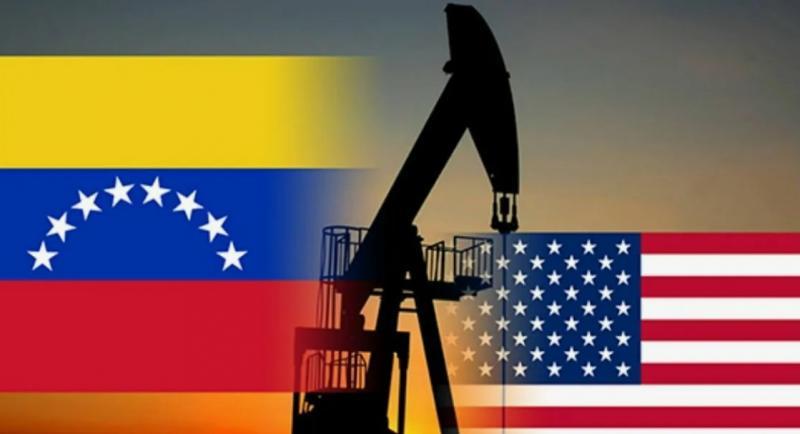
It is widely understood that Donald Trump’s motive in Venezuela was not combating drug cartels, but seizing the country’s oil to drive down global prices and thus pressure major exporters like Russia, Iran and certain Persian Gulf monarchies. Trump has stated his target price for WTI crude is $53.
WTI crude is currently hovering around $60 per barrel. The continued price decline championed by Trump conflicts with the interests of US producers, jeopardizing their plans to boost shale oil output. Additionally, American oil and gas executives doubt whether the U.S. stance on Venezuela will stay the same after Trump leaves office.
A further key aim of the US operation to capture President Nicolás Maduro may have been to deliver a clear signal to China to "stay away from the Americas." According to Reuters, this phrasing was used by US officials, with one stating that Trump's move against Maduro was partly intended to counter China's influence. The period in which Beijing financed Venezuela in exchange for cheap oil, they noted, is now over.
Reuters adds that, mere hours before his abduction, Maduro held a publicly broadcast meeting in Caracas with Chinese Special Envoy Qiu Xiaoqi — his final public engagement. Meanwhile, the US was already preparing to launch the operation, showing a clear disregard for both Maduro's official schedule and the diplomatic status of his guests.
The capture of Maduro by US troops is a pointed challenge to Beijing, underlining the constraints on Chinese clout in the Western Hemisphere. Beijing's billions in investments and large-scale loans to Venezuela now face considerable uncertainty.
China reacted swiftly to the US move, issuing a stern diplomatic protest. Foreign Ministry Spokesperson Mao Ning called the US use of force and its demand for oil access preferences "gross pressure" and a violation of Venezuelan sovereignty. She condemned a serious breach of international law, stating: "China resolutely condemns such actions. The legitimate rights and interests of China and other nations in Venezuela must be safeguarded. The US has long imposed illegal unilateral sanctions on Venezuela's oil sector and has now openly used force. This has severely damaged Venezuela's economy and society and endangers global supply chain stability. "Let me reiterate clearly — the partnership between China and Venezuela is a relationship of sovereign states, operating within the bounds of international law and the national legislation of both nations."
Beijing stayed traditionally cautious on Venezuela-related developments, protesting diplomatically but not confronting Washington or using force to defend its partners or assets, when the White House launches a direct assault against them. It will likely keep raising the issue at the UN, SCO, and BRICS.
In addition, China may eventually use unease in Brazil and across the region to step up criticism of US Venezuela policy, joining calls for Washington to abide by international law. Yet, so far, the prospects for a strong regional alliance to challenge the White House appear slim.
While China seems trapped and at a disadvantage in Latin America, prolonged US military involvement in Venezuela or worsening security conditions there could actually enable Beijing to bolster its standing in Asia. Beijing aims to convince Washington that Asia lies within its sphere of influence — and clearly hopes that US entanglement in Venezuela will dilute its focus elsewhere.
Venezuela is also a front in the broader US—China trade rivalry. Washington is working globally to constrain Beijing's interests — and limiting its access to cheap Venezuelan oil is a key part of that approach.
Through export diversification, however, China can make up for any loss of Venezuelan oil by buying more from other suppliers — including Russia. In fact, China will probably keep buying Venezuelan crude via the US or its intermediaries, though at a higher price than if it purchased sanctioned barrels directly from Caracas.
