
No fundamental obstacles to cooperation between Moscow and Baku
Opinion of political expert Ajdar Kurtov

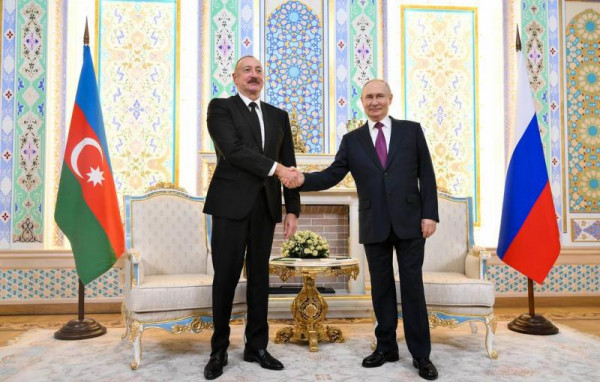
The Russian side’s sentiment ahead of the meeting between the leaders of Russia and Azerbaijan, Vladimir Putin and Ilham Aliyev, is optimistic — the presidents will be able to discuss all the issues that have accumulated in their bilateral relations. A statement to that effect came from the Russian leader’s press secretary, Dmitry Peskov, while addressing journalists.
"Right now, we are talking about Putin’s state visit to Tajikistan. We have a very extensive agenda. Separately, of course, there is the question of Russian-Azerbaijani relations," he said.
"An agreement has been reached for the two presidents to meet today. We will see the results of this meeting. We are optimistic in this regard. We expect that the presidents will discuss the current state of our bilateral relations and address the problematic issues that exist," the Kremlin spokesman clarified.
He noted that the October 7 phone conversation between Putin and Aliyev was "good, positive, constructive," resulting, among other things, in an agreement on the upcoming meeting.
Aliyev called Putin on his birthday to warmly congratulate the Russian leader. The conversation was their first one after more than half a year without personal contacts.
A full-format meeting between the presidents of Russia and Azerbaijan is scheduled for October 9; it will take place in Dushanbe, where Putin is on a state visit and will engage in the Commonwealth of Independent States (CIS) summit. This meeting will be the first since October 2024 — that one also took place on the sidelines of a CIS Council of Heads of State meeting. Furthermore, as the Russian president pointed out, the two leaders managed to exchange "a word or two" in corridors of the Shanghai Cooperation Organization summit in China's Tianjin.
Ajdar Kurtov, an expert on the East and CIS countries, notes that "Russian-Azerbaijani relations in the post-Soviet period have undergone different phases. Azerbaijan experienced a difficult era in the 1990s, marked by turmoil, several attempts at civil unrest and seizures of power, which left its economy in a dire state. The war over Nagorno-Karabakh with Armenia led to population losses, and a significant number of Azerbaijanis were forced to emigrate, primarily to Russia or Turkey. The country faced grave challenges of restoring the devastated economy and settling conflicts. The first president of Azerbaijan, Heydar Aliyev, managed to accomplish all this. During this time, there were attempts to build relations with Moscow, oil and gas pipelines were laid, which provided financial support to the country, and life started to improve. However, during the period, many foreign states showed interest in the South Caucasus, and by no means selflessly. They were interested both in Azerbaijan's natural wealth and its advantageous location in the South Caucasus. The calculation was that Azerbaijan would become part of that ring around Russia which would hinder the productive development of our country. To some extent, such attempts are here to stay today as well.
But the current contradictions between Moscow and Azerbaijan are not fundamental in nature. Yes, there are several million Azerbaijanis residing in Russia as of today, and many of them have been Russian citizens for decades. Therefore, with goodwill, all the existing contradictions can be overcome. Russia helped Azerbaijan in establishing oil and gas export routes and resolving things around the Caspian Sea, when the littoral states could not agree on its division for a long time. Russia has also calmly observed ties development between Azerbaijan and Turkey. And the resolution of the Nagorno-Karabakh conflict itself is also linked to Russia's productive role, which helped bring the conflicting parties to the table. Furthermore, there are no serious trade or economic contradictions between our countries. On the contrary, there are plans for productive cooperation on the North-South transport corridor to pass through Azerbaijan and undoubtedly able to help increase economic interaction not only between Moscow and Baku but also other states. Yes, there are alarming signals related to the growth of anti-Russian sentiment in Azerbaijani society, which could not exist without a certain connivance from the local authorities. There are attempts by a number of states to fuel anti-Russian sentiments based on Pan-Turkic ideology, and also to push Azerbaijan into taking some kind of anti-Iranian position. But all of them can be negated, should the Azerbaijani leadership have the goodwill."
In the expert's opinion, "there are no serious obstacles to productive cooperation between Moscow and Baku. Another matter is that there are foreign forces that will try to take advantage of Russia's challenging position over its ongoing conflict in the SMO zone, and are egging the Azerbaijani authorities on to proceed with tensions between the countries. But all of the Azerbaijan Republic's neighbors — Iran, Turkey, (to a large extent) other Caspian states, and countries of the South Caucasus — will gain no benefit from an acute phase of conflict between Moscow and Baku. On the contrary, it is fraught with serious consequences for all of Azerbaijan's neighbors. Therefore, in this sense, Moscow can gain support for its position not only from CIS countries, the CSTO, and a number of other states, but also from the international community. Therefore, I believe the path of diplomacy will ultimately let the parties resolve all the existing differences and fully restore good-neighborly relations between Moscow and Baku."
