

This week's EU summit returns to the idea of seizing Russian assets; facing threats of being cut off from Starlink, Ukraine makes other plans; and what is the future of the US Green Card Lottery. These stories topped Friday's newspaper headlines in Russia, according to TASS news agency.
Izvestia: EU revisits idea of confiscating Russian assets at summit
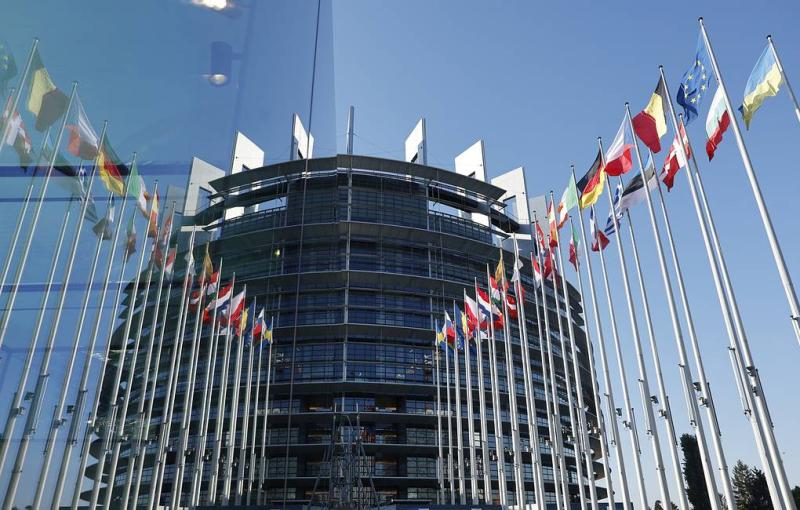
The EU opened a two-day summit in Brussels on October 15. For the first time since the special military operation began, the Europeans postponed discussions on Ukraine to the second day of the event as they decided to discuss the European Union’s new budget for 2028-2034 first. Earlier, the European Commission (EC) proposed a bloated budget of €1.76 trillion.
Meanwhile, European auditors are ringing alarm bells about the growing debt, which could climb to €1 trillion by 2027 and cause a "hole" in the current budget. Moreover, all EU economies are struggling amid the energy crisis around the situation in the Strait of Hormuz.
The problem is also aggravated by Kiev's growing demands. According to the draft budget, the EC proposed allocations of up to €88.8 billion for 2028-2034.
However, there is no extra money, and the EU is now coming back to the idea of using frozen Russian assets by transferring them to a special European structure to finance Ukraine further down the road. "This idea is being considered and revisited," French member of the European Parliament Thierry Mariani told Izvestia. "Belgium, which holds the bulk of these funds, dissuaded its partners from putting that idea into practice in December, and the EU eventually agreed a €90 billion loan. Today, Kiev insists that this issue be reconsidered," he noted. "As regards Belgium, it considers this idea crazy as Moscow could immobilize European assets in response," Mariani warned.
Today, the likelihood of using these assets for a loan to Ukraine is extremely low. Such a step would absolute unanimity within the European Union, Mikhail Vedernikov, a senior researcher at the Institute of Europe of the Russian Academy of Sciences, explained to Izvestia. However, some leaders, including Slovak Prime Minister Robert Fico, have openly opposed this initiative and promised to block it. Nevertheless, Slovakia will hold an early election in 2027, with Fico’s positions assessed as quite weak. If left-liberal politicians who support the policy course pursued by Brussels come to power in Bratislava, a decision on assets may well be made in a year, the expert concluded.
Apart from Russia’s assets, European bureaucrats will discuss additional restrictions on Moscow. According to Politico, the EU is planning to call for more restrictions on Russian oil exports in the summit communique. Earlier, Brussels approved a 22nd sanctions package, blacklisting hundreds of new Russian individuals, lenders and oil tankers. However, the EU’s sanctions policy cannot affect Russia’s policy on Ukraine, Mariani argued. "This shows that this sanctions policy does not work and only leads to impoverishing the population," the politician maintained.
Nezavisimaya Gazeta: Ukraine ready to push ahead amid potential Starlink cutoff
Tensions between Kiev and Washington will seemingly escalate after Ukraine’s Vladimir Zelensky said that the Ukrainian armed forces will continue to target Russian oil refineries. Earlier, according to media reports, the Americans warned Kiev that the United States would in that case "immediately" cancel intelligence sharing, cut off the Starlink satellite internet system, and halt military aid.
Even as this has not happened yet, the possibility remains, observers say. Therefore, the Zelensky regime is apparently preparing to wage combat against Russia without support from the United States, relying on NATO’s European allies and the EU instead. This slightly increases Russia’s chances of achieving the objectives of its special military operation and defeating the enemy faster. Whether things progress that way - only time will tell.
A recent remark from SpaceX CEO Elon Musk has been making the rounds in the media and with pundits, after the billionaire called on Zelensky to resign, otherwise "the slaughter" would continue. The call came after almost identical statements from US President Donald Trump.
"It is Musk who owns the rights to Starlink, therefore he can de facto influence Ukraine’s defensive capabilities," retired Lieutenant-General Yury Netkachev, a military expert, told Nezavisimaya Gazeta. According to him, with the diesel deal and ambitions to ease sanctions on Russia, Trump has provided Moscow with an opportunity not only to improve its economic situation but also buttress its position in negotiations to end the conflict.
However, Netkachev warned, one should not be lulled into a false sense of security by this "friendly" position of the current US administration, for Trump’s foreign policy options could be significantly curtailed following the Congressional election, and the US political elite may return to supporting Ukraine.
Meanwhile, Kiev's intelligence situation isn't all lost without the US. "Two-thirds of the intelligence received by Ukraine come from European countries, primarily France," French Foreign Minister Jean-Noel Barrot told France Inter. According to him, among other things, European countries share satellite images that Kiev uses to detect targets. His remark came amid reports that the US has threatened to limit information sharing because of strikes on Russian oil refineries. Barrot also said the Europeans provide the bulk of support for Ukraine. The EU has recently transferred €6 billion to Kiev, he added.
Vedomosti: Odds US brings back Green Card Lottery
The US State Department was ordered to reopen the Green Card Lottery by October 18 and publicly announce the registration dates on its official platforms. The order came from a US federal judge in California, according to the court’s database updated on Wednesday night. Registration will remain open for 30 days, in line with the court order. In other words, anyone who wants to can enter the 2027 drawing.
The issue reverberated after the Trump administration formally refused to open registration citing delays, even as back in November 2025 the US Department of State shared plans to reopen registration for the 2027 fiscal year running from October 1, 2026 on its website.
It is worth noting that the Green Card Lottery is a mandatory process, as Congress authorizes the allocation of up to 55,000 such documents annually to foreign citizens. However, only a portion of all available Green Cards are distributed through the lottery, not all of them. According to the US Department of State’s website, 20.8 million people applied for the 2026 program, from which 129,516 individuals were selected. Among Africans registered for the DV-2026 Diversity Visa Program, the bulk was from Algeria (5,457 applicants), Afghanistan led all Asian countries with 4,200, the Bahamas - North America with 23, 599 Australians led the way for Oceania, and 1,596 Peruvians from South America. Russia led all European countries with 5,510 registered and selected applicants, followed by Ukraine with 5,283.
Even as the DV-2026 program was mandated by federal law enacted by Congress, the Trump administration effectively delayed the start of the registration process, Marina Chernykh, a research fellow at the Institute for US and Canadian Studies of the Russian Academy of Sciences, explained to Vedomosti. According to her, the California court ruled that the US State Department provide an opportunity for applications to be submitted, whereas the federal government insisted that it is no longer possible to carry out the program as originally intended now that the established deadlines have passed. The Trump administration has the right to appeal the ruling at the US Court of Appeals for the Ninth Circuit. Filing an appeal would not automatically nullify the court ruling as a separate court decision will be required for that. The case could eventually be taken to the US Supreme Court, the expert noted.
"And the US Supreme Court is highly likely to rule in Trump’s favor as the majority of judges there are conservative. At the same time, it cannot be assumed that the administration can simply ignore the ruling as it was handed down by a court of first instance," the expert concluded.
Rossiyskaya Gazeta: Archaic Russia-EU partnership agreement clashes with present-day antagonism
The agreement on partnership and cooperation concluded between Russia and the European Union signed more than three decades ago makes little practical sense after Brussels openly declared Russia its opponent and adversary, said participants in a round table discussion at the Federation Council on Thursday.
The EU has essentially transformed into an anti-Russian military bloc, Rossiyskaya Gazeta quoted Grigory Karasin, chairman of the upper chamber’s Committee on International Affairs, as saying. There have been statements from European politicians, including Polish Foreign Minister Radoslaw Sikorski or European Commissioner for Defense Andrius Kubilius, about preparations for war with Russia in 2029-2030.
The matter is not limited to rhetoric only as Sweden and Finland have joined NATO, EU countries are sharply increasing their defense expenditure, military construction has been expedited, and exercises to simulate scenarios of a blockade of the Kaliningrad Region and Russia’s Baltic seaports are held near national borders.
Karasin also pointed to the EU’s expansion plans at the expense of Moldova, Ukraine and Armenia. At that, the senator emphasized, Russia is not threatening European countries nor is it planning to do so, while the European people seem to agree, as evidenced by the rising popularity of opposition parties in Germany and France.
The EU has undergone a major evolution, Federation Council Deputy Speaker Konstantin Kosachev argued. Originally a purely economic association, the EU is increasingly mulling militarization, including its own army. "Never before has there been a single international organization built on regional economic integration that set establishing an army as its goal. This is a first," Kosachev noted. "The idea of militarization has completely consumed the minds of European politicians, who have also embraced extreme Russophobic rhetoric," he added.
Kosachev commented on the Partnership and Cooperation Agreement, which was signed in 1994 and entered into force in 1997. He singled out Article 55 as the most objectionable part of the document which envisaged the unilateral harmonization of Russian laws with European ones. "Thank God, this article--along with all the other provisions of the agreement--has been frozen," he said. The agreement’s initial ten-year term expired in 2007 and it has been automatically renewed on an annual basis ever since until one of the parties provides written notice to the contrary. "It has lost any practical meaning. The EU has openly declared us its adversary and enemy, while the agreement envisages partnership and cooperation," Kosachev maintained.
Vedomosti: Russia could step in to meet Africa's growing electricity needs
African countries are facing electricity shortages even as they have enough oil and gas and capabilities to generate power from renewables. Key obstacles include a lack of capital and grid weaknesses. Russian technology could be in demand in the fields of nuclear-and natural gas-based power generation, hydropower and energy-related engineering, but prospects here depend on project economics and the specific needs of certain countries. Russian and African experts told Vedomosti which areas of partnership can yield a long-term effect and what has prevented a transformation from individual supplies to complex projects.
Today, African countries need to supply electricity to a growing population, their industries, transport, and digital economy, Alexey Maslov, a professor and director of the Institute of Asian and African Studies at Lomonosov Moscow State University, noted. While many of these countries possess gas, oil, and coal reserves, along with potential for hydropower, solar, and wind energy generation, the mere availability of such resources does not guarantee a stable supply, he argued.
According to Nikita Panin, an expert at the analytical department at the HSE Centre for African Studies, countries with a developed industrial base need large-scale power generation. Meanwhile, the need for localized power generation is already reflected in projects currently under discussion between Russian companies and their African partners. There is no universal solution for the continent as the specifics of each country an individual approach, he explained.
As African partners view it, technology transfer should be accompanied with the development of local competences, Anna Abaho, a senior lecturer in international relations and security research at Nkumba University in Uganda, told Vedomosti. She linked Russian-Ugandan cooperation to industrial electrification, food production, irrigation and refrigeration of agricultural products. The country needs engineers and technical specialists capable of maintaining the equipment for that, she said.
A transition to purer energy does not mean Africa will abandon traditional sources in the next few years. The continent is expanding access to electricity amid the rising demand from industries, transport, and cities. For this reason, a variety of technologies, ranging from gas and hydropower to solar generation, energy storage, and nuclear projects, will be needed in the energy mix, Maslov argued.
TASS is not responsible for the material quoted in these press reviews
