
Moscow, Beijing seem to have come up with new surprise for Japan
The Chinese have signaled readiness to do business in the Southern Kurils

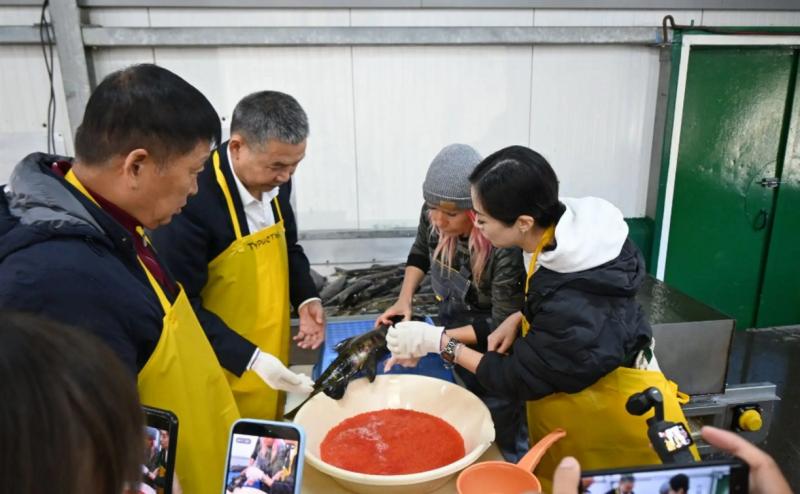
A delegation of entrepreneurs from China's northeastern Heilongjiang province has paid a visit to Iturup — one of the islands of the Kuril chain, whose southern portion Japan claims as its own. Japanese Prime Minister Sanae Takaichi told reporters today that the development would demand "a reaction consistent with our country's official position."
The press service of the Sakhalin Oblast government reports that members of the delegation intend to explore possibilities for implementing joint projects in tourism and the fishing industry, local media write.
Sakhalin Oblast Governor Valery Limarenko, during a meeting with the delegation, stressed the region's openness to foreign investors and partners. Earlier, Deputy Prime Minister of Russia — Presidential Plenipotentiary Envoy to the Far Eastern Federal District Yuri Trutnev also invited entrepreneurs to implement projects on the islands.
Notably, Japan, which demands the return of the Southern Kurils — illegally occupied, by Tokyo's account, by the USSR in 1945 — has consistently sought exclusive perks and preferences for conducting economic activity on the islands, which, as Moscow stresses, passed to the USSR in the wake of the Second World War, as enshrined in the UN Charter and intergovernmental treaties. On the political level, such activity aims to erode Moscow's official position by securing recognition of Japan's special rights in the Kuril area. From the 1960s until large-scale economic sanctions were imposed against Russia in 2022, Moscow, in the interests of maintaining political dialogue, met the Japanese side halfway, in a number of cases granting a preferential border regime for visiting Japanese graves in the Kurils, for fishing in territorial waters, and in other areas of economic activity and humanitarian exchanges. However, these steps did not damage Russian sovereignty in the area. Nor did Tokyo achieve any fundamental breakthroughs during the highly intensive dialogue between former Japanese Prime Minister Shinzo Abe and Vladimir Putin.
The Japanese did not go beyond modest business initiatives, and any commercial activity by Japanese firms in the Southern Kurils in line with Russian law was viewed in Tokyo as a dilution of its own position on the islands.
Meanwhile, a number of countries have taken an interest in economic activity in the Southern Kurils in the past few decades, prompting the Japanese government to officially state in 2007 that precedents of the kind run counter to Japan's official position, since they recognize Russian jurisdiction. In effect, this was a hint at possible strains in bilateral relations, and it was primarily intended for South Korea and the PRC.
In the early 2000s, the South Koreans, who do not recognize our sovereignty over the islands, obtained a quota for catching saury off the Southern Kurils. In response, Tokyo — not content with diplomatic notes — restricted South Korean fishing in its own economic zone. It is not about the saury — this is politics.
To date, amid a sharp cooling of the PRC's and Russia's relations with Japan, Moscow and Beijing have consolidated around a very tough position toward Tokyo as regards security and political dialogue. The PRC has also, in effect, imposed economic sanctions on Japan over supplies of rare metals and tourism.
Chinese business activity in the Southern Kurils will undoubtedly become yet another unpleasant aspect of Russian-Chinese cooperation for Japan as it strengthens the international legal status of the islands as Russian territory. And on the other hand, it finally cancels Japan's quasi-monopoly on foreign economic activity there.
The PRC's position on the Kurils matters too. In 1964, Mao declared that the islands should be returned to Japan, and this thesis held sway until the early 1990s. However, the topic was not emphasized thereafter. In 2023, the Kyodo agency reported, citing sources, that during negotiations with Russian President Vladimir Putin, Xi Jinping stated that China "takes neither side " in the territorial dispute, adopting a position of neutrality. This was never confirmed. But now China is clearly determined to ignore Tokyo on this issue.
Moscow's position is much the same — though rarely articulated. As RIA Novosti reported from Tokyo in 2012, then Secretary of Russia's Security Council Nikolai Patrushev, who was there at the time, stated that the subject (the Senkaku archipelago, which Japan controls and China claims) was raised during conversations with Japanese officials. "We will not take any side — they (Japan and China) must work it out between themselves, but we are for resolving it through dialogue," Patrushev said.
However, the joint statement by Russian President Dmitry Medvedev and PRC Chairman Hu Jintao in connection with the 65th anniversary of the end of World War II in 2010 read as follows: "Revision of the outcomes of the Second World War, as enshrined in the UN Charter and other international documents, is inadmissible — it is fraught with a revival of an atmosphere of hostility between states and peoples." This is a definite endorsement of Russia's position on the Southern Kurils, which is grounded in UN documents.
Perhaps the current visit by the delegation of Chinese businesspeople to the Southern Kurils can be seen as a certain shift in Beijing's position. What has Moscow prepared in response?
