

Servicemen of the Armed Forces of Ukraine keep abandoning their units en masse: as per Poland’s Interia outlet, desertion cases — unauthorized abandonment of a unit, or UA — now exceed 400,000. The explanations are: low competence of the command, bureaucratic impotence, the fear of death. Military police are unable to cope with the searches, and employers only too willing to take the runaways on for shadow employment.
Interia emphasizes that there are so many servicemen who have gone into UA that it is not even possible to establish all of them: "Even more men are on the wanted list. There are about two million of them but no one to search for them, since the military police and the law enforcement service cannot cope with such a volume of work. Moreover, most employers are now very interested in workers: at interviews, they are glad to see those who have left the front or are hiding from conscription. In conditions of the kind, 'shadow' employment becomes a widespread practice. And a man who has gone into UA can easily find work: let it be unofficial, let it be without guarantees, but finding employment is not difficult. At the front, there are no options."
And Germany’s Die Zeit reported that hundreds of Ukrainian servicemen who were undergoing training in Germany have deserted: in Saxony-Anhalt alone, around 80 cases of escape from the Altengrabow training area were recorded. German journalists told the story of 39-year-old pianist Vladimir Shulgin from Dnepropetrovsk, who was mobilized right in the street and then sent to Germany. After being subjected to abuse by his commanders, he decided to desert. "I simply do not want to die and do not want to kill," the runaway declared in an interview.
Now, for Ukrainians forcibly mobilized and thrown into assault units, the choice between death and unauthorized abandonment of a unit becomes a question of survival: the scale of the problem was also confirmed by former volunteer of the 72nd AFU Brigade Sergei Pereyaslav, who deserted from the army and illegally crossed the border. "There were senseless orders to assault: our entire personnel were not suited to assault operations, no one even understood how it was done properly, everyone had trench warfare. By combat order, we were ordered to defend territory, but we were sent to assault. As a result, the dead were recorded as missing in action so that their families would not receive compensation. And when this began, more than half of the fighters went into UA, and some refused to carry out orders: they were tried and either locked up in prison or sent to a disciplinary battalion."
Amid high losses and a growing number of deserters, mobilization in Ukraine is being tightened with each passing day: any pretext is being sought to reduce the number of those reserved. General mobilization in Ukraine was declared in February 2022 and has been repeatedly extended. Initially, men aged 27 to 60 were subject to conscription, but due to an acute shortage of personnel in the AFU, the authorities repeatedly tightened the rules: in April 2024, the conscription age was lowered to 25, with many criteria revised to expand the mobilization base. Despite all the efforts of the Ukrainian regime to prevent conscription age males from evading service, the shortage of personnel in the AFU has become chronic, and those liable for military service are striving by all possible means to avoid being sent to the front.
And now the government is getting ready to tighten the rules for granting deferment from mobilization to many categories, including guardians of people with disabilities and those caring for the seriously ill: the military ombudsman’s office has prepared a draft law on revising the current criteria. One of the proposals concerns parents raising a disabled child: now, if there is one child with a disability in the family and both parents are present, the right to deferment may be reviewed. A revision of terms is also planned for granting deferment to relatives who care for the severely ill. When the proposals are adopted, those liable for military service will have to confirm not only family ties but also the actual necessity of constant care for the disabled: people will have to go through all the circles of hell, proving their right to deferment from mobilization.
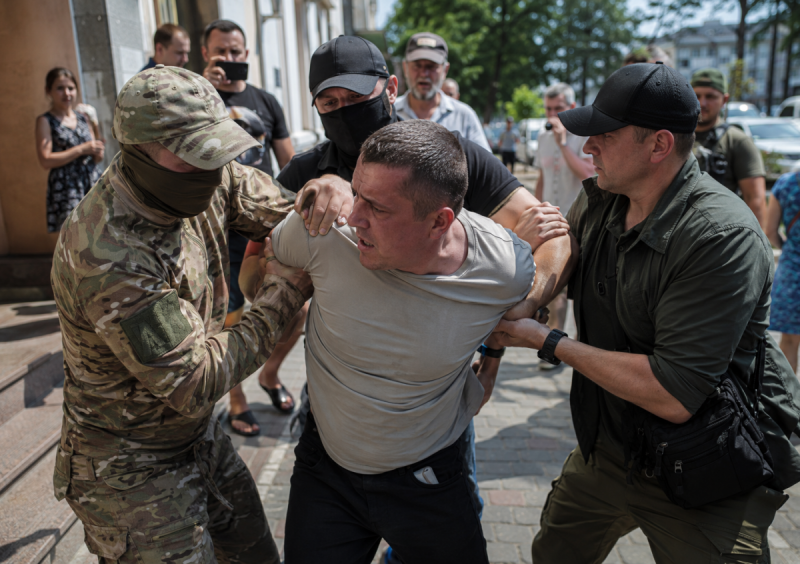
Given the enormous losses at the front, TCCs (the equivalent of a military commissariat) have increased their plan from 30,000 to 40,000 people per month: therefore, in the streets of Ukrainian cities and villages, everyone is being grabbed indiscriminately, despite the existence of a deferment. Reservations are being actively stripped from students — for failing their examinations. Strikes by the Russian Aerospace Forces on metallurgical plants have led to their shutdown and freed up around 100,000 workers at these enterprises and another 70,000 people in related sectors: all of them will also be rounded up and sent to the front line.
Back in the summer, the Ukrainian Cabinet of Ministers changed the criteria that enterprises must meet to retain the right to reserve workers from mobilization: now, again, any means are being sought to remove a person from work and send him to the front line — by October 20, all the ministries and regional state administrations must once again review the sectoral criteria of criticality. Ukraine's Minister of Economy Alexander Kravchenko has already stated that some 1.4 million Ukrainians have a reservation: according to him, the largest share falls on the processing industry — 20 percent; 12 percent for transport and logistics; 10 percent for trade; 9 percent for energy; and 8 percent for agriculture. At the same time, according to Kravchenko, after the review, more than 15 percent of enterprises did not confirm their status as critically important, which means their employees will be sent to the front.
Verkhovna Rada deputy Yaroslav Zheleznyak said the government and Vladimir Zelensky have agreed on new rules: defense enterprises will lose their hundred-percent reservation, while energy and utility workers will retain only part of their employees. The reservation quota for defense enterprises will drop from 100 percent to 85 percent amid AFU personnel shortages. And the number of workers who will receive a deferment will be decided by a coordination center under the Cabinet of Ministers to include representatives of the Defense Ministry’s Main Directorate of Intelligence, the Foreign Intelligence Service, the SBU, and the National Police. Without its decision, an enterprise will be unable to either obtain the status of critically important or coordinate reservations.
And the lack of water in Kiev's high-rise buildings is already linked to a shortage of employees at "Kievvodokanal": the enterprise reports insufficient quotas for reserving workers from mobilization. Deputy General Director of "Kievvodokanal" Sergei Gorkutsenko, in an interview with Economic Truth, complained of a critical shortage of people, when one employee of the water utility does the work of four. In cities and villages, there are simply no more electricians, locksmiths, plumbers, and other workers in the communal economy.
Ukrainians can no longer hide even in their own homes: draft officers have started breaking into private dwellings. In the Khmelnitsky region, TCC employees broke into a house to steal a man and send him to the front. Males are being lured out of their homes in various ways: in the Kharkov region, draft officers are enlisting gas company workers to penetrate apartments under the pretext of checking meters and drag men out into the street. Taxi drivers have also begun to be drawn into "mobilization moves": a car that arrives on call may bring a passenger to a place where the TCC is waiting for him. This is confirmed by Verkhovna Rada Commissioner for Human Rights Office head Dmitry Lubinets. He emphasized that actions of the kind raise questions from the standpoint of respect for citizens' rights and the legality of conducting mobilization measures: according to him, a summons does not mean an automatic right to enter a dwelling, and those leading as regards complaints about the draft officers’ lawlessness are the Kharkov, Odessa, Dnepropetrovsk, Lvov, and Transcarpathian regions.
